 Jorge Arango
Information architect and consultant who has spent three decades helping organizations, from non-profits to Fortune 500 companies, make digital systems easier t...
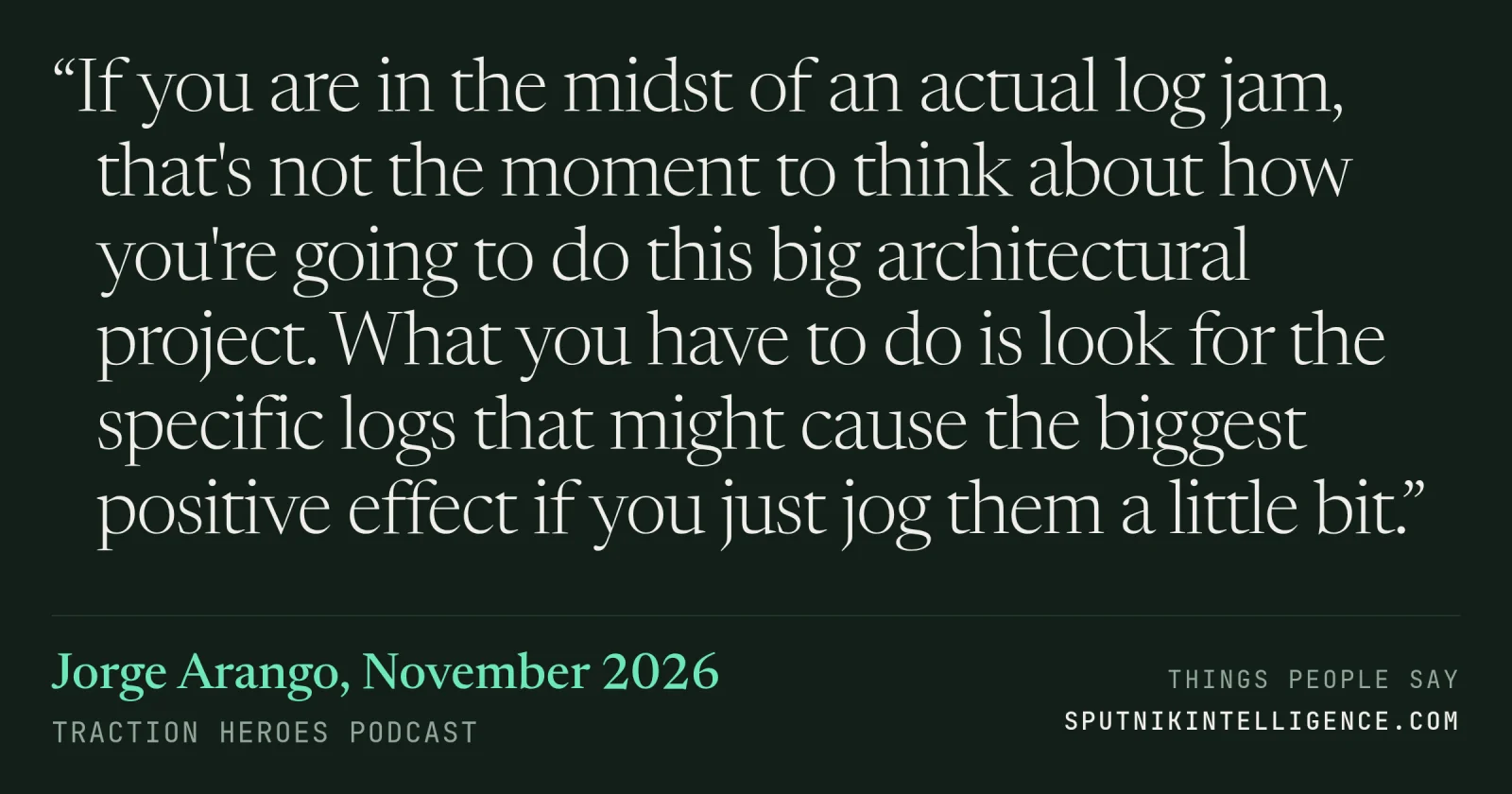
“If you are in the midst of an actual log jam, that's not the moment to think about how you're going to do this big architectural project. What you have to do is look for the specific logs that might cause the biggest positive effect if you just jog them a little bit.”
Traction Heroes · User Experience · November 2026
Context
The hosts had been discussing the pull toward big systemic fixes. Jorge says a permanent fix has its place, but only after the immediate jam is cleared.
Transcript
…right? One of the examples that Spolsky uses in this post is a fairly common pattern in software development, which is part A of the application is generating some kind of message, and part B is also having to do that. So now you’re thinking, it’s like, well, I need a messaging framework
…of the challenge isn’t just the time it takes and isn’t just the effort it takes to get these more systemic fixes in place, but it’s also trying to communicate the setup, the time, and what it will actually yield, since only two of the data points or problems have even materialized at this point.
There is a role for solving the problem of logs getting jammed in the river permanently, Mm-hmm. right? You want to be able to circle back and think about how you might float these five thousand logs out without them getting stuck, and that will probably require some kind of large-scale systemic intervention. But if you are in the midst of an actual log jam, that’s not the moment to think about how you’re going to do this big architectural project. What you have to do is look for the specific logs that are, that, uh, might cause the biggest positive effect if you just kinda jog them a little bit.
Yeah. And this-- You know, Ed Catmull in Creativity, Inc., the latest edition, not the first edition, hits this head-on as a strategic problem and really paints a very compelling picture for how to know when and then how to apply the longer-term, more systemic, more strategic fix. And I mean, if…
Go, going back to the UK thing, right? Stay calm and, Carry on. and carry on, right. Well, but I think that here I would invert that statement Ah. meaning, like, you know, don’t panic. Instead, think about the system. You know, understand that what is happening is a systemic problem, but then look…
Yeah. And this is where leadership becomes a question. Like, at what point do you say we really need to start attending to this in a more systemic way? We need to look at it. We need to understand it. We need to figure out how to make a transition.
More from Traction Heroes