 Ethan Mollick
I am a professor at the Wharton School of the University of Pennsylvania.
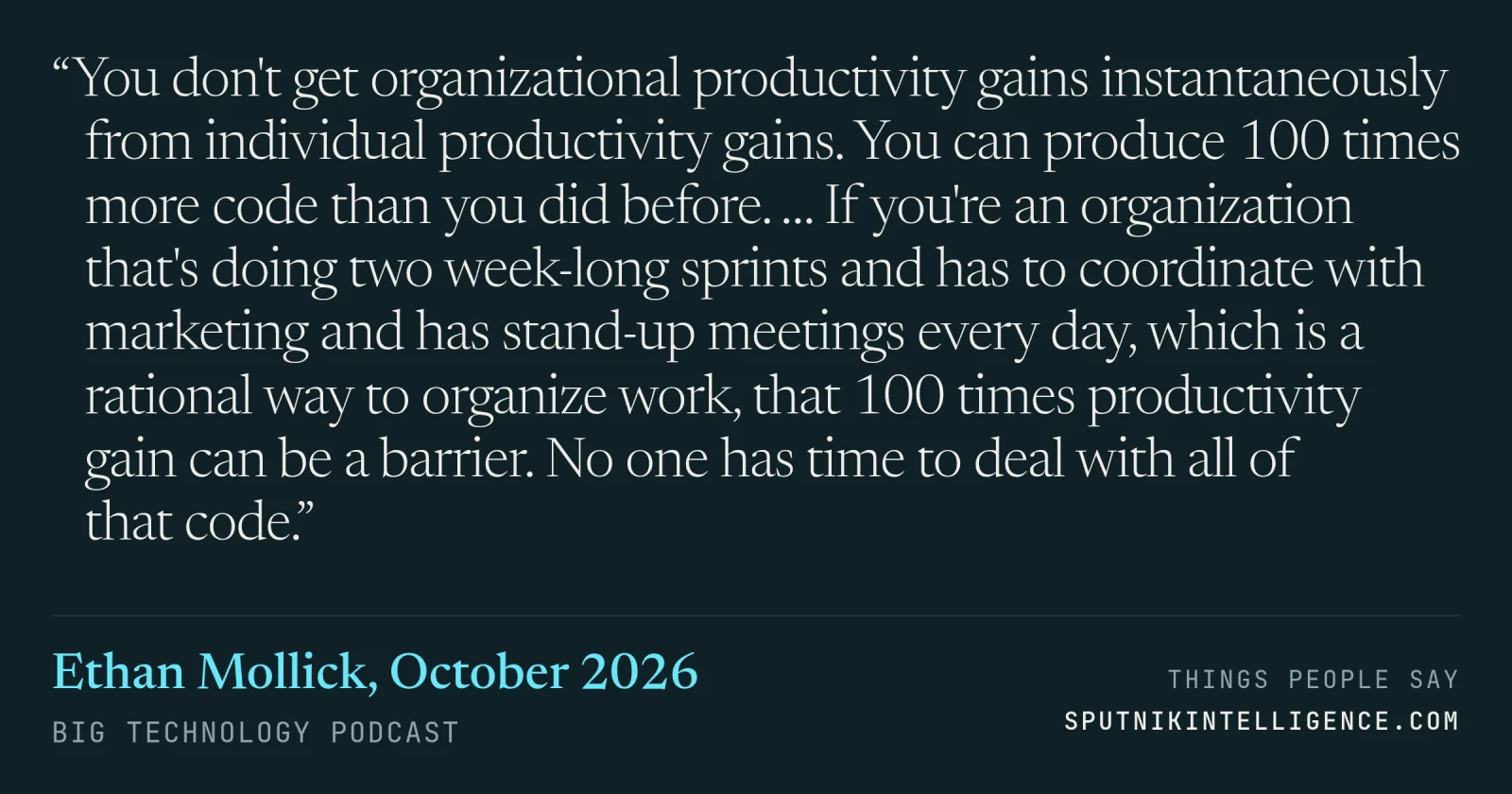
“You don't get organizational productivity gains instantaneously from individual productivity gains. You can produce 100 times more code than you did before. … If you're an organization that's doing two week-long sprints and has to coordinate with marketing and has stand-up meetings every day, which is a rational way to organize work, that 100 times productivity gain can be a barrier. No one has time to deal with all of that code.”
Big Technology · Tech Strategy & Big Tech · October 2026
Context
Alex Kantrowitz opened by asking why AI's power isn't showing up in productivity statistics, citing Dallas Fed data. Mollick's answer: organizations haven't adapted yet, citing 20 times more code producing only 30% more shipped products.
Transcript
Thanks for having me.
…Expert jobs are seeing more productivity gains than the low AI Expert jobs, but they're actually seeing less productivity gains than they saw during COVID and even less productivity gains than they saw pre-COVID at some times. The spikes just do not reach the same heights. What's going on, Ethan?
I mean, I think anyone who's an organization probably has the right answer to that problem, which is you don't get organizational productivity gains instantaneously from individual productivity gains. You can be 100%, produce 100 times more code than you did before. And that's great if you're a solo entrepreneur producing a lot of code. If you're an organization that's doing two week-long sprints and has to coordinate with marketing and has stand-up meetings every day, which is a rational way to organize work, that 100 times productivity gain is actually can be a barrier, right? No one has time to deal with all of that code. And we see that too in shipping stats. 20 times more code being produced, 30% more products being shipped, right? And so it's not an uncommon problem. We haven't adapted organizations to AI yet.
Yeah, I mean, there have been some stats, I think you're referencing this, in the app store, where there have been many more apps shipped than previously, but even fewer reviews than before, right? So it's like the productivity, quote unquote, or the work looks like there's been more done. But when…
Well, actually, those are two different things. So one thing is the flood of stuff, right? And we're seeing that everywhere. So there's a lot more novels, a lot more games, a lot more apps. But I'm actually talking directly. There's a nice set of studies looking at products shipped, right? And…
Yeah, I've thought when it comes to these capabilities at the companies that are really going to at least in the near term, term pull ahead are going to be the ones that say individuals who are using this technology we're going to empower you to actually go ahead and you know break free from some…
More from Big Technology