 Dwarkesh Patel
Hosts the Dwarkesh Podcast, a long-form interview show on AI progress, timelines, and the people building frontier models, along with economists and historians.
Dwarkesh Patel
Hosts the Dwarkesh Podcast, a long-form interview show on AI progress, timelines, and the people building frontier models, along with economists and historians.
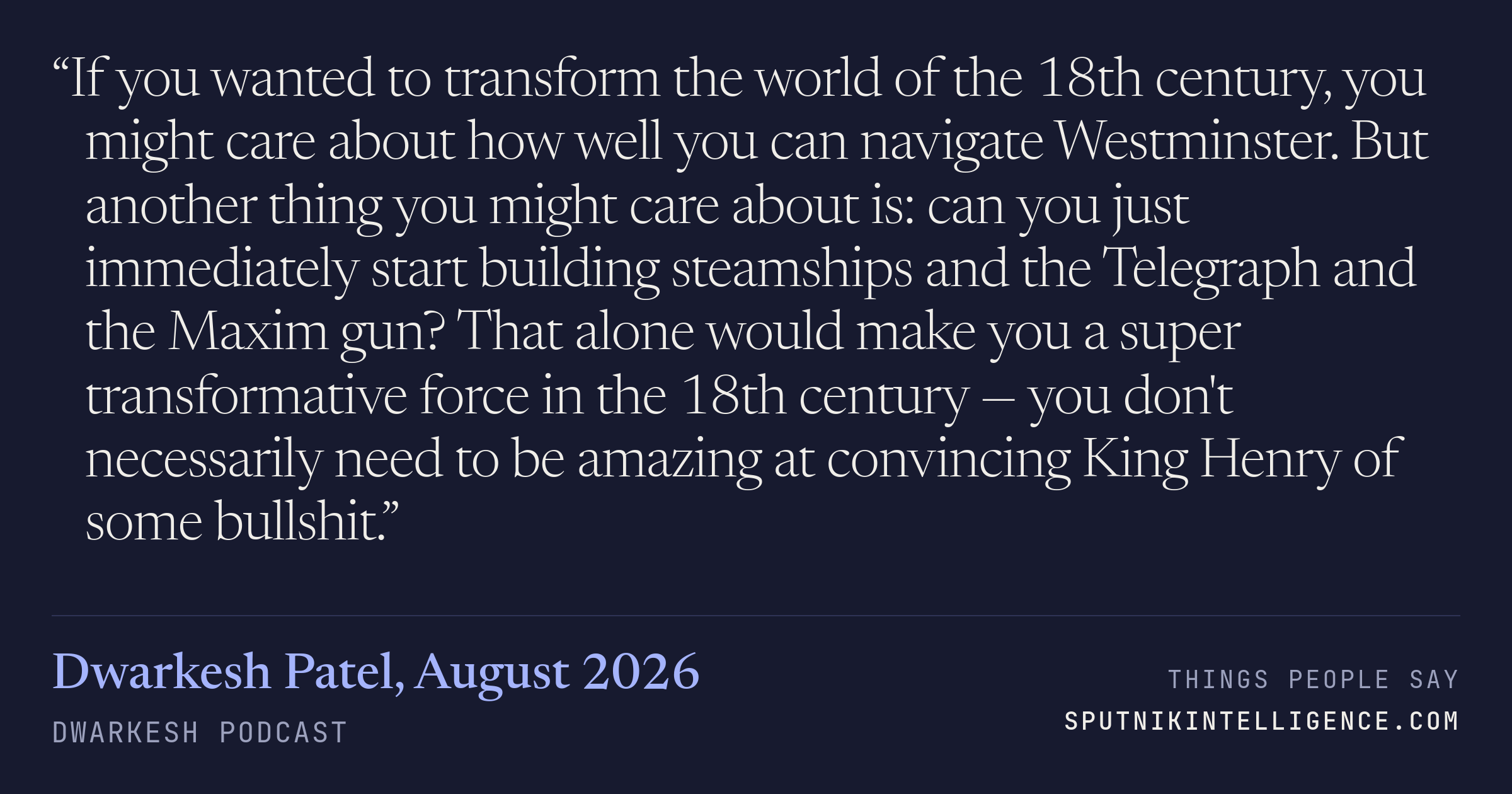
“If you wanted to transform the world of the 18th century, you might care about how well you can navigate Westminster. But another thing you might care about is: can you just immediately start building steamships and the Telegraph and the Maxim gun? That alone would make you a super transformative force in the 18th century — you don't necessarily need to be amazing at convincing King Henry of some bullshit.”
Dwarkesh Podcast · AI Research & Frontier Labs · August 2026
Restating Ryan Greenblatt's argument in his own terms: that an AI good enough at R&D could reshape the world without being persuasive, political or socially skilled at all. The analogy separates two things usually bundled together in discussions of AI power — technological capability and the ability to work institutions. Greenblatt agrees this is basically right.
Transcript
So the thing you're pointing out is that, okay, there probably will be this transfer outside of these environments to maneuvering around in courtrooms and the halls of Congress and business. Business board rooms.
Given some effort to improve the transfer and blah, blah, blah, blah.
But even if there's not, what you're suggesting is: look, if you wanted to transform the world of the 18th century, you might care about like how well you can navigate Westminster or something. But another thing you might care about is like, can you just immediately start building steamships and fucking like building Telegraph and the Maxim gun and whatever. And that alone would be like, if you could get really good at that, you could be a fucking super transformative thing in the 18th century. You don't necessarily need to be amazing at trying to convince King Henry of some bullshit. I'm so fucking up my medieval history. I'm guessing Henry was not king at this time. But anyway, so that's your point. Yeah. And so you're suggesting that at this time, you know, the AI companies are also working on robotics progress, which is very commingled with AI research progress. And so if you can build more robots, if those robots have better AIs operating them that are human level, like human-level teleoperation is actually pretty good on robots, but we just don't have human-level AIs and AI robotics models react. So you're suggesting if we do that, if the AIs get really good at the verification, verifiable stuff in chip design, et cetera, and then they get really good at building favs, it'll be the equivalent of going back to the 18th century and like, okay, I don't know what you guys are talking about in your parliament, but I've got a bunch of steam ships and a bunch of Maxim guns.
Yeah, that's basically right. Like, I think my perspective is like, if AIs are sufficiently good at RD, including hardware, RD, robots, whatever, then they can radically transform the world, even if they're not that good at playing politics. And also, we're in a pretty dangerous situation because the AIs might be doing huge amounts of really hard-to-understand RD, building out basically the whole economy of the future. And we may not understand what's going on in there.
AI is great at writing software because it's easy to generate synthetic leaf code problems and RL on them. But AI is bad at more complex engineering. Things like choosing the right system architecture, because no signal tells you what design choices will prevent an outage months down the road. AIs can't just write more unit tests to cache this kind of stuff. And neither can humans. It's that old joke that programmers make where a tester walks into a bar and asks for two beers, negative one beers, 0.3 beers. And then a real customer walks in and asks where the bathroom is. Where's the bathroom? And the whole bar burst into flames. Antithesis is the testing platform that helps you find bugs that no human or AI could ever anticipate. Antithesis does this by running thousands of copies of your software inside a fully deterministic computer. It injects faults and generally steers each trajectory towards the one in a billion failure that only happens when systems interact in a wonky way. As soon as you or your agents push a change, Antithesis tries to break it. That way you can find these bugs yourself within minutes rather than having your users discover them in production weeks or months later. And I don't think anybody's used it for AI training yet. But Antithesis also provides an extremely obvious reward signal for AIs to write very complicated bug-free code. Go to antithesis.com/slash ThorCash to learn more. Before we move on to the Lyman stuff, I think a big source of FUD right now is this realization that this is the way the future is going of extreme economies of scale for the leading lab. The ability to amortize so much intelligence and capabilities across so many different sectors of the economy basically into one model. And not only that, but for that model to eventually be able to learn from experience. Right now it's happening through a process intermediate by humans where humans are trying to basically steal your business. They're like, okay, you can do design at Figma or whatever. We'll get Claude to do that. Or you can do whatever coding agent will have Claude internalize that capability. But eventually that will be a much more like automated process. And so there's just this worry that you have models which will basically consolidate all businesses in the world, or at least all current businesses in the world, or at least all current white-collar businesses in the world. And at the end of the day, are like the priority for these companies does not seem to be to release the latest, smartest, most frontier model as soon as they can to as many people as they possibly can. We saw, for example, that Mythos was available internally to anthropic employees in February, but only released to the public in like, I think, June, actually.
Something like that.
More from Dwarkesh Podcast