 Eliza Filby
I’m Dr Eliza Filby, a historian of the present.
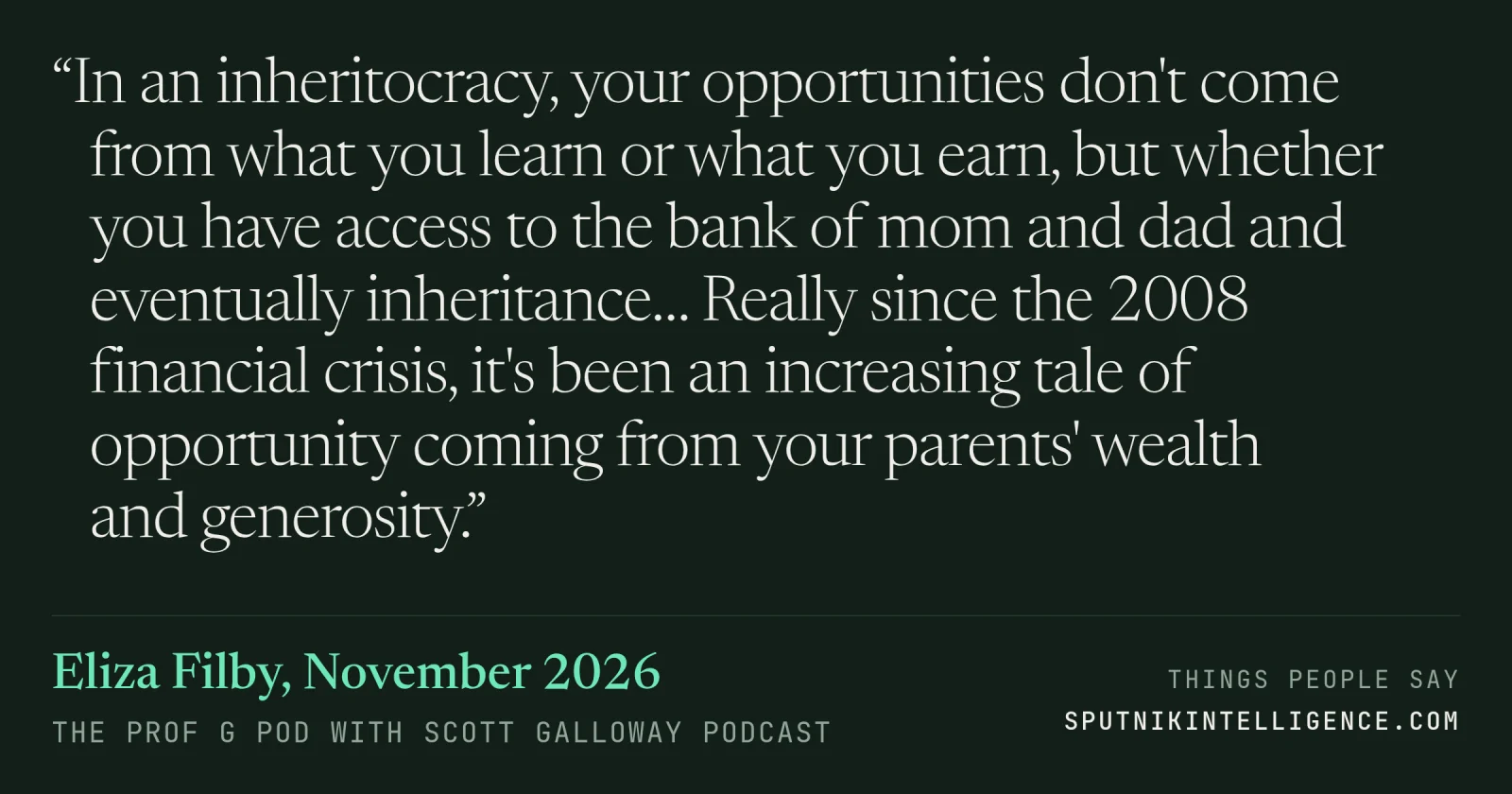
“In an inheritocracy, your opportunities don't come from what you learn or what you earn, but whether you have access to the bank of mom and dad and eventually inheritance… Really since the 2008 financial crisis, it's been an increasing tale of opportunity coming from your parents' wealth and generosity.”
The Prof G Pod with Scott Galloway · Tech Strategy & Big Tech · November 2026
Context
Scott Galloway asked historian Eliza Filby to define 'inheritocracy', the word in her book title. She says she coined it as the opposite of meritocracy, and it frames the whole episode.
Transcript
La South London, a place you know quite well, I think.
…data point, and that is over 5.5 trillion sterling in property wealth will be passed from baby boomers to millennials in the UK over the next few decades. In the US, the equivalent figure is $124 trillion through 2048. Let's start with the basics. What is an inheritocracy and how did we get here?
Right. So I kind of deliberately chose this word, a provocative title that essentially made up, right, as the antidote to a meritocracy, the idea that hard work led to reward. In an inheritocracy, it's a defeatist narrative in which basically your opportunities don't come from what you learn or what you earn, but whether you have access to the bank of mom and dad and eventually inheritance. And I wanted to explain what I felt was increasingly the narrative for young people is this idea of we were pushed into the knowledge economy and encouraged to really work hard and build that sort of academic prowess and get into a career. But actually the truth is, really since the 2008 financial crisis, it's really been an increasing tale of opportunity coming from your parents' wealth and generosity.
You've argued that the shift from a wage economy to a wealth economy left this generation worse off than their parents were at the same age. You've also said we've had over 30 years of over-parenting with parents more involved in their adult children's lives than ever. How much of this…
That's such a great question because I think one impacts the other, right? I mean, we saw this narrative of we have to invest in our children, the deliberate use of financial language when we talk about parenting. Parenting becomes, I mean, Richard Reeves, your great friend, talks about this, you…
So it feels like the perfect storm of an upward spiral for some people. And if you aren't on that spiral, you're just basic nutrition, if you will, for the people on the spiral. And that is you can take care of their grandmother or you can bring them. Their food or take them in an Uber to where…
More from The Prof G Pod with Scott Galloway