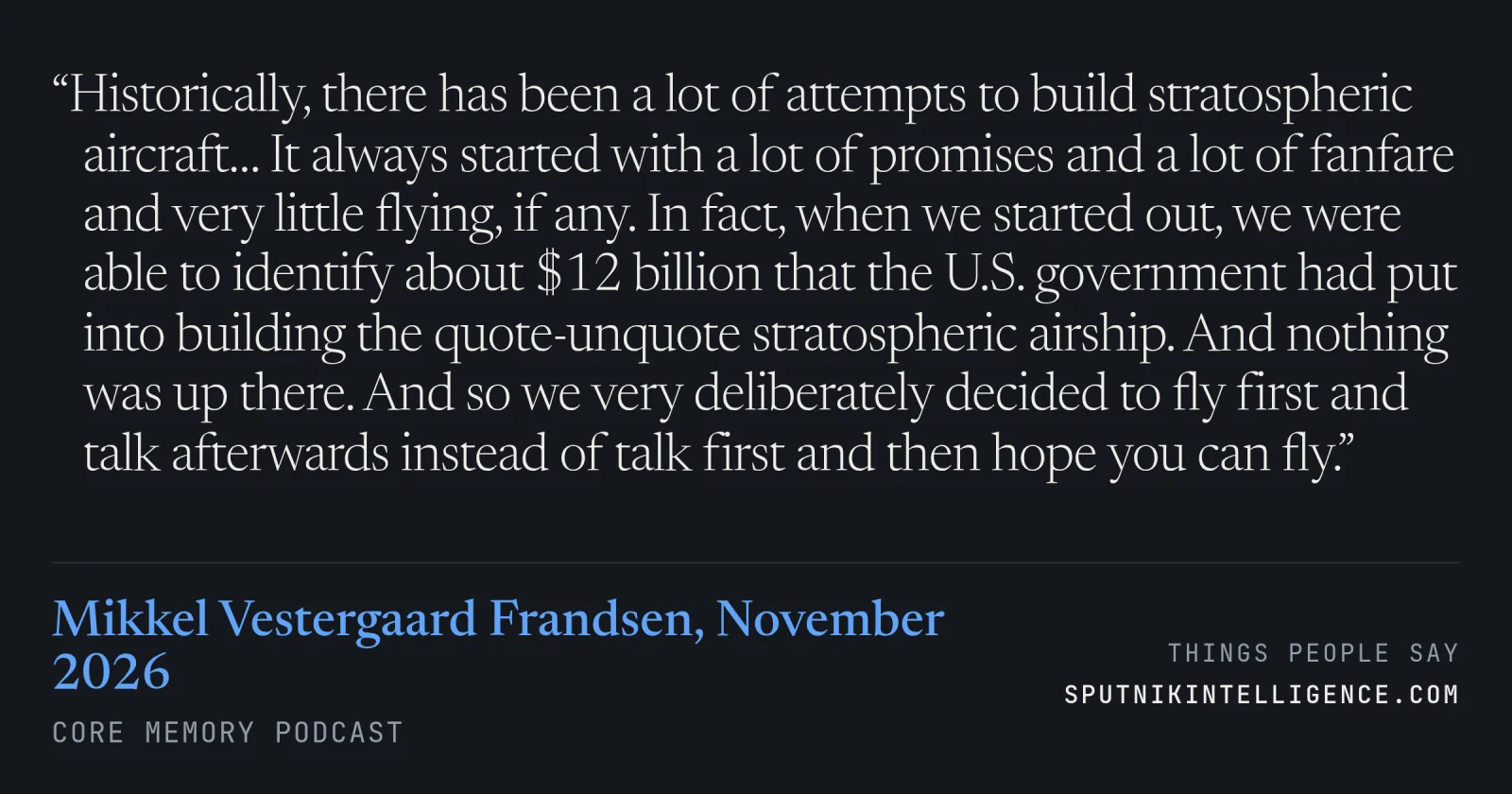
“Historically, there has been a lot of attempts to build stratospheric aircraft… It always started with a lot of promises and a lot of fanfare and very little flying, if any. In fact, when we started out, we were able to identify about $12 billion that the U.S. government had put into building the quote-unquote stratospheric airship. And nothing was up there. And so we very deliberately decided to fly first and talk afterwards instead of talk first and then hope you can fly.”
Core Memory · Startups & Venture · November 2026
Context
Ashlee Vance said Sceye had stayed under the radar, even though someone putting $100 million of their own money into aerospace usually draws attention. Mikkel Vestergaard Frandsen explains the quiet as a deliberate choice, set against a history of high-altitude platforms that were announced loudly and never flew.
Transcript
Yeah.
…I just feel like I feel like Sky's been a little, you know, somebody puts $100 million of their own money into an aerospace effort. It tends to get a ton of attention. But I feel like you've been a little under the radar, but you guys have been building up to this point where you're starting to.
Yeah. Let me unpack that. Historically, there has been a lot of attempts. To build stratospheric aircrafts, PAPs, stratospheric platforms. And they haven't ended up. They got a lot of different. And it always started with a lot of promises and a lot of fanfare and very little flying, if any. In fact, the U.S. government, when we started out, we were able to identify about $12 billion that the U.S. government had put into building the quote-unquote stratospheric airship. And nothing was up there. And so very deliberately decided to fly first and talk afterwards instead of talk first and then hope you can fly. Yeah.
Yeah. I mean, you know me. Look, I love aerospace. Everything. I think what you've built is extremely cool. I have covered some of these stratosphere balloons, these airships. They've tended to end. It's very difficult business. Yeah. Yeah. And so
we're talking to you because we've graduated from testing at this point.
Yeah. And I know we talked about it before, but you still, if I'm being brutally honest, just on the satellite front, I just feel like it really has gone so much faster and farther than anyone would have expected. And it's going to make life difficult for you guys. Even though I see the use cases…
More from Core Memory