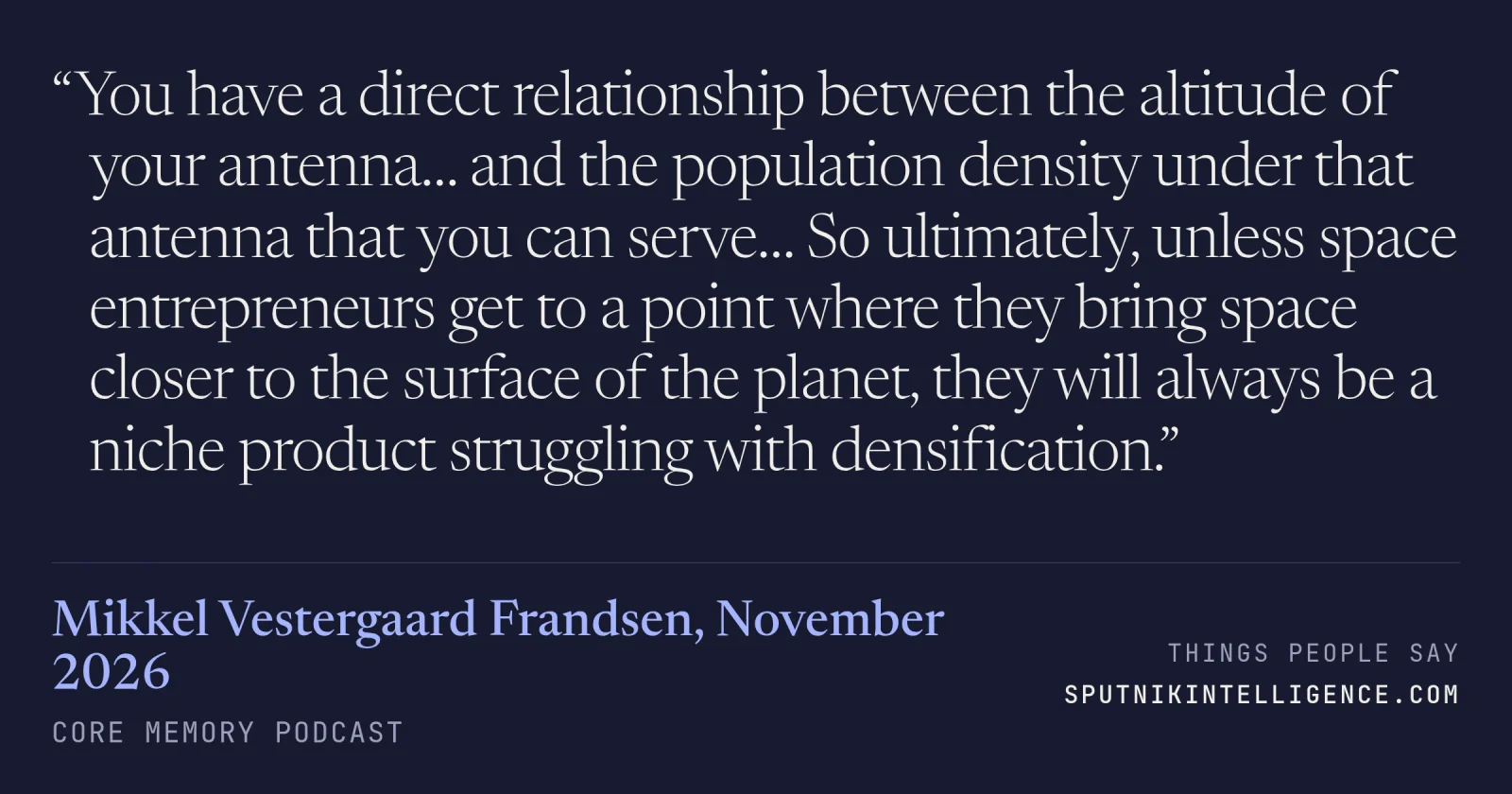
“You have a direct relationship between the altitude of your antenna… and the population density under that antenna that you can serve… So ultimately, unless space entrepreneurs get to a point where they bring space closer to the surface of the planet, they will always be a niche product struggling with densification.”
Core Memory · Startups & Venture · November 2026
Context
Ashlee Vance said he is skeptical a stratospheric platform business is needed, given how fast Starlink has grown. Mikkel Vestergaard Frandsen says he isn't pitching against satellite constellations, and argues that antenna altitude limits how many users a satellite network can serve.
Transcript
Let's unpack that.
Okay.
…And the reason for that is that you have two reasons for that. You have a direct relationship between the altitude of your antenna, AC antenna on a tower or in the stratosphere in space, and the population density under that antenna that you can serve, because there's a direct relationship between the altitude and the antenna and the amount of traffic you can put under that cone, right? So ultimately, unless space entrepreneurs get to a point where they bring space closer to the surface of the planet, they will always be a niche product struggling with densification. You do see some known constellations that are aiming at moving their fleets closer to the surface from 340 to 290 miles as far as I understand. That's still a far cry from the 12 miles we're at. Adding to that, that to maintain signal strength, your power consumption grows with the cube of the distance, and we're still 30 times closer to the surface of a planet. We have some rather significant…
we're heading to this world where we've got autonomous vehicles, we've got drones. I mean, I wrote about this in my last book. So I buy into this theory. I mean, I think we need this ubiquitous, high-speed internet fabric that is going to be this glue for the modern world. And you're saying that…
governments around the world agree with this because the hype, the ubiquitous network that the private sector is trying to build is a carbon copy of the hybrid space architecture that governments are trying to build. Because of that layer cake that you need for constant resilient connectivity, LEO…
if everything goes according to plan, sometimes when I write about satellite internet, you know, it was like half the world, 3.5 billion people, cannot be reached by high-speed internet today. Satellites are serving some of that now. I mean, how many of these do you think? 15 million of that. Of…
More from Core Memory