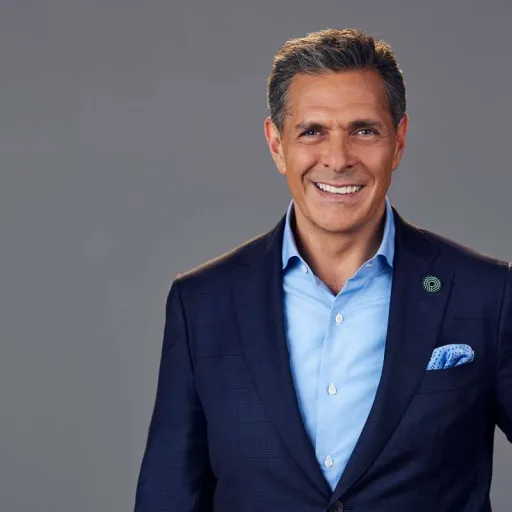
 Daniel Lubetzky
On Think Fast Talk Smart: Communication Techniques
Daniel Lubetzky
On Think Fast Talk Smart: Communication Techniques
“If you do not know something and you can say, that's a great question, I actually don't have the answer to it. All of a sudden, I like that person. I lean in. ... The opposite, total certitude at all times, for me doesn't excite me.”
Think Fast Talk Smart: Communication Techniques · October 2026
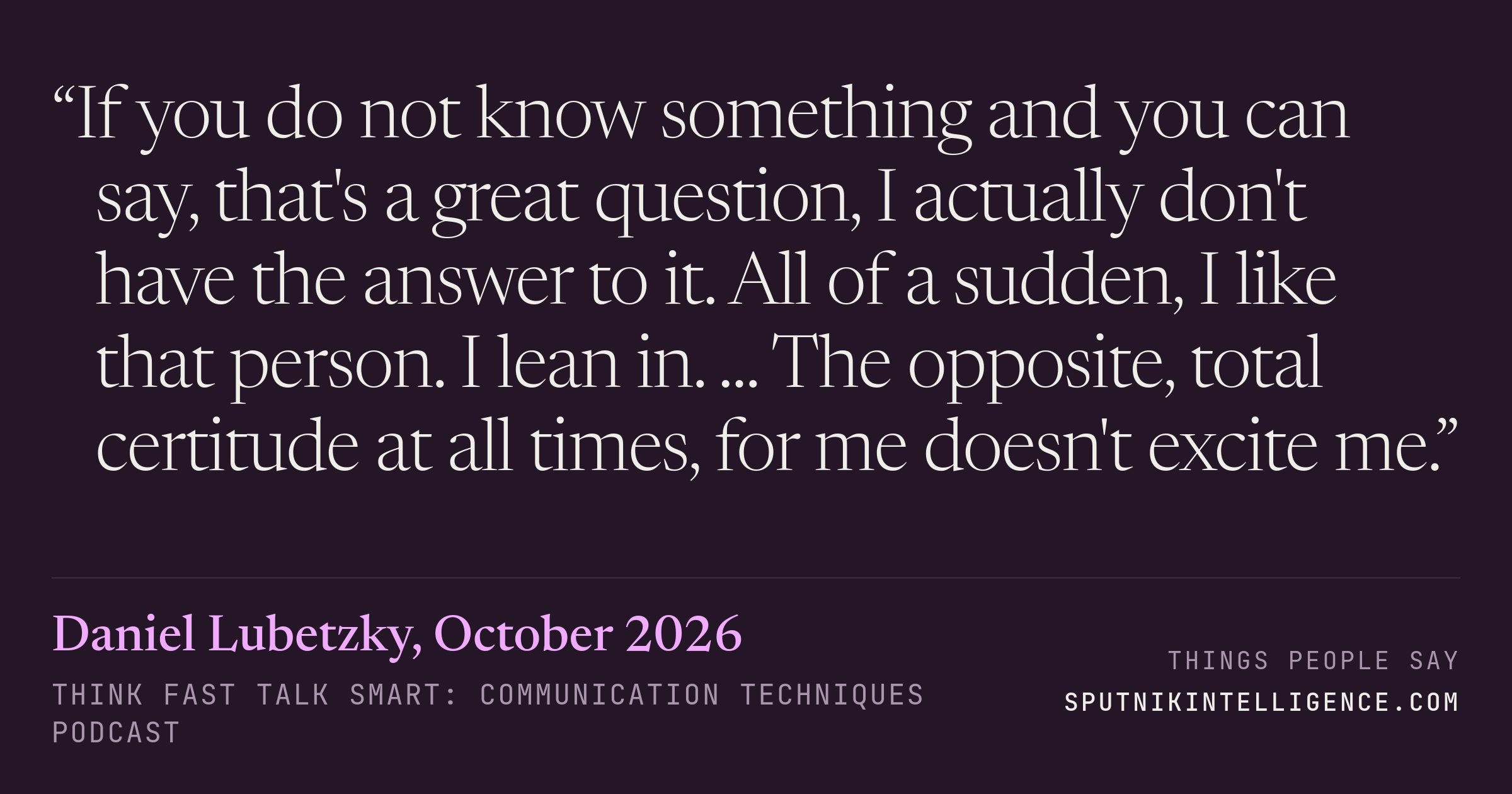
Matt Abrahams asks Lubetzky, who has sat through hundreds of pitches on Shark Tank, for the most common communication mistake founders make. His answer is the feeling that you must be right and show mastery at all times. He adds that founders should still know their basics.
Transcript
Probably the most important is listening, is the ability for To which is very hard for all of us and particularly for me to do. I always want to share and I like to hear my voice and I have ideas and I think I know where people are going. And as you know, I'm launching a podcast called Build or Break, interviewing some of the most extraordinary people from Matthew McConaughey to Mark Cuba and from Kendra Scott to Lucia Harish across a spectrum of business, artistry, geographies, demographies. And definitely, definitely the hardest skill for me has been to learn to listen. And I'm enjoying Build or Break because it's so challenging for me to not be the interviewee where I can go everywhere else and you're the one that has to keep the train running. So listening, I think, is an incredibly powerful skill. And even the use of pauses when you're speaking, that negative space very often creates a lot of positivity. So I think the use of pauses is very important. I think more broadly, in terms of the communications tools that I would recommend to others, is first and foremost, as much as possible, practice, practice, practice. In Build or Break, one of the things that has become very clear to me is that all of the most extraordinary people tried a bunch of things that didn't work, but they got back on the horse, they dusted it off, and then they tried and tried again. So developing the skills and the tools for you to have the courage to get back on the horse, keep trying, because the more that you practice, the more reps that you put into it, the better you'll get at it. I think there's a lot to be said for learning how to articulate, how to be transparent, how to construct sentences, but above all, to not lose your authenticity, to be yourself always, because I find that you can be very polished, but if you lose the essence of who you are, people are going to tell. So I think the single most important thing is for you to be authentic, for you to be yourself. And then within that, be present and be comfortable understanding that you're there for a reason, that people want to hear you. Very often we get nervous and we feel that we're not supposed to be there. And so we speak very fast and then people can't understand you. So slowing yourself down, being present and connecting with people, listening to the audience and connecting with them to understand what's the right beat for your conversation.
Lots of rich responses and ideas there. I really resonated with the idea that pausing leads to positivity. I like the play on words and I like that. Taking the beat to let the other person finish and the ability to listen is hard. I would like to get your thoughts on business and building business. Obviously, you have lots of experience with that. You have watched hundreds of pitches on Shark Tank. What is the most common communication mistake entrepreneurs make when they're trying to influence people or move them towards their position?
The feeling that you need to be right and you need to demonstrate mastery at all times, no matter what, can really be your greatest undoing. If you do not know something and you can say, that's a great question, I actually don't have the answer to it. All of a sudden, I like that person. I lean in. I'm like, okay, when this person speaks, I'm going to trust what they say. By the way, they should know all their basic stuff. But as a general rule, it's okay to admit when somebody shares something you haven't thought about or where you don't have a perfect answer to it and you acknowledge it because it goes back to what you were talking about earlier about the importance of introspection and demonstrating self-reflection. And so if you're able to show the ability to, as you go along, learn things that you need to learn, I think it's a very important gift. And the opposite, total certitude at all times, for me doesn't excite me.
So being human and admitting what you know and what you don't know and putting on a false bravado or false knowledge gets you in trouble. I have often heard, and I'd be curious to get your opinion, that people in your position, investors, supporters of businesses, the idea is important, but the person behind the idea is even more important. Do you believe that to be true?
I think for me and for almost all investors, that's the case. Like obviously, there's three things that fundamentally need to be there. The person, the product, and the market. Like there needs to be a fit. Somebody needs to be looking for it. The product or service needs to be better than the others and the person or entrepreneurs do that. Ideally, you have all three. But if you don't have the entrepreneur, you don't have anything, in my opinion. Whereas if you have the entrepreneur and the other two are weak, you can work towards the others. So I heard Warren Buffett talk about this many years ago. It's not unique. Always you'd bet on an entrepreneur over the product because the entrepreneur can then adjust to make things fit. It's the most essential thing.
The reason I asked the question is I think. Lot of entrepreneurs. I do a lot of coaching of people who pitch, and a lot of them really fixate on the product or the service, the market, which are very important, as you said, but they don't pay any attention to how they themselves are selling themselves and how they're coming across. And what I'm hearing you say is it's important to be authentic and let people know who you are and where you stand. I have a question about building businesses and audiences. You've built brands yourself and you certainly coach others. When you're building a brand's audience from the ground up, how do you strike that balance and manage that tension between staying focused on your core mission, but also being flexible enough to respond to what the market demands? That seems to be a specific skill.
More from Think Fast Talk Smart: Communication Techniques