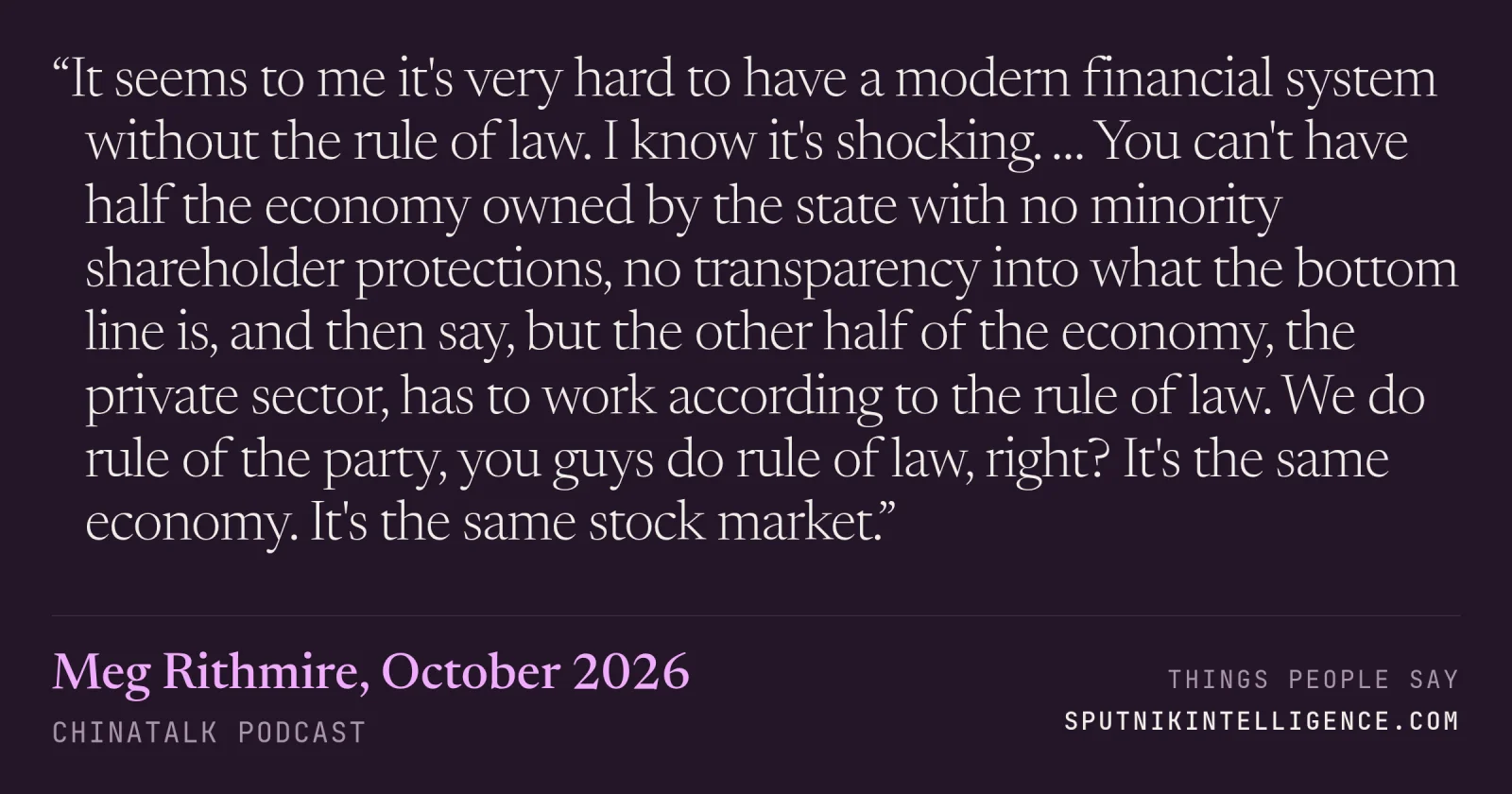
“It seems to me it's very hard to have a modern financial system without the rule of law. I know it's shocking. … You can't have half the economy owned by the state with no minority shareholder protections, no transparency into what the bottom line is, and then say, but the other half of the economy, the private sector, has to work according to the rule of law. We do rule of the party, you guys do rule of law, right? It's the same economy. It's the same stock market.”
ChinaTalk · Geopolitics & World Affairs · October 2026
Context
Asked how Xi's anti-corruption drive is going, Rithmire described a familiar cycle of accommodation and crackdown. She pushes back on the "technocratic fantasy" that good regulators alone can build a clean financial sector, and says she doesn't think any authoritarian system can.
Transcript
…huge, you know, under, you know, kind of gray risks that once they start moving very quickly become quite catastrophically destructive. And so they're worried about the scale of debt. They're worried about the scale of asset control. But it's really about the systemic changes with land and finance.
You published this book two years ago. You ended it on a bit of an ambiguous note of like, good luck, man. Like, this is going to be harder than it seems. You know, how is he doing? And like, what is the hangover that the country is still working through from trying to work out of this?
…the government starts to bail it out just under a different name. The principles of those companies were detained and treated through kind of the punitive system of the party rather than the way that bankruptcy might work. And, you know, so then, you know, what ends up happening is that it's the same logic over again. And so my, you know, like it's not earth-shattering what I'm about to say, but it seems to me it's very hard to have a modern financial system without the rule of law. I know it's shocking. And economists will be like, obviously, right? But then we get lured into this technocratic fantasy all the time that actually you can have a great financial sector. You just have to have, you know, good technocrats to regulate it, right? You have to have good, you know, as long as you have good financial instruments and good technocrats. But actually, it takes kind of political safety for…
Yeah. There is a brilliant book by Ling Li that came out last year called The Governance of a Party State: Corruption Law and the Modist Operandi of the CCP. And she does a bit of a microcosm of this, looking in particular about judicial reforms. And look, it's not like smart people haven't tried.…
Right. And I mean, I'm glad you bring up that book because there's a huge analogy that I make in the book and in subsequent work where, you know, and the legal scholars have this thing, you know, rule by law. We're not rule of law, right? We don't submit ourselves to the discipline of law, right?…
So what's the counter argument? Like, look, it's annoying. People are going to take their percentages, but free market. Look where it got America. You know, they've outsourced all of their production. They're this shell of their industrial might circa, I don't know, 1960. And the party, even though…
More from ChinaTalk