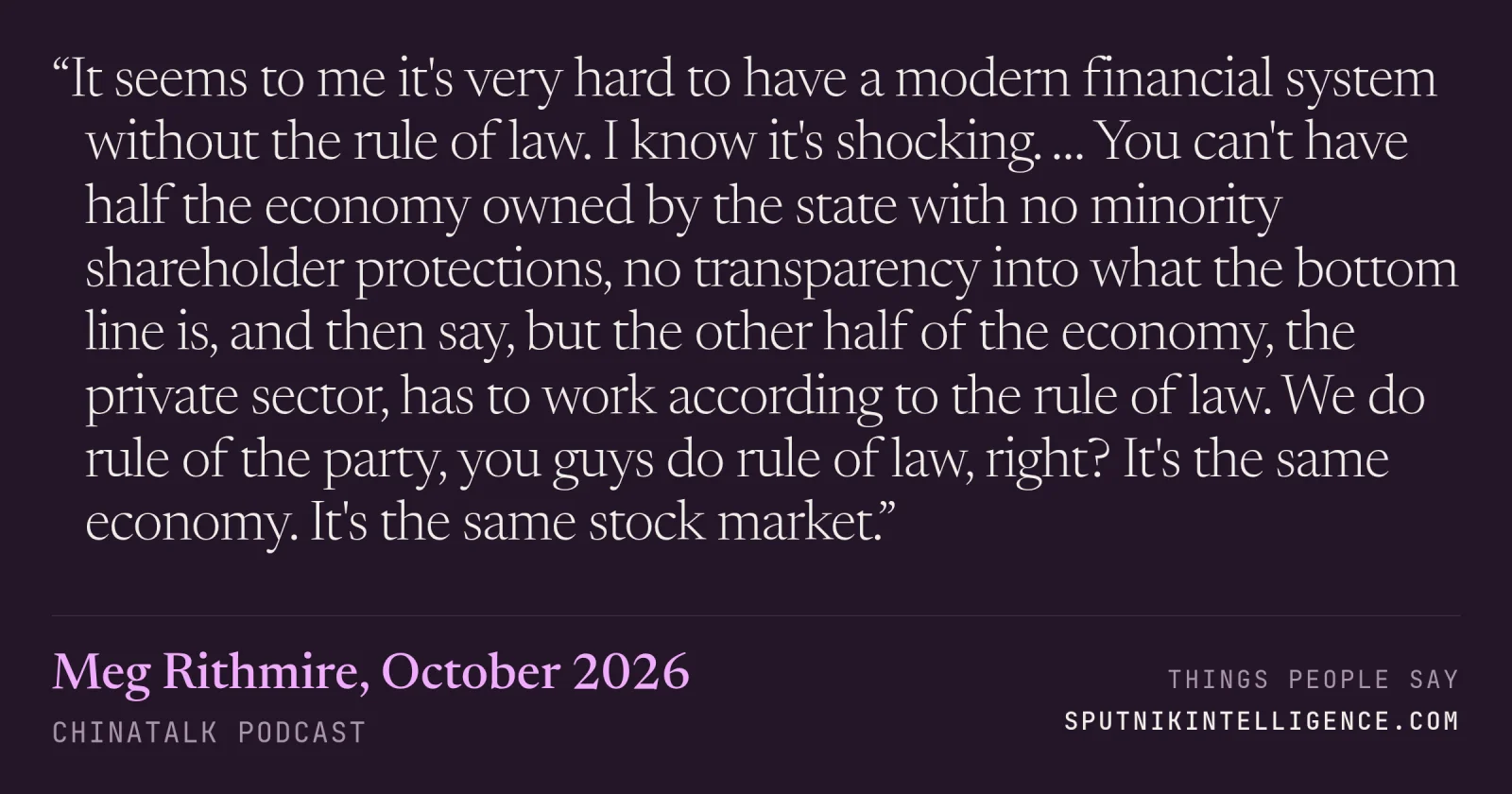
“In 2008, China was like the 172nd worst country in the world for getting a construction permit. But also in 2008, half of the world's construction cranes were in China. And we see with our eyes that someone's building buildings, whether they have a construction permit or not.”
ChinaTalk · Geopolitics & World Affairs · October 2026
Context
Rithmire was explaining why corruption in reform-era China worked partly as a workaround for difficult formal institutions. She says the problem later became one of scale, with sprawling conglomerates tunneling investor money through thousands of subsidiaries.
Transcript
…that, you know, within the party state itself, obviously corruption was endemic and a problem, which is why his first major thing is an anti-corruption campaign. But then also within the corporate sector, things were a mess. Corporate governance is a mess, right? These massive companies are a mess.
Let's talk about the scale of the mess and why it was a big deal, because we had, you know, corruption. You know, who doesn't? In the 80s, 90s, and 2000s, but you also had rapid growth. And like, you know, you got to break a few eggs, right? It's like everyone's getting richer. It's fine.
And corruption was a solution to the problem of, you know, very difficult formal institutions in China. So you have formal institutions. So I like to say, you know, in 2008, China was like the 172nd worst country in the world for getting a construction permit. But also in 2008, half of the world's construction cranes were in China. And we see with our eyes that, you know, someone's building buildings, whether they have a construction permit or not. So to your point, some of this corruption is sort of necessary to get around the way that the Chinese formal institutions work. But then there's a scale of it that is totally different. So if you go back to that period and you think about some of the most prominent Chinese companies that were investing in the United States at that time, right? We have Anbang Insurance, you know, Hainan Airlines, right? We have Wangda, these huge companies, right, that were buying up the Waldorf Astoria. They were purchasing insurance companies in Europe and the United States. They bought Club Med in Europe, right? And once you look…
Sounds not great. How does this become a like macroeconomic problem as well as like a party system problem if you or she's staring at it in 2012, 2013?
Okay, so I'll try to, I'll try to be precise about it because you said correctly, you know, the book goes back to reform and opening, goes back before that too, even to the 50s, right? When you think about this historic relationship. And, you know, what's what's irritates me sometimes is when…
1953.
More from ChinaTalk