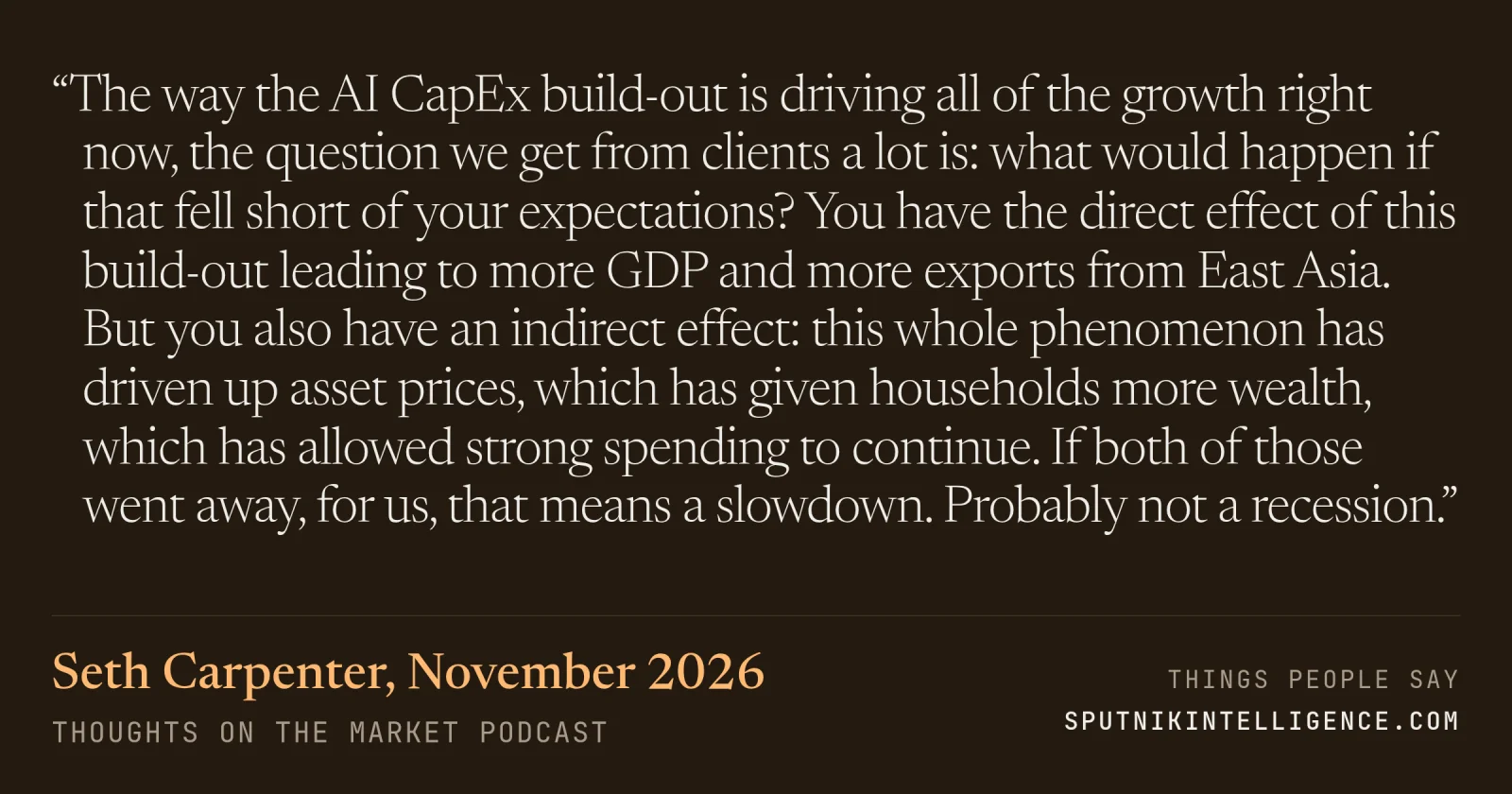
“The way the AI CapEx build-out is driving all of the growth right now, the question we get from clients a lot is: what would happen if that fell short of your expectations? You have the direct effect of this build-out leading to more GDP and more exports from East Asia. But you also have an indirect effect: this whole phenomenon has driven up asset prices, which has given households more wealth, which has allowed strong spending to continue. If both of those went away, for us, that means a slowdown. Probably not a recession.”
Thoughts on the Market · Money & Markets · November 2026
Context
Asked about alternatives to Morgan Stanley's base case for 2027, Seth walks through the scenario where AI spending falls short. It comes as the AI trade unwinds and this year's big AI-linked IPOs trade below their offer prices.
Transcript
…have to hike more than that. I would say if we're wrong, there are probably more paths to more rates from central banks and higher inflation than to lower. So I would say that's one place where I think our view maybe has a bit of tension with at least the way the market's trying to price things.
Now, you've talked a lot about the base case. What are some of the alternate scenarios you see for the global economy?
Yeah, I personally think it's critical to come into any round forecasting round with a base case, but that only gets you so far. You really have to ask yourself, how could we be wrong? And so what we tried to do was to sketch out four alternate scenarios that have some of the key risks that we think are there in the economy and that we're talking to clients about in markets. So in terms of a faster growth scenario, there really are two key scenarios that we try to analyze. One, demand. Demand for capex, demand for consumer spending, especially in the United States where demand overall is just stronger than we think. And that outcome leads to faster growth, but it also leads to much higher inflation. And so in response to that, the Fed and other developed market central banks are going to have to raise interest rates more and maybe to the same peaks that we saw in the last hiking cycle coming off of the COVID inflation. On the other hand, we're trying to figure out how is AI adoption happening? How much can productivity pick up? And so we also thought about a Faster growth scenario where it's mostly driven by faster aggregate supply. That is, the productivity picks up faster. And the big difference there is that you're able to get faster growth without the same kind of inflationary pressures. Now, central…
And of course, all of those risk scenarios just means the range of outcome for risk assets is unusually wide.
Yeah, I think that's right. There is a huge amount of uncertainty here. We are in uncharted territory in so many ways. The AI phenomenon all by itself is just a brand new situation for everybody in markets. But energy prices and everything that's going on in that space, there's still a lot of…
And of course, we're going to be talking about that in our next podcast. Seth, thanks for taking the time to talk.
More from Thoughts on the Market