 Kyle Chan
Research Fellow at Brookings, a DC think tank.
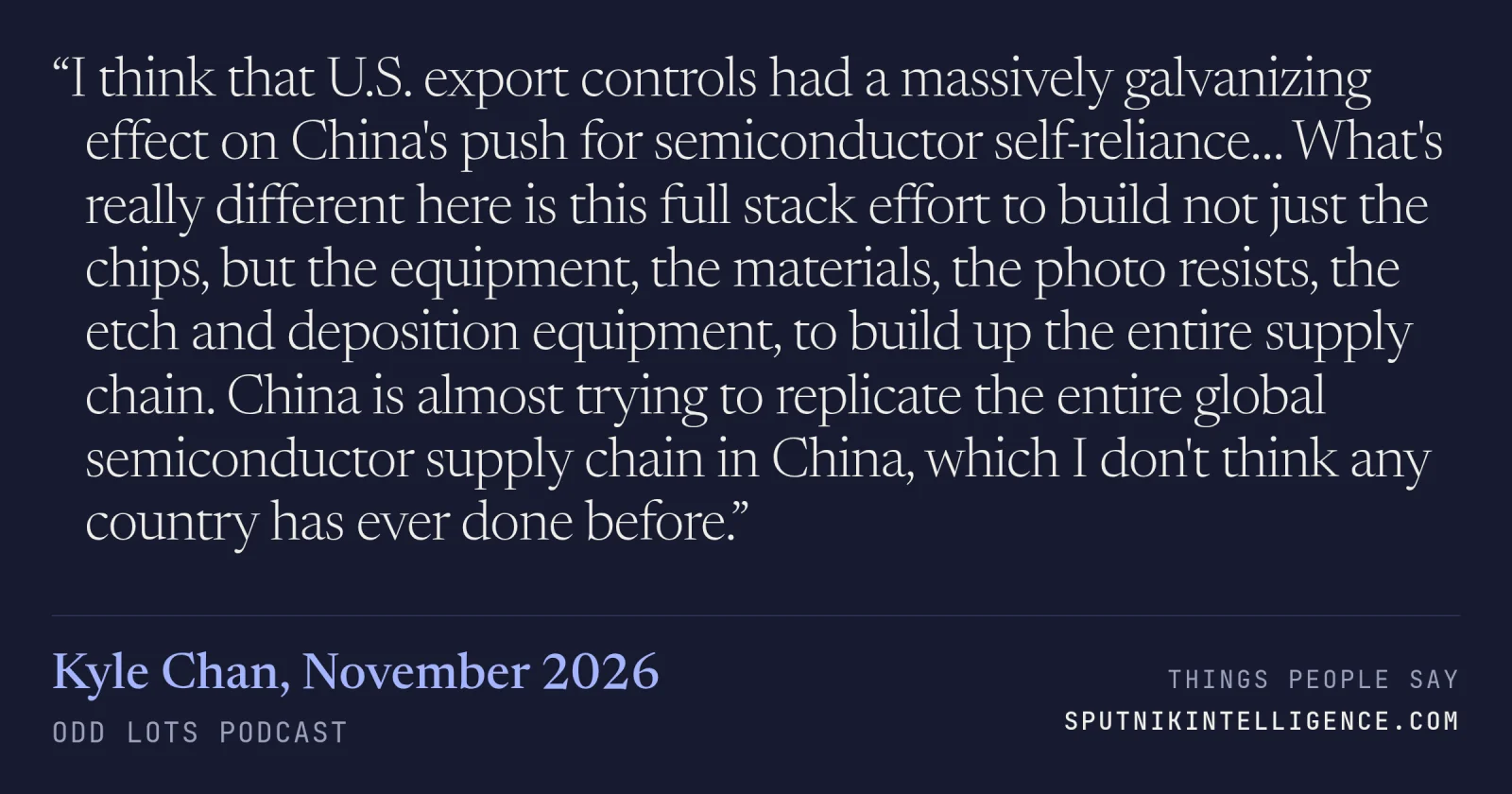
“I think that U.S. export controls had a massively galvanizing effect on China's push for semiconductor self-reliance… What's really different here is this full stack effort to build not just the chips, but the equipment, the materials, the photo resists, the etch and deposition equipment, to build up the entire supply chain. China is almost trying to replicate the entire global semiconductor supply chain in China, which I don't think any country has ever done before.”
Odd Lots · Money & Markets · November 2026
Context
Tracy Alloway asked whether US export controls sped up China's own chip development. Chan says yes: the mood shifted from 'we should make our own chips' to 'we must, at all costs'.
Transcript
…neural processing units, but it's sort of BYOH, bring your own HBM. You're going to have to source that from elsewhere. So that's another bottleneck in the near term. Yeah. So that's sort of where we stand in terms of the shift in capabilities, but then also the bottlenecks on the production side.
…of speeding up China's own technological development and like lending even more of a sense of urgency to develop their own chip competitors. When you look at what's happening with Huawei chips now, does it feel like that's happened? That China has like had its kind of Sputnik moment, I guess.
Yeah, absolutely. So I think that U.S. export controls had a massively galvanizing effect on China's push for semiconductor self-reliance. People who argue against that point to the fact that China has had a longer effort predating US export controls to try to develop their own sort of national chip industry. You have national semiconductor plans, you know, going back into the 2010s. But what's really different here is sort of this full stack effort to build not just the chips, but the equipment, the materials, the photo resists…
You like set your sights on being able to match global scale, and eventually you just grind and grind and you get there. And China has obviously done that in several areas and beyond just getting to the frontier, racing past the frontier. Batteries is one of the obvious categories that just comes…
Absolutely. The trade-offs here are really sharp. And there are trade-offs all over the Chinese industrial policy landscape. It's like one of the big themes that I focus on. And in this specific case, you have this trade-off between today, can you close the gap with the U.S. AI frontier? Can you…
Can you talk a little bit more about, I guess, the long game here or what Beijing would regard as a success? Because it's very easy to imagine a scenario where China becomes very good at a bunch of new technologies, partly by integrating a lot of its existing firms or doing the sort of vertical…
More from Odd Lots