 Sherry Turkle
Professor at MIT and a licensed clinical psychologist who has studied people's relationships with technology for decades.
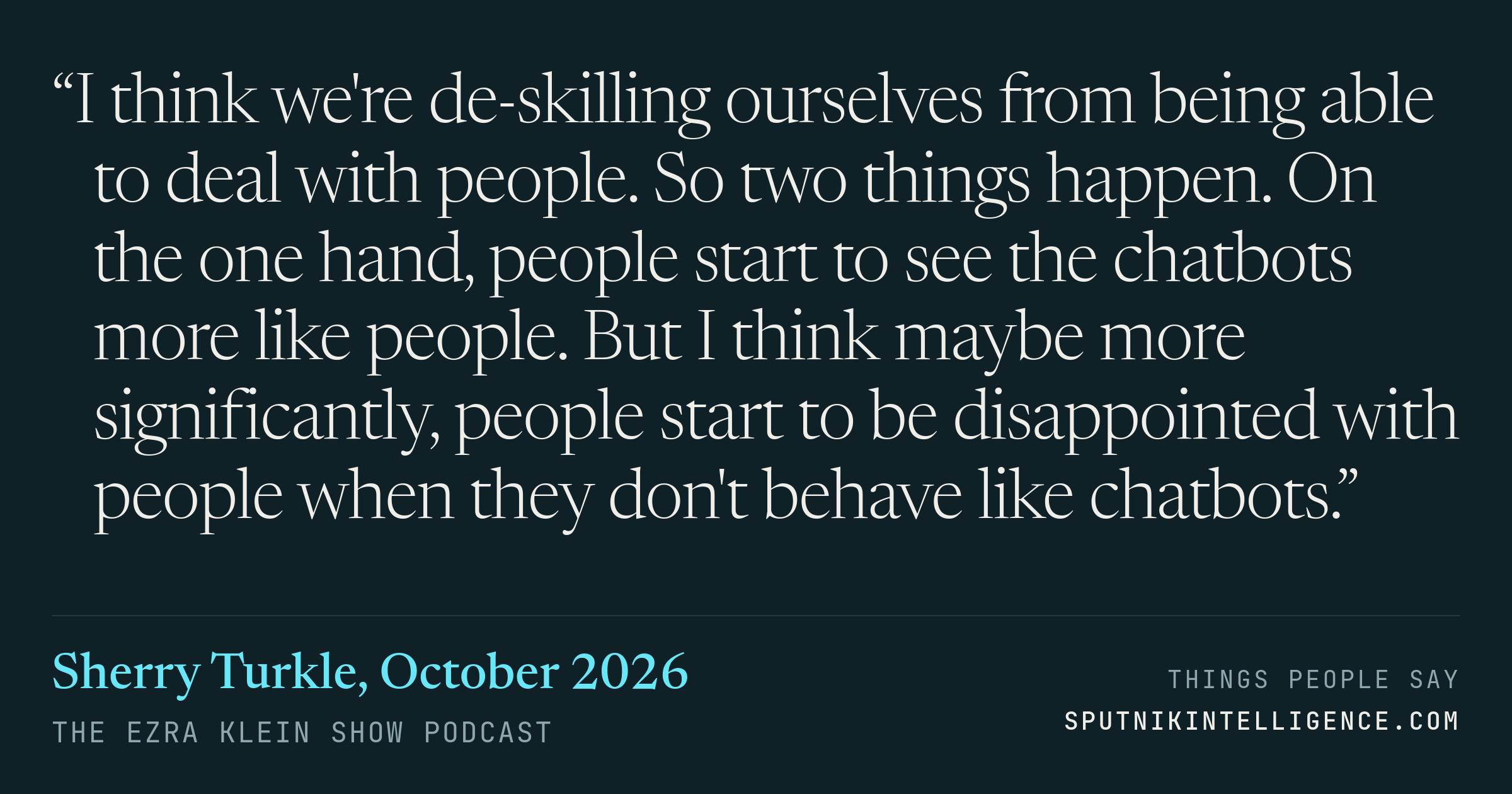
“I think we're de-skilling ourselves from being able to deal with people. So two things happen. On the one hand, people start to see the chatbots more like people. But I think maybe more significantly, people start to be disappointed with people when they don't behave like chatbots.”
The Ezra Klein Show · Ideas & Essays · October 2026
Ezra Klein worried that chatbots train us to expect conversations that mirror and reassure us, with no friction. Asked what that does to people's expectations of the humans in their lives, Turkle answers by drawing on Joseph Weizenbaum's fear that people would come to see themselves as computers.
Transcript
Why?
…you, they change. They don't offer you friction. They don't push back any more than you want them to. And so I guess when you have done the research on this, one of you looked at it. What do you think shifts in people's expectations for the human beings in their life when they spend time in these?
I think we're de-skilling ourselves from being able to deal with people. So two things happen. On the one hand, people start to see the chatbots more like people. But I think maybe more significantly, people start to be disappointed with people when they don't behave like chatbots. They start to think of themselves as if they were computers. And which is one of the themes of Weisenbaum's work, that, you know, why was he so upset? Is that it wasn't just that people were treating a computer as a person. He was worried that they started to see themselves as computers. What
do you mean by that?
That they started to see themselves as not having agency, not having relational capacity, not wanting to have weakness, not wanting to have vulnerability. That being like a computer became a kind of model for what it was to be a person. So, for example, they were very behaviorist in their…
like a legendary psychoanalyst.
More from The Ezra Klein Show