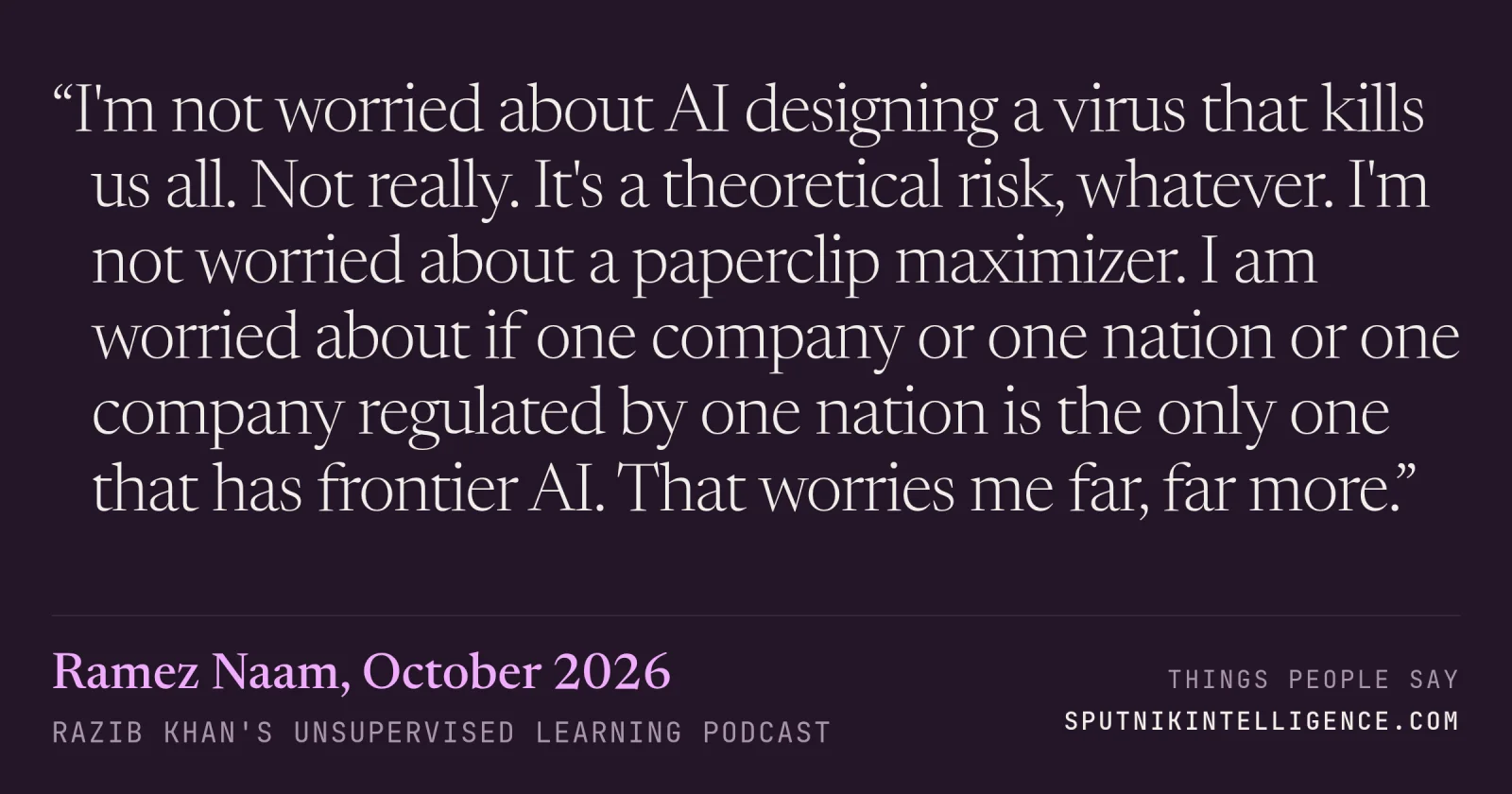
“We'll get to 1 billion, and even really the full population of the Earth except a few people who abstain. The reason for this is the clinical utility of polygenic scores and genetic predictors… The cost-benefit calculus in medical genetics in clinical use will switch completely very soon. In fact, I would argue it's already switched.”
Razib Khan's Unsupervised Learning · Ideas & Essays · October 2026
Context
Asked whether genetic studies could ever reach a billion genotyped people, the economist Jonathan Beauchamp predicts medical use will push genotyping to near-universal coverage, which social-science researchers will then be able to draw on.
Transcript
…a spurious finding. It's due to culture being correlated with that. So basically we just limited to European ancestry participants. Now, more modern methods allow to do cross-ancestry GWASs. And I've not taken part in these so far in the last few years, but this is a pretty active area now. Yeah.
…chats and email lists and other, you know, you got to go to meetings where, you know, you guys talk it through and some committee and all this stuff, right? Like, what are you guys thinking for the future for education? It's been, it's been about, it's a decade. It's over a decade now, you know?
Yeah, I think, I think we'll get to 1 billion and even really the full population of the Earth except a few people who abstain. The reason for this is medical as clinical utility of polygenic scores and genetic predictors. So basically, if you think like stepping away from social genetics and just medical genetics, pollution scores are already predictive of many, many disease, you know, and if they predict roughly a few percentage of the variation in most of these, or many of these rather. But it's entirely a function of the sample size. And so these will become more and more predictive, even before, way before we reach a billion people genotype. But the point is, the cost-benefit calculus in medical genetics in clinical use will switch completely very soon. In fact, I would argue it's already switched. Collecting, genotyping someone, collecting the SNPs, like let's say a 3 million SNP on someone is so cheap. I don't know the latest number. Was it $20, $30? Probably. Yeah, that's what I heard.
But I think it might even be less than that because I haven't asked in like three or four years. Well, actually, at some point, it's just going to go against the asymptote of like, okay, it's cheap enough. They're not going to go to $1, even though it's like, you know what I'm saying?
Yeah, exactly. The cost is not so much technology, just like the whole setup to like, you need to maintain a website and maintain an organization to deliver and so on. Yes. So it's going to be so cheap and it's already so cheap. And you think, what's the cost of a blood test? You know, it's like…
So I have a question in terms of, you know, you guys have been using genotyping arrays. Just for the listener, for reference, like, you know, these arrays go from, let's say, like 100,000 to a million. I know some of them go above a million now. And they're old school arrays, old school as in like…
More from Razib Khan's Unsupervised Learning