 Zeke Hausfather
"A tireless chronicler and commentator on all things climate" -NYTimes.
Zeke Hausfather
"A tireless chronicler and commentator on all things climate" -NYTimes.
“Strong El Niños add about 0.2 degrees to annual temperatures the year after they peak. … We add about 0.2 degrees from human emissions every eight years. And so we're essentially adding a permanent super El Niño worth of heat to the climate system every eight years just by burning coal, oil, and gas.”
The Great Simplification with Nate Hagens · September 2026
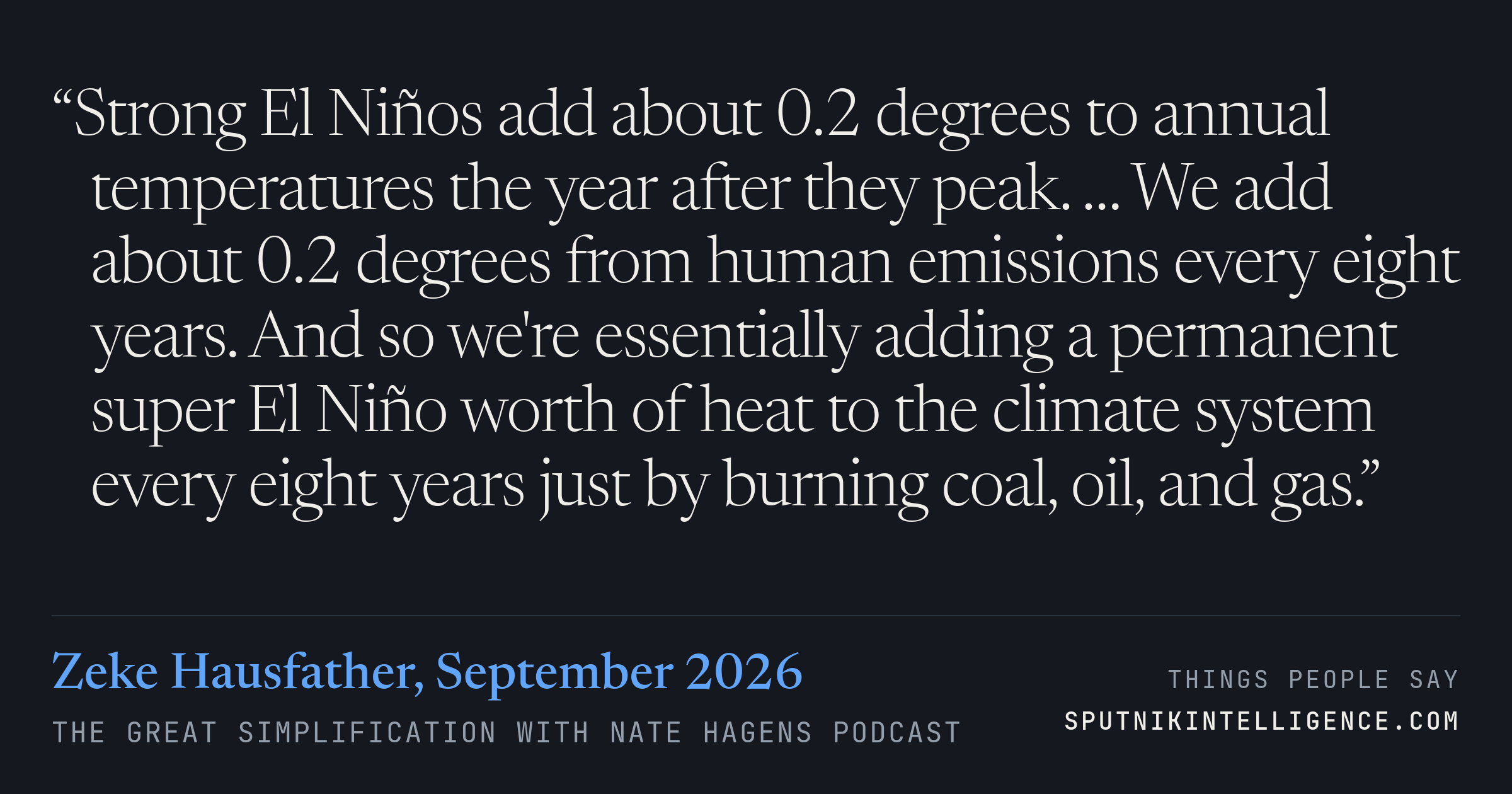
Hausfather had just said an El Niño year is a sneak peek of what the new normal will be about a decade on. Here he puts numbers on it: the temporary bump from a strong El Niño is roughly what human emissions add permanently every eight years.
Transcript
Yeah, I mean, the line keeps going up, right? You know, until we get emissions all the way down to zero, which isn't going to happen anytime soon, the world will continue to warm. And so, you know, an El Niño year like what we're experiencing right now is in some ways a sneak peek of what the new normal will be a decade from now, right?
Right. Oh, that's a way to look at it. When you have a strong El Niño, it's a glimpse at what it would be 10 years out, the average. Yeah,
strong El Niños add about 0.2 degrees to annual temperatures the year after they peak. You know, this year might be 0.3 because this El Nino is crazy. But we add about 0.2 degrees from human emissions every eight years. And so we're essentially adding a permanent super El Nino worth of heat to the climate system every eight years just by burning coal, oil, and gas. Trevor Burrus, Jr.:
I want to get into the El Nino, but one more question on the scenarios. So on another podcast recently, you said the SSP3 scenario felt a little close to home for you these days. Why does that specific scenario hit home and what does it do to the emissions picture? Aaron Ross Powell,
the SSPs are an attempt to look at different potential socioeconomic futures. So there's five different SSPs: SSP1, which is a sort of a world that very much embraces sustainability and more modest resource use. There's SSP2, which is sort of current trends broadly continuing as they are today. I'll get back to SSP3 in a second. SSP4 is a world of very high inequality. The rich get very, very rich. The poor stay relatively poor. And then SSP5 is a world where everyone gets quite rich, but continues to burn fossil fuels. Willy-nilly. So, SSP3 is sort of the worst world from an adaptive capacity standpoint. It's a world that is relatively poor overall, that is characterized by resurgent nationalism, a lack of international cooperation, lots of regional conflicts. Countries turn more back to domestic resources because there's not a robust trade in things. Many things that seem to be very much characterizing the last decade or so with what we're seeing in Ukraine and the Middle East and all these other conflicts. I hope that's a blip. I hope that doesn't become the dominant mode of the 21st century because it would also just be a really bad future for humanity. But that's a world that, because of a lack of cooperation, because of slow growth, because of persistent poverty in places like sub-Saharan Africa, the world is a very bad position to adapt to the impacts of climate change. And we're seeing slower technological growth, we're seeing slower technological transfer and deployment. And so emissions remain high for quite some time. And so, in the new set of scenarios, the ones that we published for the upcoming IPCC report, the high scenario is associated with an SSP3 world. And so, it's one where global emissions continue to increase. They're about 50% higher by 2100 than they are today. So, not crazy. We're burning 50% more fossil fuels in 75 years than we are today.
Zero chance of that.
More from The Great Simplification with Nate Hagens