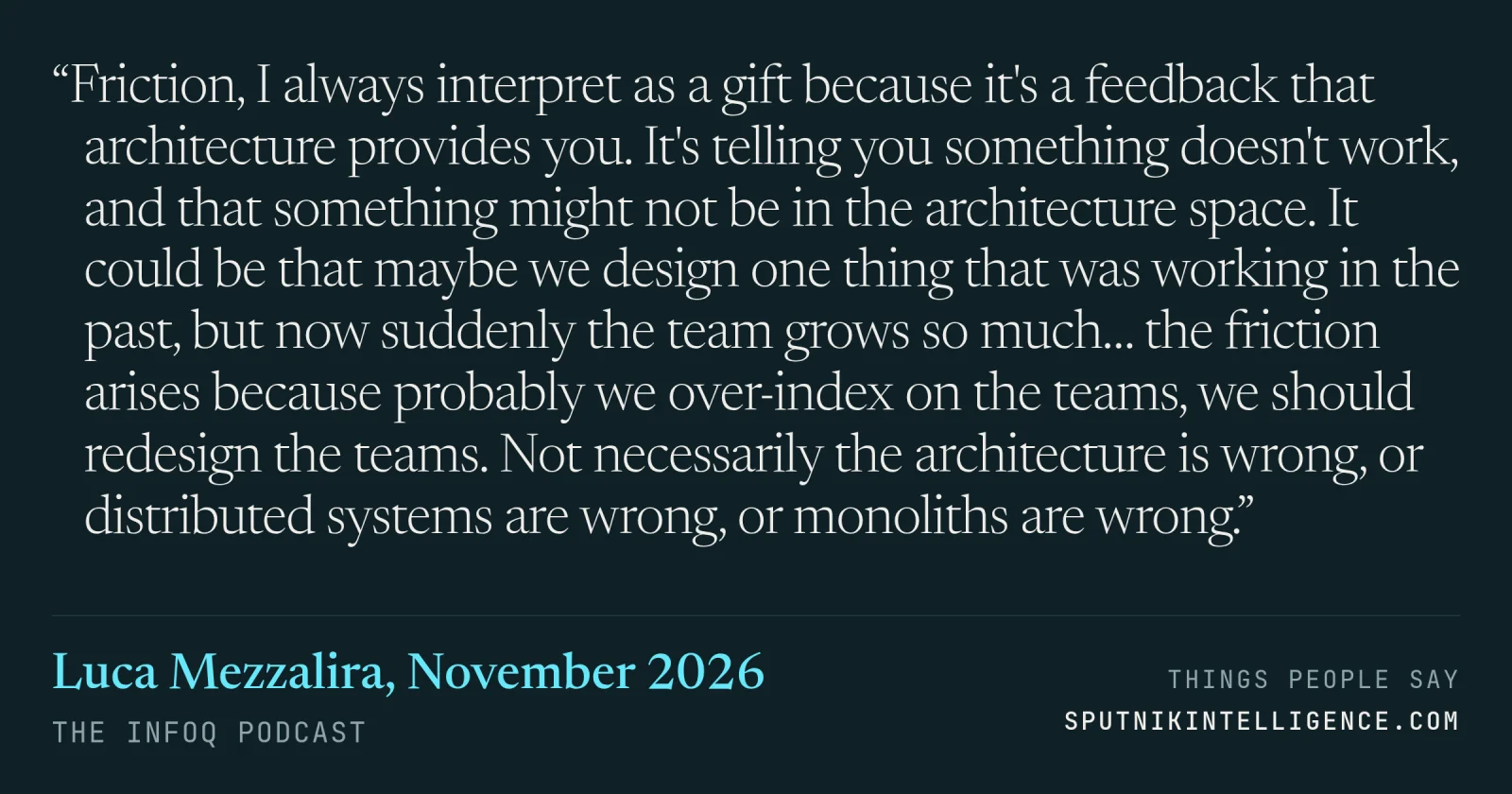
“Friction, I always interpret as a gift because it's a feedback that architecture provides you. It's telling you something doesn't work, and that something might not be in the architecture space. It could be that maybe we design one thing that was working in the past, but now suddenly the team grows so much… the friction arises because probably we over-index on the teams, we should redesign the teams. Not necessarily the architecture is wrong, or distributed systems are wrong, or monoliths are wrong.”
The InfoQ Podcast · Hands-On Engineering Podcasts · November 2026
Context
Asked what he hates about architecture, Mezzalira said it is people who blame the architecture first when something goes wrong. He treats friction as a signal about team and organization structure, the socio-technical view that runs through the episode.
Transcript
…other people, try to figure out the different ideas, see which one sticks better, maybe running a POC, document this thing, understand why a certain decision was made in a certain period of time. All these kinds of things for me are extremely fascinating. I found a lot of pride on doing this job.
Conversely, what about architecture do you hate?
…are coming out from university, and probably I need to figure out something that is less complicated to start with. Obviously, if I work on a very complex system and Elixir is needed, or I want to use, I don't know, ACA with an actor model implementation, I need to adapt this architecture for a specific context. So, in my opinion, architecture is just there for surfacing good and bad things. Friction, I always interpret as a gift because it's a feedback that architecture provides you. It's telling you something doesn't work, and that something might not be in the architecture space. It could be that maybe we design one thing that was working in the past, but now suddenly the team grows so much or they split in a way, but the code is still needed to be co-located. And therefore, the friction arise because probably we over-index on the teams, we should redesign the teams in order to have better things. Not necessarily, the architecture is wrong, or distributed systems are wrong, or monoliths are wrong. I think architecture, all of them are still useful nowadays. There are some of them…
And sometimes it's some people don't appreciate that there was a trade-off that was made. Yes, we consciously made this case not to be optimal because we had to achieve something else. It's that same lack of perspective.
Exactly. Thinking about holistically on the system is the other challenge that happens very often. I think it comes with maturity and experience. It's not, let's say, that you have for free. I probably was similar to those people at the beginning of my career because I didn't see holistically on…
What profession, other than being an architect, would you like to attempt?
More from The InfoQ Podcast