 Chip Huyen
I work at the intersection of AI, education, and storytelling.
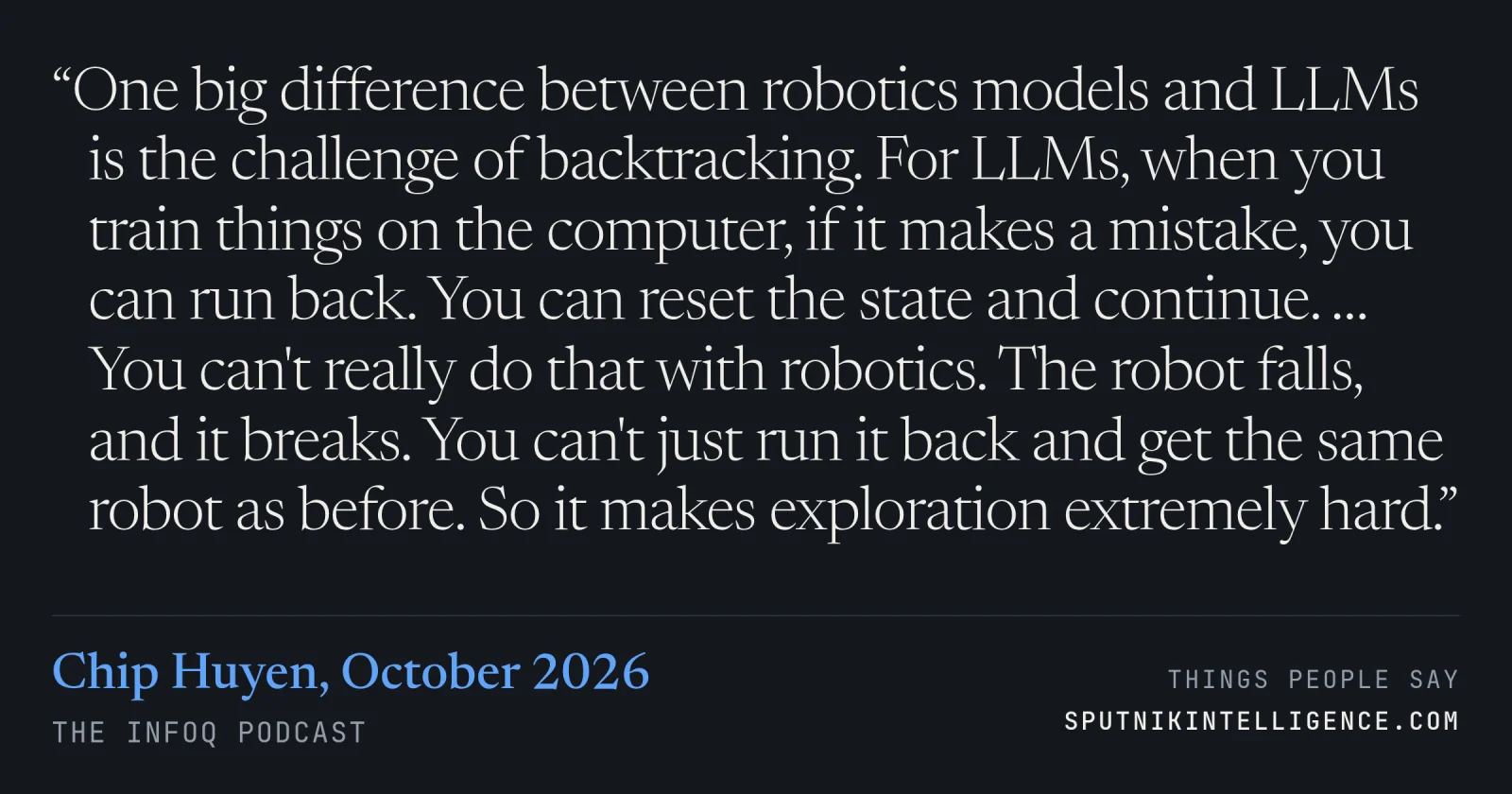
“One big difference between robotics models and LLMs is the challenge of backtracking. For LLMs, when you train things on the computer, if it makes a mistake, you can run back. You can reset the state and continue. … You can't really do that with robotics. The robot falls, and it breaks. You can't just run it back and get the same robot as before. So it makes exploration extremely hard.”
The InfoQ Podcast · Hands-On Engineering Podcasts · October 2026
Context
In the physical-AI part of the panel, people often say robots should become as tractable as self-driving cars or language models. She argues the training problem is different, because a real robot can't be reset.
Transcript
…that are going to happen for open source robotics, all the things that are going to happen from AI agents to physical agents. All of this is just going to start moving faster and faster over the next year because they, I mean, right now, the AI is here. Now, we have to put it in our physical world.
…to be definitely one of the applications that's going to see a lot more attention, a lot more developments, right? Daniel, there is manufacturing or any other physical industrial use cases. Any other thoughts, Chip, robotic robots and vision language models? How do you see them kind of working?
Yeah, I think it's very, very exciting. Definitely a lot of say that it's the next frontier to get the models into the real world. And we see a lot of progress. And I think the only challenge is that it's like there are like several challenges. So people keep saying that like robotics is like cars, right? Like LM to say, okay, we know we already have a lot of robots in the real world. I have Waymos everywhere. We have jukes. I'm not sure Zook is out. I'm sorry. I haven't never driven one, but I see the advertising for it. So we see a lot of robots in the real world. So people keep telling me that, like, oh, we know how to train maximum LMs, multi-model stuff. We know how to train robots, like set up in cars. We should know how to train robots to work with real world. But I don't think it's quite the same. So one big difference between robotics models and LMs is that the challenge of backtracking, right? For LMs, when you train things on a virtual, like on the computer, if it makes a mistake, you can run back, right? You can reset the state and continue. So you can do a lot of like explorations and pick the best state. You can't really do that with robotics, right? Like…
Thanks, Chip. Yeah, definitely. We are kind of running shorter on the time remaining in this meeting. So I know there are a lot of topics. We have talked about the topics that at least that we think are definitely important to be aware of. But I know there are other topics that we can probably, we…
Yeah, I think we could regret relating multi-agent systems and AI engineering because it's not as hopeless as we might have seen when I was going through chip, you know. But there's a lot of things that we could bind together and bring together to correlate to how we solve problems that we have…
If we can start wrapping up, you know, so this is kind of my favorite part of the podcast to request each panelist to make a prediction for next year. And we'll take a checkpoint next year and see how these predictions have kind of been realized. So, yeah, we can start off with Chip. What do you…
More from The InfoQ Podcast