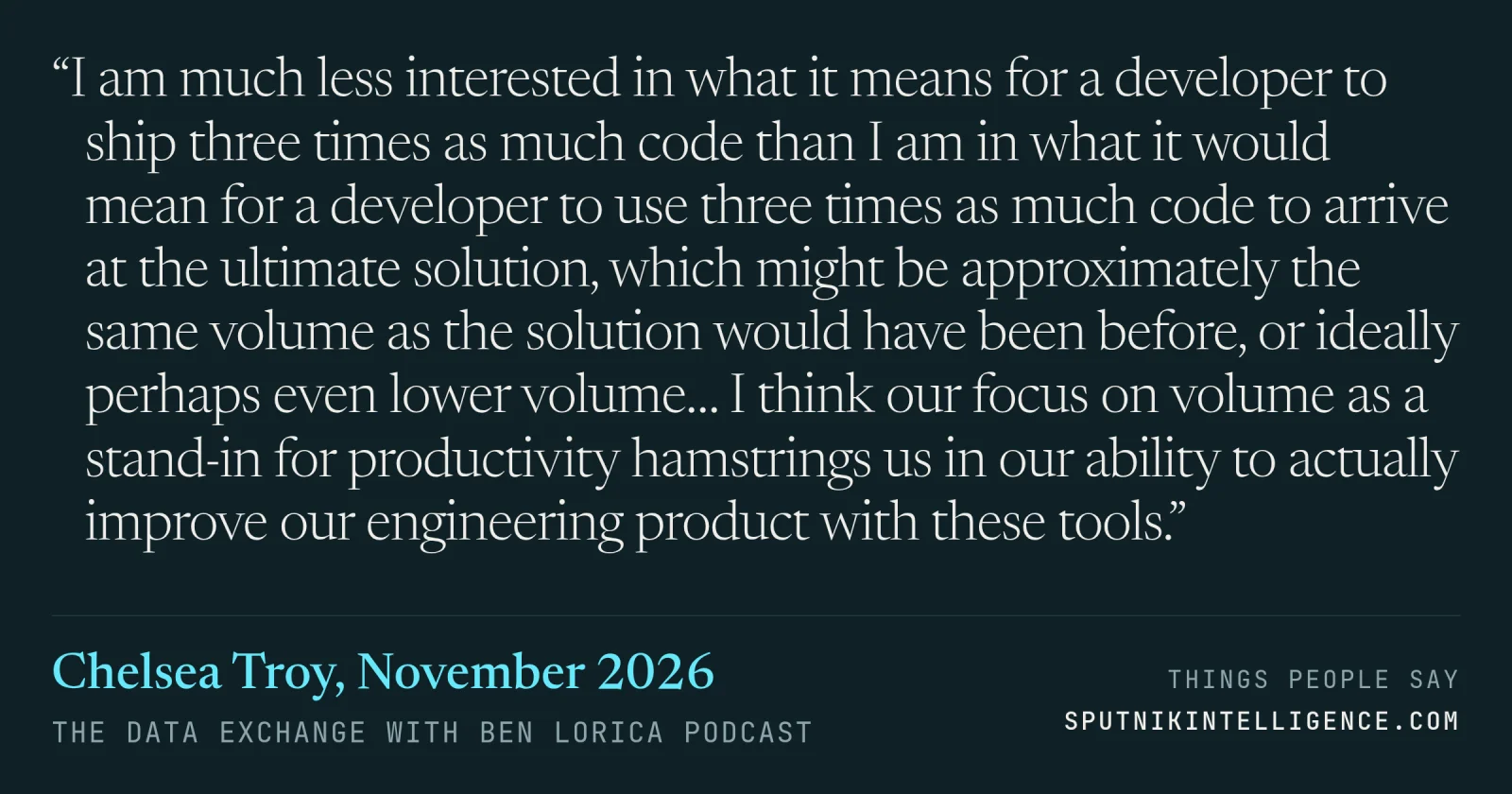
“I am much less interested in what it means for a developer to ship three times as much code than I am in what it would mean for a developer to use three times as much code to arrive at the ultimate solution, which might be approximately the same volume as the solution would have been before, or ideally perhaps even lower volume… I think our focus on volume as a stand-in for productivity hamstrings us in our ability to actually improve our engineering product with these tools.”
The Data Exchange with Ben Lorica · AI Research & Frontier Labs · November 2026
Context
The host had cited studies showing developers write more code with AI tools while the amount of software shipped and used has barely moved. She argues companies are measuring the wrong thing.
Transcript
…sort of a detour that allows them to express that interest in the craft again, which I think gives us license to examine whether they should have been separated from the craft in the first place, whether that was the appropriate way to develop the standard career path in software engineering.
…I'm never going to use this code again. I'm just going to use one of these tools. But if it's something gets more serious, then it turns out that it doesn't move the needle as much because people obviously still have to follow all the rigorous processes, right? So I don't know what you think.
…bar charts and pie charts and stuff that we've been writing before. And the way that the Zeitgeist focuses on the increase in volume that AI makes available, I think, disappoints me because the availability of this tool removes all of these bandwidth limitations that previously prevented us from being able to doggedly pursue the best quality of the thing that it is that we're trying to ship. I think our focus on volume as a stand-in for productivity hamstrings us in our ability to actually improve our engineering product with these tools.
Yeah. So it's all, yeah, I like what you said there. So it seems like then, Chelsea, companies that put themselves in a position where they can actually run these experiments and track the results. In other words, I don't know what the equivalent of an experiment platform, you have a staging…
I think so. I think that there is a lot of opportunity in having the ability to do these things. The thing that I've been experimenting the most with lately is data visualization. And I do this for a number of reasons. I work on data visualization, of course, in my day job because we talk about how…
right. So in closing, I'll have you predict, which I'm sure is going to be difficult to do given that these things change every week. So in one year's time and in two years' time, how does the day of a typical developer or software engineer change?
More from The Data Exchange with Ben Lorica