CT

Chelsea Troy

Things Chelsea Says on Podcasts

Where to Find Them

Chelsea Troy writes Maintainable . They have also been a guest on Ruby Rogues (2 times) , Legacy Code Rocks , The Data Exchange with Ben Lorica , Elixir Wizards and Software Unscripted .

Recently: “The Real Impact of AI on the Developer Job Market” on The Data Exchange with Ben Lorica (November 2026); “Black-Belt Debugging with Chelsea Troy - RUBY 663” on Ruby Rogues (December 2024); “Code Reviews with Chelsea Troy” on Legacy Code Rocks (July 2024); “From Bootcamp to Teaching Masters' Comp Sci” on Software Unscripted (May 2023); “Chelsea Troy - All Code Has Maintenance Load” on Maintainable (May 2022); “Chelsea Troy - All Code Has Maintenance Load” on Maintainable (May 2022).

What They Said

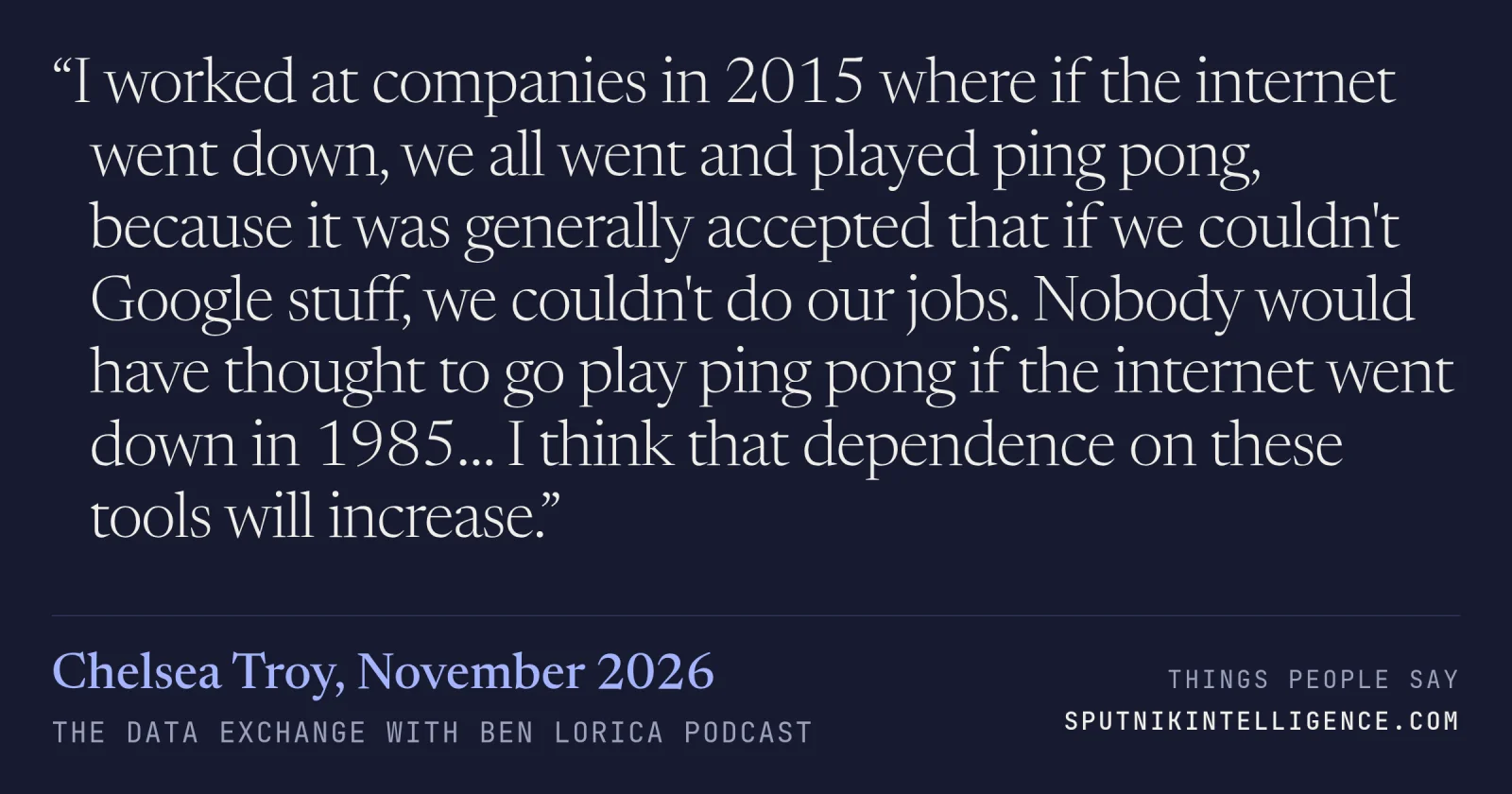
“I worked at companies in 2015 where if the internet went down, we all went and played ping pong, because it was generally accepted that if we couldn't Google stuff, we couldn't do our jobs. Nobody would have thought to go play ping pong if the internet went down in 1985… I think that dependence on these tools will increase.” — Chelsea Troy, The Data Exchange with Ben Lorica

Her one-year prediction for developers. She compares AI coding tools to search engines, which didn't take developers' jobs but made them dependent.

The Data Exchange with Ben Lorica · 2026-11-25 Permalink → Listen →
The Data Exchange with Ben Lorica Around 34:32 into the episode
Chelsea Troy

Oh, that's an excellent question.

Ben Lorica

One year first and then be more speculative in the two years.

Chelsea Troy

…However, I worked at companies in 2000, I don't know, let's say 15, where if the internet went down, we all went and played ping pong because it was generally accepted that if we couldn't Google stuff, we couldn't do our jobs. Nobody would have thought to go play ping pong if the internet went down in 1985 because largely programmers did not have general access to the internet in 1985. And so I think that dependence on these tools will increase. We're already seeing folks when the tools go down say they can't get their jobs done, et cetera, et cetera. I think that kind of thing will be

Ben Lorica

or if they're on the flight and the Wi-Fi is spotty, right?

Chelsea Troy

Well, right. There's this sort of like, yeah, I think that there will be adjudication around the dependence on these tools that is acceptable for developers to have and also acceptable for developers to communicate. At the two-year mark, you know what? I will tell you, at the two-year mark, here is…

Ben Lorica

And with that, thank you, Chelsea. You can follow the work of Chelsea Troy online at mozilla.org. Please join the thousands of people who subscribe to our newsletter, which you can find at gradentflow.com. Thanks for joining us. If you like the show, please subscribe and rate us through Apple…

Speaker names come from our own diarization. The position is estimated from where the line sits in the episode.
“You write code, you're a good technologist, you create value. And to the extent that you are successful at it, you get rewarded with a promotion to a job that uses none of the skills that you just developed and a whole bunch of skills that you now don't have.” — Chelsea Troy, The Data Exchange with Ben Lorica

Asked whether AI tools are bringing managers back to writing code. She says some managers are glad to return to hands-on work, and uses that to question the usual path from engineer to manager.

The Data Exchange with Ben Lorica · 2026-11-25 Permalink → Listen →
The Data Exchange with Ben Lorica Around 22:31 into the episode
Chelsea Troy

I think there's,

Ben Lorica

am I just imagining this? Because I've had these conversations with a bunch of people. It seems like it's a real thing.

Chelsea Troy

You know, it may be the case. I don't think I've had as many conversations with folks in environments where managers were compelled to code. I do know that in my own personal experience, I've talked to a number of managers who are very excited about the way that Agentic coding tools now give them the ability to write code with a lot of times it's like a bandwidth issue. They have limited time. They have other responsibilities. Or sometimes it's this like, well, I became a manager six years ago. And because the pace of technology moves very fast, that means that my skills are now obsolete. And so I no longer have the ability to actually keep my hand on the wheel as to what we're doing. But now with Agentic Tools, I don't necessarily need that same level of update because I still have the ability to precisely communicate my requirements is the idea. And if I can precisely communicate my requirements, then Agentic Tools can do it for me. I think a lot is still up in the air as to how useful this is going to be. I know that a number of larger…

Ben Lorica

No, no, I like that. I like that bouncing back and forth because I think that I've actually had a lot of friends who've done that as well. And if anything, I think the misunderstanding of this Agent encoding tools probably is much more in the senior leadership role rather than the middle management…

Chelsea Troy

Yeah, I think that with regard to the way that these tools are used at the organizational level and the outcomes that we're seeing, if I were to offer a half-baked, perhaps cancelable take on the situation, I'm a little trepidatious and saddened that a lot of the zeitgeist around the way to use…

Ben Lorica

Yeah. So it's all, yeah, I like what you said there. So it seems like then, Chelsea, companies that put themselves in a position where they can actually run these experiments and track the results. In other words, I don't know what the equivalent of an experiment platform, you have a staging…

Speaker names come from our own diarization. The position is estimated from where the line sits in the episode.
“Some companies still put you on a video call and ask you to write down Dijkstra's in 40 minutes. Theoretically it's a critical thinking challenge. Ultimately that interview is a validation that you have already been taught Dijkstra's algorithm, because Dijkstra did not come up with Dijkstra's in 40 minutes.” — Chelsea Troy, The Data Exchange with Ben Lorica

Asked how hiring interviews change when AI can write the code. She argues the classic algorithm interview was always a memorization test, and that AI may push interviews toward judging decision-making instead.

The Data Exchange with Ben Lorica · 2026-11-25 Permalink → Listen →
The Data Exchange with Ben Lorica Around 13:31 into the episode
Chelsea Troy

…a really useful case study for how you might work on such a massively impactful programming project yourself in the future, whether or not it's in Python, because Python provides us with sort of like a gold standard for how a complex project with a large user base might be maintained over time.

Ben Lorica

…I've worked with startups where they even encourage some of the candidates to spend a day or two days at the company. And here, here, maybe you can try out this little project. And then at the end of the day, we can discuss it. So, what is the change, Chelsea, in terms of the interview process?

Chelsea Troy

Yeah. So, it's an interesting question because I think that interview processes in programming have in some ways codified a difference between how we evaluate developers and how eval and how developers provide value to an organization for a pretty long time. Hello Wayne has this really excellent series about the history of software engineering interviews and the fact that many of our most common interview questions, and this is before the advent of agentic coding, many of our most common interview questions are interview questions that we inherited over time from a period in which programmers had to do a lot more from scratch. So, for example, we would ask students or we would ask interview candidates rather to implement a linked list from scratch. And if you were to ask a programmer in 2005 why we asked them to implement a linked list from scratch, the reason that we would give is that we want to evaluate their critical thinking capability and their architectural design capability and all of these things. But that's actually a retcon answer as to why we would ask that interview question.…

Ben Lorica

So have you noticed, Chelsea, among your students who are on the job market, right? So this year on the job market compared to on the job market last year, has it been more challenging to get this first or this entry-level or first job for these students year to year?

Chelsea Troy

I think that it is really challenging right now. I don't envy students who are trying to go into industry at the moment. And I think that actually is LLMs play a part in that. I think the biggest part that LLMs play in that is that companies are experiencing a lot of turmoil figuring out, first of…

Ben Lorica

Yeah. Yeah. So the other thing that it seems like Chelsea companies are doing, so there's the notion of maybe we should slow down hiring entry level. That's one of the mistakes they're making. The other thing that seems to be fashionable these days is, hey, we don't actually, we should have all…

Speaker names come from our own diarization. The position is estimated from where the line sits in the episode.
“There's this idea that maybe if we just have senior engineers, they can delegate to LLM agentic coding tools, and then we don't need to hire entry-level engineers. I think companies are going to be able to try that for a few years. And then eventually it's going to become clear that continuing to invest in talent for the industry is going to be an important thing for companies to do, regardless of the tools that are or are not available.” — Chelsea Troy, The Data Exchange with Ben Lorica

Asked whether the entry-level job market is harder for her students this year. She says it is very hard, and that companies are unsure whether they need junior engineers at all now that coding agents exist.

The Data Exchange with Ben Lorica · 2026-11-25 Permalink → Listen →
The Data Exchange with Ben Lorica Around 16:31 into the episode
Chelsea Troy

…focuses to the extent that junior developers are able to pick up on that or entry-level developers are then developing that skill set. That's much closer to what's actually important on the job than whether you've memorized dijkstras, which you're never going to have to code from scratch yourself.

Ben Lorica

So have you noticed, Chelsea, among your students who are on the job market, right? So this year on the job market compared to on the job market last year, has it been more challenging to get this first or this entry-level or first job for these students year to year?

Chelsea Troy

I think that it is really challenging right now. I don't envy students who are trying to go into industry at the moment. And I think that actually is LLMs play a part in that. I think the biggest part that LLMs play in that is that companies are experiencing a lot of turmoil figuring out, first of all, how to evaluate entry-level candidates. And also there's all this consternation about whether companies need entry-level candidates. There's this idea that like maybe if we just have senior engineers, they can delegate to LLM agenda coding tools. And then we don't need to hire entry-level engineers. I think companies are going to be able to kind of try that for a few years. And I think then eventually it's going to become clear that continuing to invest in talent for the industry is going to be an important thing for companies to do, regardless of the tools that are or are not available. But I think we are still currently in this phase, that like few year phase, where companies are experimenting with whether we can eliminate this entire class of employees. I think ultimately the conclusion is going to be we cannot. But because we are in that period, I think that currently there's a lot of anxiety among students about…

Ben Lorica

Yeah. Yeah. So the other thing that it seems like Chelsea companies are doing, so there's the notion of maybe we should slow down hiring entry level. That's one of the mistakes they're making. The other thing that seems to be fashionable these days is, hey, we don't actually, we should have all…

Chelsea Troy

I think there's,

Ben Lorica

am I just imagining this? Because I've had these conversations with a bunch of people. It seems like it's a real thing.

Speaker names come from our own diarization. The position is estimated from where the line sits in the episode.
“I am much less interested in what it means for a developer to ship three times as much code than I am in what it would mean for a developer to use three times as much code to arrive at the ultimate solution, which might be approximately the same volume as the solution would have been before, or ideally perhaps even lower volume… I think our focus on volume as a stand-in for productivity hamstrings us in our ability to actually improve our engineering product with these tools.” — Chelsea Troy, The Data Exchange with Ben Lorica

The host had cited studies showing developers write more code with AI tools while the amount of software shipped and used has barely moved. She argues companies are measuring the wrong thing.

The Data Exchange with Ben Lorica · 2026-11-25 Permalink → Listen →
The Data Exchange with Ben Lorica Around 25:31 into the episode
Chelsea Troy

…sort of a detour that allows them to express that interest in the craft again, which I think gives us license to examine whether they should have been separated from the craft in the first place, whether that was the appropriate way to develop the standard career path in software engineering.

Ben Lorica

…I'm never going to use this code again. I'm just going to use one of these tools. But if it's something gets more serious, then it turns out that it doesn't move the needle as much because people obviously still have to follow all the rigorous processes, right? So I don't know what you think.

Chelsea Troy

…bar charts and pie charts and stuff that we've been writing before. And the way that the Zeitgeist focuses on the increase in volume that AI makes available, I think, disappoints me because the availability of this tool removes all of these bandwidth limitations that previously prevented us from being able to doggedly pursue the best quality of the thing that it is that we're trying to ship. I think our focus on volume as a stand-in for productivity hamstrings us in our ability to actually improve our engineering product with these tools.

Ben Lorica

Yeah. So it's all, yeah, I like what you said there. So it seems like then, Chelsea, companies that put themselves in a position where they can actually run these experiments and track the results. In other words, I don't know what the equivalent of an experiment platform, you have a staging…

Chelsea Troy

I think so. I think that there is a lot of opportunity in having the ability to do these things. The thing that I've been experimenting the most with lately is data visualization. And I do this for a number of reasons. I work on data visualization, of course, in my day job because we talk about how…

Ben Lorica

right. So in closing, I'll have you predict, which I'm sure is going to be difficult to do given that these things change every week. So in one year's time and in two years' time, how does the day of a typical developer or software engineer change?

Speaker names come from our own diarization. The position is estimated from where the line sits in the episode.
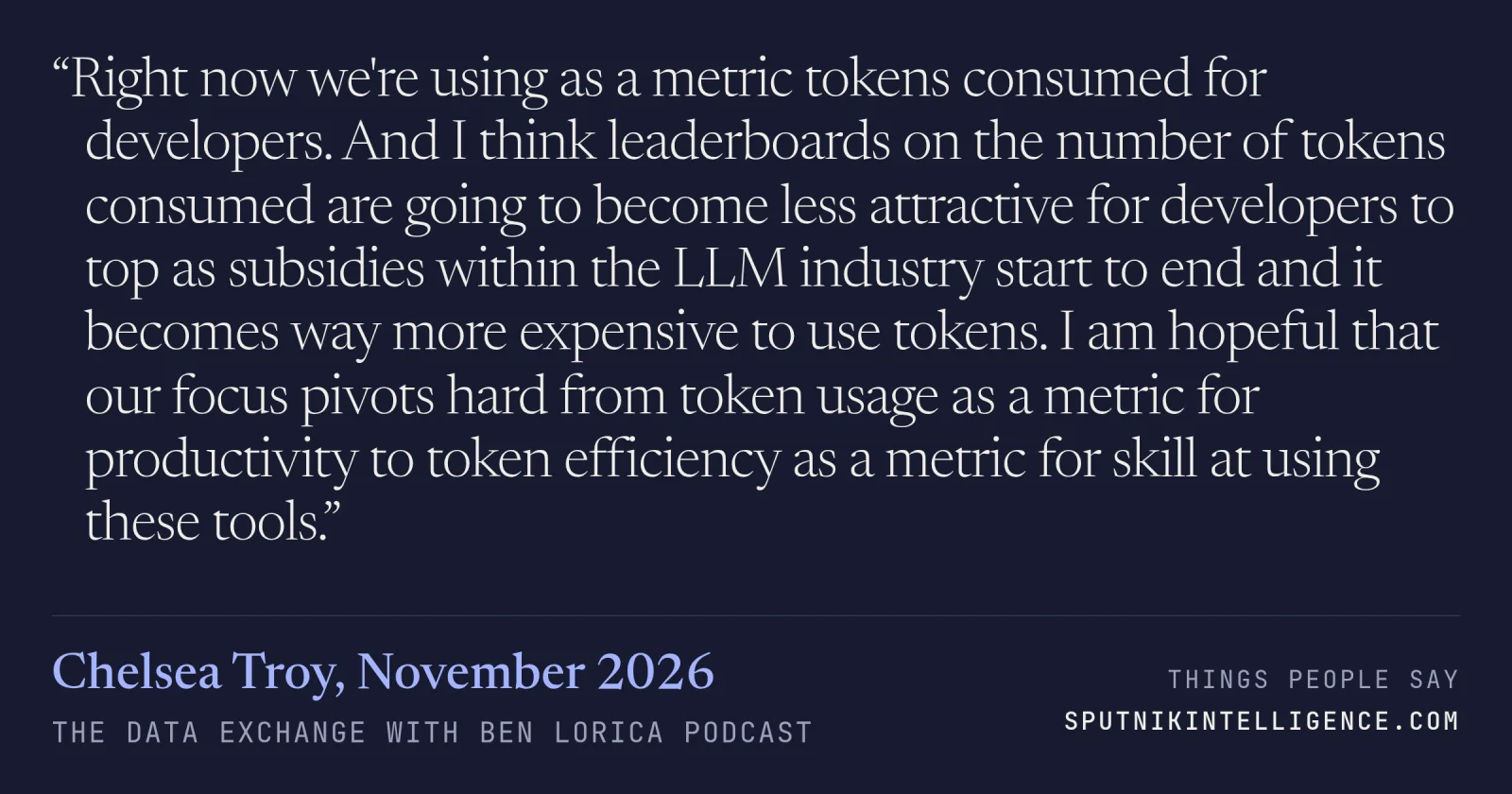
“Right now we're using as a metric tokens consumed for developers. And I think leaderboards on the number of tokens consumed are going to become less attractive for developers to top as subsidies within the LLM industry start to end and it becomes way more expensive to use tokens. I am hopeful that our focus pivots hard from token usage as a metric for productivity to token efficiency as a metric for skill at using these tools.” — Chelsea Troy, The Data Exchange with Ben Lorica

Asked to predict how a developer's day will look in two years, with what she called giant error bars. She expects the way companies measure AI coding use to change once AI usage stops being subsidized.

The Data Exchange with Ben Lorica · 2026-11-25 Permalink → Listen →
The Data Exchange with Ben Lorica Around 37:32 into the episode
Chelsea Troy

…down in 1985 because largely programmers did not have general access to the internet in 1985. And so I think that dependence on these tools will increase. We're already seeing folks when the tools go down say they can't get their jobs done, et cetera, et cetera. I think that kind of thing will be

Ben Lorica

or if they're on the flight and the Wi-Fi is spotty, right?

Chelsea Troy

Well, right. There's this sort of like, yeah, I think that there will be adjudication around the dependence on these tools that is acceptable for developers to have and also acceptable for developers to communicate. At the two-year mark, you know what? I will tell you, at the two-year mark, here is what I think hope will happen. Giant error bars around this. Right now, we're using as a metric tokens consumed for developers. And I think that the number of tokens consumed and leaderboards on the number of tokens consumed are going to become less attractive for developers to top as subsidies within sort of the LLM industry start to end and it becomes way more expensive to use tokens. I am hopeful, in fact, that our focus pivots hard from token usage as a metric for productivity to token efficiency as a metric for skill at using these tools. I'm hopeful that that will happen. I am also hopeful that at the two-year mark, we start to see folks, hopefully, are well on our way to seeing folks focus on using these tools in some of the ways that you and I have talked about earlier in this conversation, not just as a way to get through tickets faster, but as a way to arrive at each ticket and an end that is much more…

Ben Lorica

And with that, thank you, Chelsea. You can follow the work of Chelsea Troy online at mozilla.org. Please join the thousands of people who subscribe to our newsletter, which you can find at gradentflow.com. Thanks for joining us. If you like the show, please subscribe and rate us through Apple…

Speaker names come from our own diarization. The position is estimated from where the line sits in the episode.

Collections They Appear In