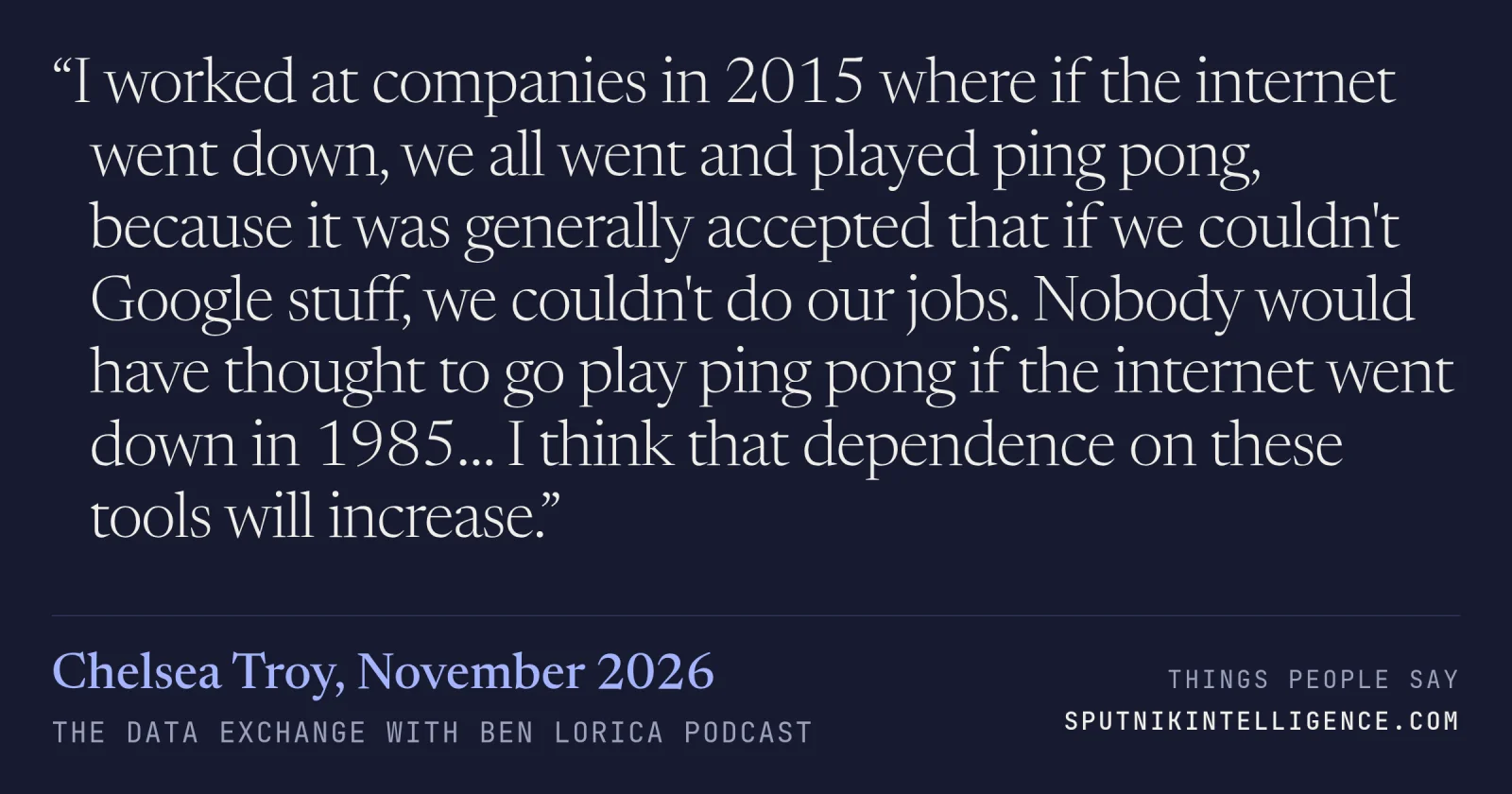
“Some companies still put you on a video call and ask you to write down Dijkstra's in 40 minutes. Theoretically it's a critical thinking challenge. Ultimately that interview is a validation that you have already been taught Dijkstra's algorithm, because Dijkstra did not come up with Dijkstra's in 40 minutes.”
The Data Exchange with Ben Lorica · AI Research & Frontier Labs · November 2026
Context
Asked how hiring interviews change when AI can write the code. She argues the classic algorithm interview was always a memorization test, and that AI may push interviews toward judging decision-making instead.
Transcript
…a really useful case study for how you might work on such a massively impactful programming project yourself in the future, whether or not it's in Python, because Python provides us with sort of like a gold standard for how a complex project with a large user base might be maintained over time.
…I've worked with startups where they even encourage some of the candidates to spend a day or two days at the company. And here, here, maybe you can try out this little project. And then at the end of the day, we can discuss it. So, what is the change, Chelsea, in terms of the interview process?
Yeah. So, it's an interesting question because I think that interview processes in programming have in some ways codified a difference between how we evaluate developers and how eval and how developers provide value to an organization for a pretty long time. Hello Wayne has this really excellent series about the history of software engineering interviews and the fact that many of our most common interview questions, and this is before the advent of agentic coding, many of our most common interview questions are interview questions that we inherited over time from a period in which programmers had to do a lot more from scratch. So, for example, we would ask students or we would ask interview candidates rather to implement a linked list from scratch. And if you were to ask a programmer in 2005 why we asked them to implement a linked list from scratch, the reason that we would give is that we want to evaluate their critical thinking capability and their architectural design capability and all of these things. But that's actually a retcon answer as to why we would ask that interview question.…
So have you noticed, Chelsea, among your students who are on the job market, right? So this year on the job market compared to on the job market last year, has it been more challenging to get this first or this entry-level or first job for these students year to year?
I think that it is really challenging right now. I don't envy students who are trying to go into industry at the moment. And I think that actually is LLMs play a part in that. I think the biggest part that LLMs play in that is that companies are experiencing a lot of turmoil figuring out, first of…
Yeah. Yeah. So the other thing that it seems like Chelsea companies are doing, so there's the notion of maybe we should slow down hiring entry level. That's one of the mistakes they're making. The other thing that seems to be fashionable these days is, hey, we don't actually, we should have all…
More from The Data Exchange with Ben Lorica