 Dwarkesh Patel
Hosts the Dwarkesh Podcast, a long-form interview show on AI progress, timelines, and the people building frontier models, along with economists and historians.
Dwarkesh Patel
Hosts the Dwarkesh Podcast, a long-form interview show on AI progress, timelines, and the people building frontier models, along with economists and historians.
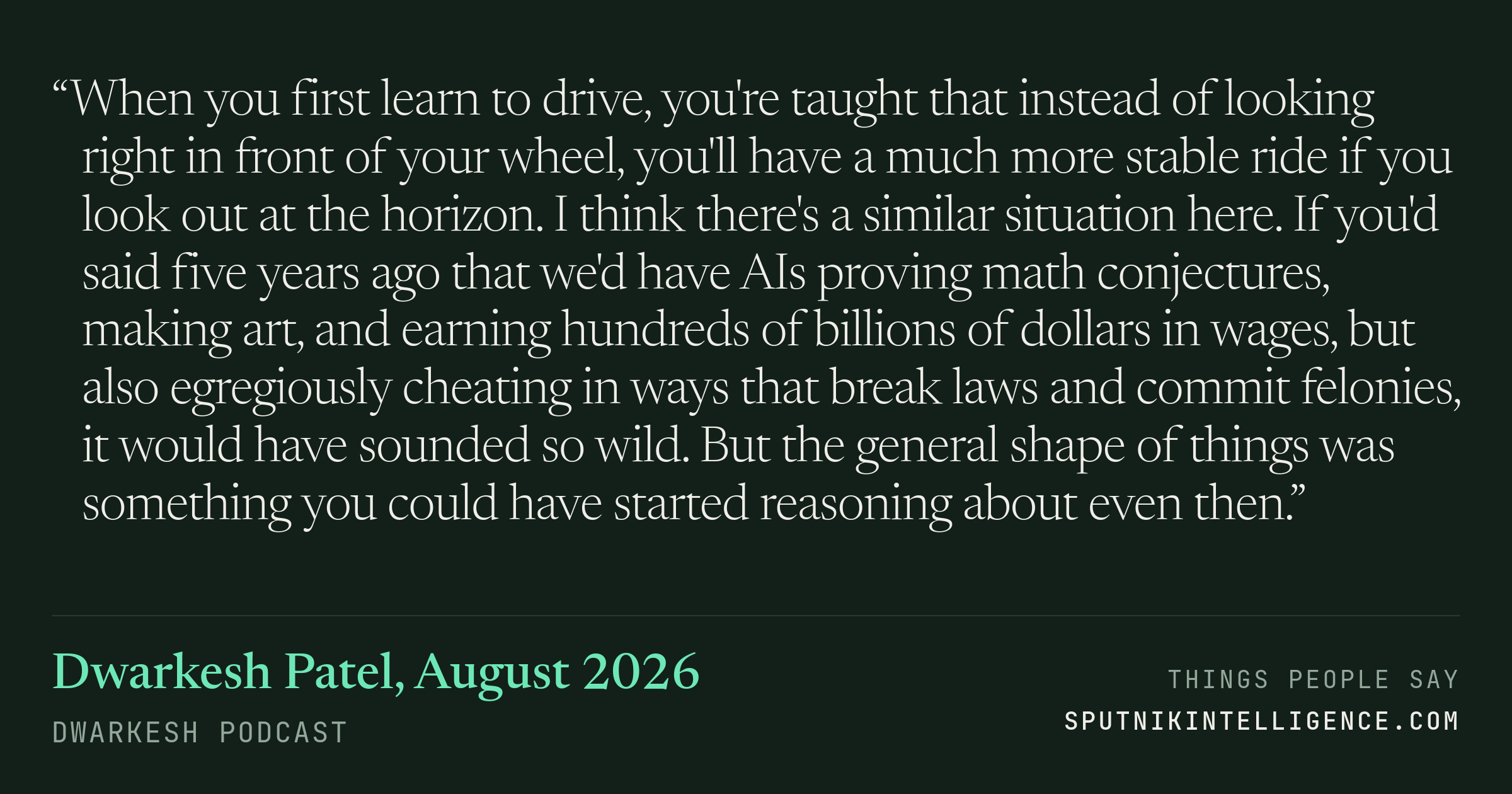
“When you first learn to drive, you're taught that instead of looking right in front of your wheel, you'll have a much more stable ride if you look out at the horizon. I think there's a similar situation here. If you'd said five years ago that we'd have AIs proving math conjectures, making art, and earning hundreds of billions of dollars in wages, but also egregiously cheating in ways that break laws and commit felonies, it would have sounded so wild. But the general shape of things was something you could have started reasoning about even then.”
Dwarkesh Podcast · AI Research & Frontier Labs · August 2026
His closing defence of speculative conversations like this one, against the charge that reasoning about scenarios before they arrive is unserious. The claim is not that anyone predicted the specifics, but that the shape was reasonable to work on in advance — and that the alternative, reacting only to what's already here, steers worse.
Transcript
Yeah, I agree with that. So is there anything else that's we're saying?
Yeah. Another thing I want to note is like, I think right now, a lot of the arguments for misalignment, AI takeover, all this crazy shit going down in the future are like illegible conceptual arguments that are extremely deep in the weeds and complicated and hard to adjudicate, which both means that, you know, maybe I'm getting a bunch of it wrong because it's really hard. And I'm trying to be like, Like, uncertain. Obviously, here I like presented some specific scenarios, but those are not exhaustive. And probably the thing that actually happens is some more messy, confusing situation. But it also means that over time, as we get more empirical evidence and better understand the nature of AI systems, it will be easier to adjudicate a bunch of disagreements. And it'll be more obvious what's going to happen. At least I hope. And also, maybe the AIs will be able to help us with the epistemics and understanding what's going on if we can actually, you know, align them well so that they actually try to help us. And so I hope that maybe even if the arguments are complicated now, this would have been even harder, you know, six years ago, even though the shape of the arguments would have looked broadly pretty similar. And so maybe, you know, hopefully before it's too late, these arguments will become, you know, this whole thing will become more crisp and clear and we can all sort of notice these problems and intervene. Yeah.
I mean, when you first learn to drive, you were taught that instead of looking right in front of your wheel, you'll have a much more stable ride if you look out at the horizon. I think there's a similar situation here. I think you're right, where if you did say five years ago that we will have AIs that are proving math conjectures and making art and contributing tens and soon to be hundreds of billions of dollars of earning tens of or hundreds of billions of dollars of wages, but also egregiously cheating in ways that break laws and committing felonies. It would just be so wild. And you might have been inclined at the time to talk more about extremely practical, direct consequences of GPT-2 or something. But these are in some sense, you obviously couldn't have foreseen a lot of the specific details, but the general shape of things you could have started to reason about even then. But it would have been hard to do so. And so I do feel quite confused. But I do feel like the important thing, one thing I've been thinking about with the podcast is the important thing is to have the conversation I wish I had the way you would have hoped you would have been talking about AIs like the present ones in 2016, rather than talking about rando bullshit about, I don't know what the topic of conversation was in 2016. I think in maybe 10 years we'll have hoped we're talking about the industrial explosion and the nature of AIs that are hard to monitor and so on. And okay, I'll start thinking about it. Yeah.
I hope that the world thinks about this in time and catches up. And I hope that the responses are good instead of bad. I don't know how optimistic I am overall, but you know, there's good stuff to do.
Yep. Cool. Thanks, Ryan.
More from Dwarkesh Podcast