 Scott Duke Kominers
Sarofim-Rock Professor of Business Administration at Harvard Business School and a research partner at a16z Frontier, working on market design, marketplace and...
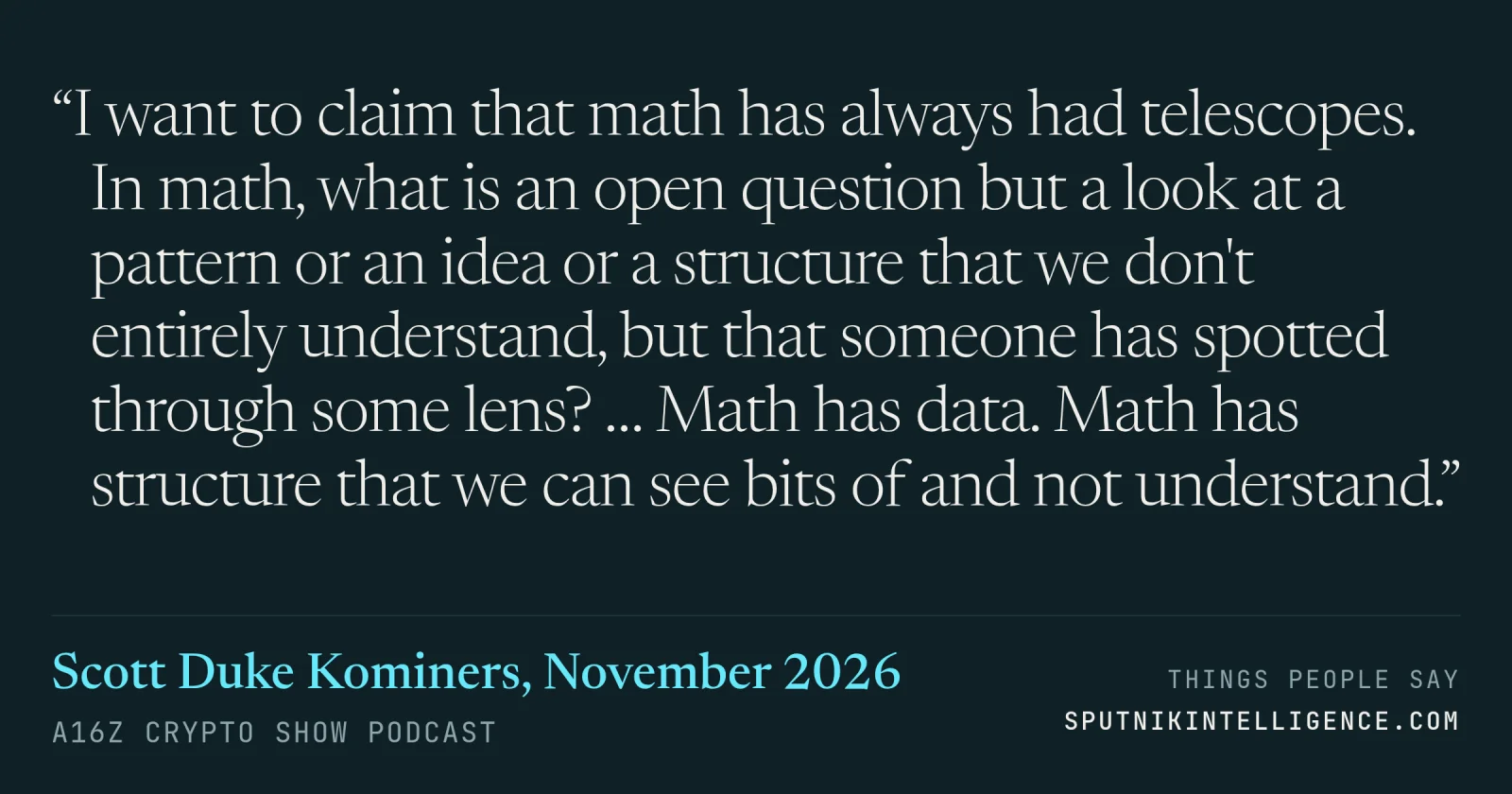
“I want to claim that math has always had telescopes. In math, what is an open question but a look at a pattern or an idea or a structure that we don't entirely understand, but that someone has spotted through some lens? … Math has data. Math has structure that we can see bits of and not understand.”
a16z crypto show · Crypto & Web3 · November 2026
Context
This is Scott's reply to a co-guest's worry about a billion-page AI proof of P versus NP that no human could read. He argues that mathematicians already study objects they cannot fully explain, so a huge machine-made proof would give more to study rather than end the field.
Transcript
proofs they have produced,
we can quite easily understand. But what happens when we move beyond that and the proofs are just too long? Okay, let me
make a controversial claim. So I want to claim that math has always had telescopes, right? That like, you know, in math, what is an open question but a sort of look at a pattern or an idea or a structure that we don't entirely understand, but that someone has spotted through some lens, right? And so, Dan, to your example of the like billion page, you know, P not equals N P proof, like that feels to me very similar to the idea of, you know, here we have this quadratic form where we think we know exactly which integers it represents and we don't know how to explain why, right? Like that's, you know, kind of the same, except in one of them, you have, you could generate sort of, you have oracle access to generating new information about it. And the other, you know, at some, you know, some fidelity. And the other you have oracle access to opening a page. You know, I can open page 700,321,416. Just made that number up. It's not like, I don't know, a password or whatever. No seed phrases hidden in this podcast. To me, like those are, you know, that's very much what math is, right? Like…
a really good vision in some sense. Do you expect P versus N P to be solved in this fashion? We're kind of stuck a little bit. We kind of don't even have an approach to proving it. So it's going to definitely, it's very likely going to be quite a complicated proof. But actually, Scott's vision, I…
It's worth mentioning briefly, right? We actually know like formal barriers to proving P does not equal NP, assuming that's the way the answer goes. Maybe I should hesitate to say most of us believe now because some people seem to have flipped their views. But anyway, I
don't know for sure, but I think everyone in this call shares the same prior.
More from a16z crypto show