 Dwarkesh Patel
Hosts the Dwarkesh Podcast, a long-form interview show on AI progress, timelines, and the people building frontier models, along with economists and historians.
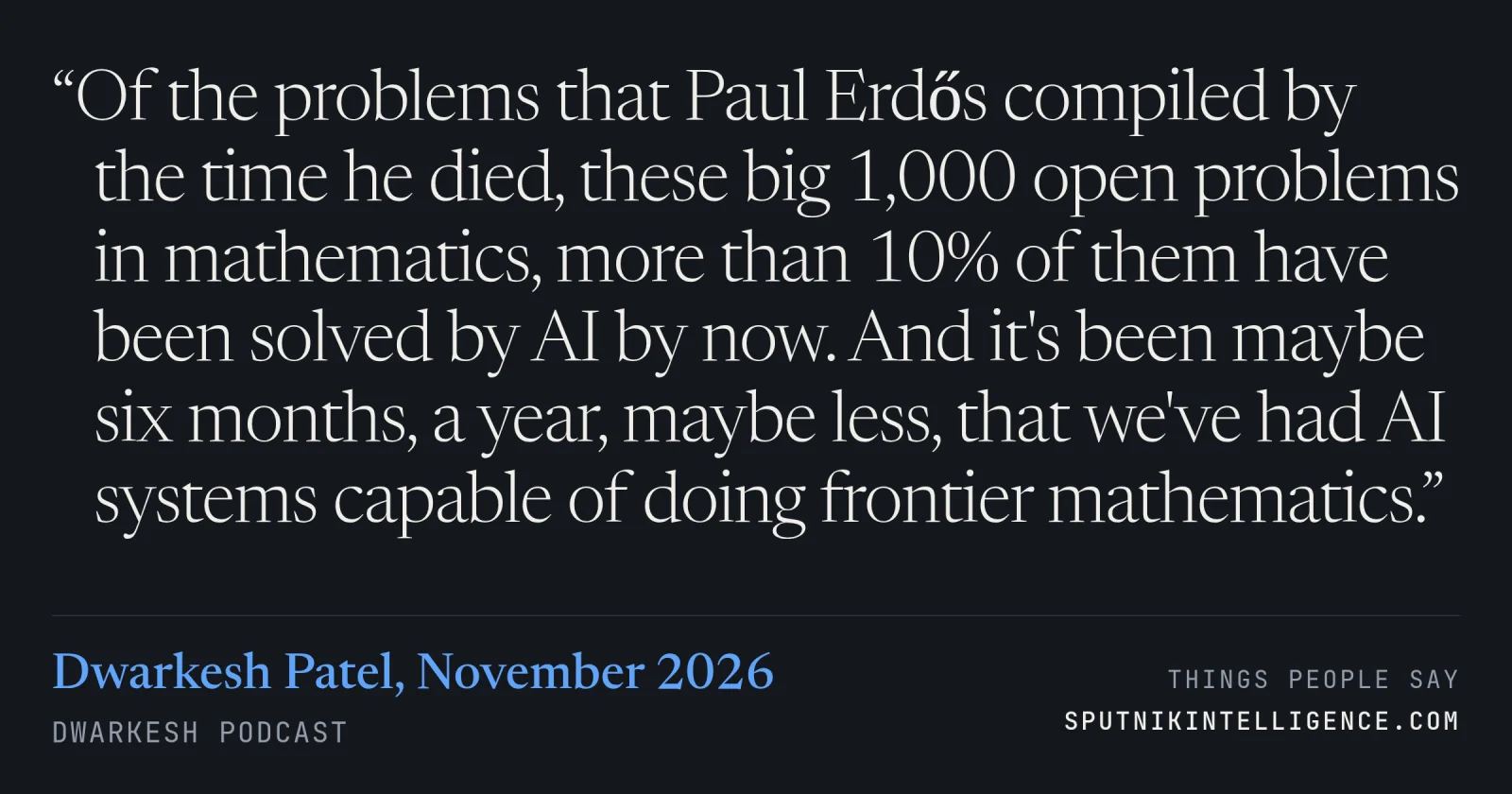
“Of the problems that Paul Erdős compiled by the time he died, these big 1,000 open problems in mathematics, more than 10% of them have been solved by AI by now. And it's been maybe six months, a year, maybe less, that we've had AI systems capable of doing frontier mathematics.”
Dwarkesh Podcast · AI Research & Frontier Labs · November 2026
Context
A critic compared continual learning to an unsolved Millennium Prize problem whose solution can't be timed. Dwarkesh answers with AI's recent run in mathematics, in a week when an AI-assisted proof of the Riemann hypothesis was in the news.
Transcript
…that means. We just have to use intuitions about what that could mean based on what happened in history, what happened with evolution. And the other alternative is just to not face the possibility that progress in this arena is going to continue and is going to have big implications for the world.
…has already shown us what happens to such problems. End quote. Then his response is: sure, but there's a difference between AI can solve a millennium level problem and AI can solve this specific millennium level problem. If the blocker is a specific problem, the timing spread becomes much wider.
Yep, that makes sense. And in fact, that's why I'm not saying AIs can solve millennium price problems, therefore our sample efficiency will be solved tomorrow. Now, that being said, let me explain why I think it's still a fair analogy. There's a couple points to it. I think it would be fair to say if I said, look, AI can solve protein folding and protein folding used to be hard. So why can't it make nano machines? It's like, well, it's like one particular problem that fits the kind of deep learning we're doing in 2020. That doesn't mean every single problem will get solved. But as I argue in my blog post, the particular kind of progress that AI is eliciting in mathematics and not Just in the Millennium Prize problem, that is just one example. There have been hundreds of open problems that have been solved. You know, of the problems that Paul Erdos compiled by the time he died of these big 1,000 open problems in mathematics, more than 10% of them have been solved by AI by now. And it's been, I don't know, six months, a year, maybe less that we've had AI systems…
So he's quoting you again: quote, the other big piece of evidence for transfer is human evolution, end quote. And then he says, except if AI was following the sort of pattern we saw for human evolution, we should have seen better transfer long before AI started solving Millennium problems. This…
I don't think it's the case that you can characterize current AIs as more spiky given their data distribution than humans are. Or humans are relative to the evolutionary environment. We are really bad at adding 10-digit numbers in our head because that is not something that evolution has…
Okay, so you mentioned scaling up RL even further. And I think that's a good segue to another one of Courserin's points. So here again is you quoted. Rather, my claim is that scaling up RL training will give AIs the abilities necessary to ramp quickly in new contexts. It'll go through an…
More from Dwarkesh Podcast