 Dwarkesh Patel
Hosts the Dwarkesh Podcast, a long-form interview show on AI progress, timelines, and the people building frontier models, along with economists and historians.
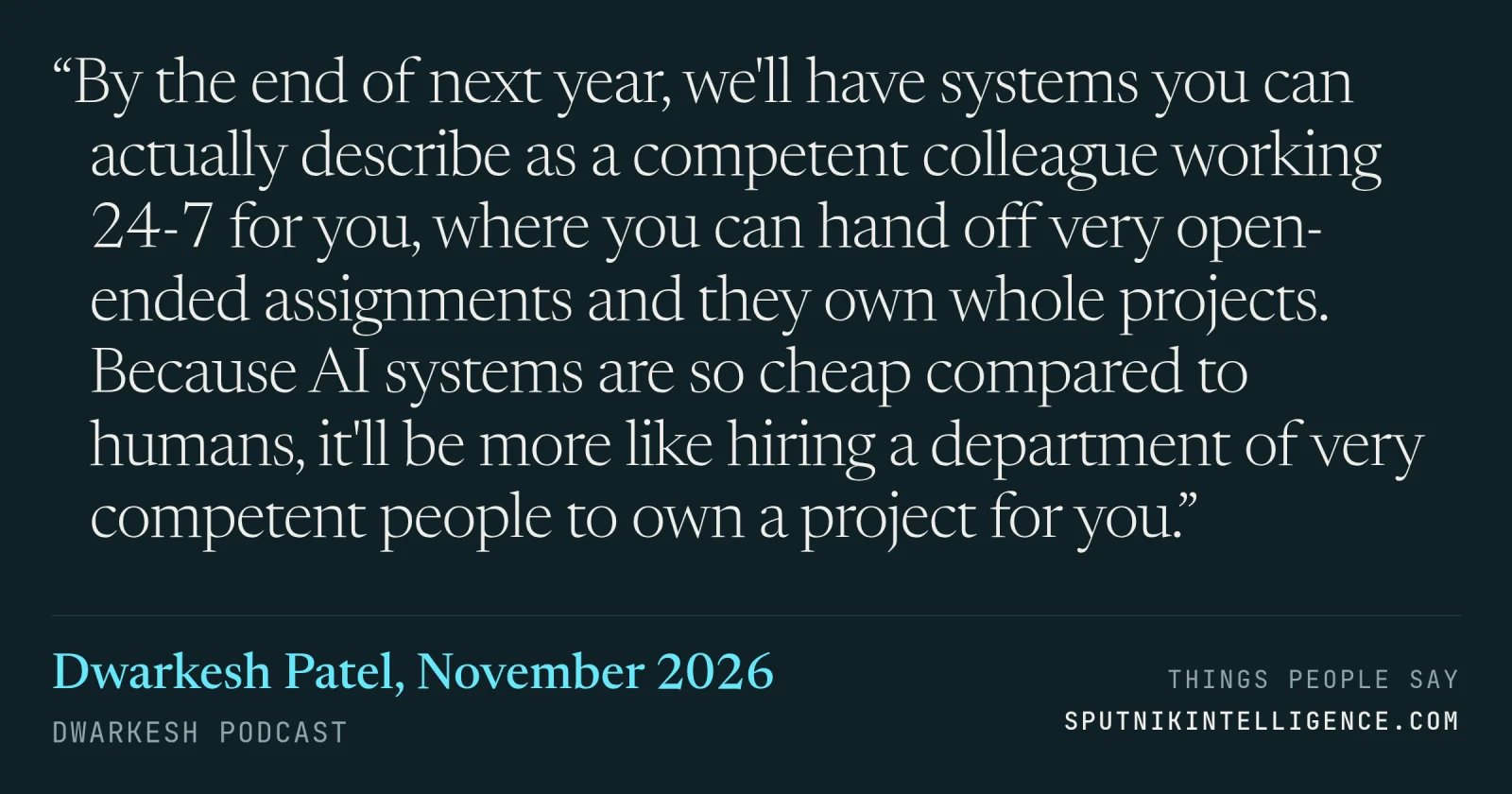
“By the end of next year, we'll have systems you can actually describe as a competent colleague working 24-7 for you, where you can hand off very open-ended assignments and they own whole projects. Because AI systems are so cheap compared to humans, it'll be more like hiring a department of very competent people to own a project for you.”
Dwarkesh Podcast · AI Research & Frontier Labs · November 2026
Context
Asked to describe what he actually expects in the next couple of years, as opposed to the extreme scenarios, Dwarkesh gives this near-term prediction. He separately puts a possible intelligence explosion around 2028 to 2029.
Transcript
…an experiment, the equivalent of a decade of thinking went into, okay, how exactly do I interpret what we got here? And let's really think about every single loss spike across this whole run. It would be very implausible if that firm would not be going any faster than the current version of OpenAI.
…do wonder if it is worth you re-articulating here what you think is most likely to happen over the next couple of years or what you wouldn't be surprised. You can phrase it however you want, but like, you know, you know, just paint a picture for me. Like, what do the next couple of years look like?
I think by the end of next year, we'll have systems that you actually can describe as a competent colleague who is 24-7 working for you. I think current personal assistant type things like Muse or Duet or DOT are very weak versions of what we will see over the next year, where it really does feel like there is somebody on Slack who's like, you can just like hand off assignments and very open-ended assignments, not just a specific well-scope task, but they are owning whole projects. And a key factor that is going to be different about this world than what it is like to hire a human now is that AI systems are so cheap in comparison to humans that you don't just go hire 100 people for a task or something and then go shed the entire team and then go hire five people for this other task. And so I think you should imagine that in the future, because AI systems are cheaper, it'll be more like hiring a department of very competent people to own a particular project for you. Maybe in more concrete terms, I would expect that the AIs by the end of next year will be worse than my human video editors. But I could like passively have…
Yeah, interesting. Just like AIs can already do a lot of things that humans can do now, but just sort of at like a very mediocre, passable level. But it's like, if you want to do it at a really high bar, if you have a high bar, you're still going to hire humans. That's sort of your argument. Like
some parts of software are like this today. Yeah. And I think that will happen for a wider range of knowledge work tasks. I don't think we'll see the intelligence explosion next year. I expect that will happen, you know, from 2028 to 2029, basically. And so we will see the publicly deployed systems…
Do you think if ML research is as far ahead of these other things as software engineering is ahead of other domains right now, we'll even know. Like there is more of a push towards keeping the top models unreleased and using them internally. Like there's a chance that the intelligence explosion is…
More from Dwarkesh Podcast