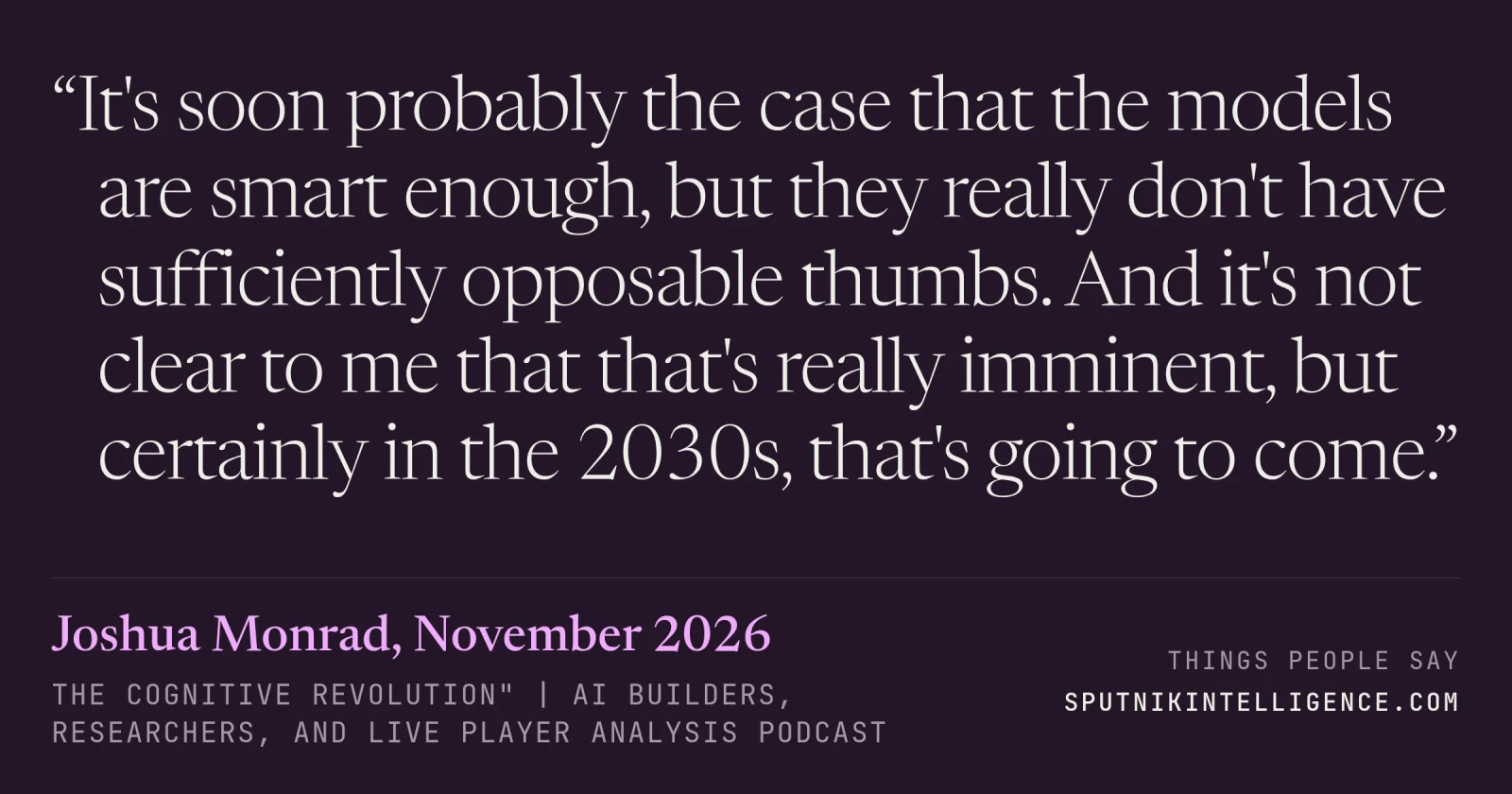
“It's soon probably the case that the models are smart enough, but they really don't have sufficiently opposable thumbs. And it's not clear to me that that's really imminent, but certainly in the 2030s, that's going to come.”
The Cognitive Revolution" | AI Builders, Researchers, and Live Player Analysis · AI Research & Frontier Labs · November 2026
Context
Monrad was laying out four phases of AI-related bio risk, ending with end-to-end attacks with no humans in the loop. In his view the near-term limit is robotics and lab hands, not model intelligence.
Transcript
what we mean by pretty far off. Yeah,
the nature of the exponential is kind of weird here, obviously. Maybe for starters, just give me kind of your broad survey of where are we in biosecurity as we are here end of October, beginning of November, 2026.
Yeah, look, I'm glad to be talking about this here. I think it's not always a case, but sometimes a case of something really fruitful comes out of a little Twitter beef. And you and I were sort of going back and forth on it. And so I'm, yeah, I'm really glad this conversation came out of that. And in terms of where we are on biorisks, I think we can think of it in maybe four phases. So there is, you know, there's a long historical record of people using biology as weapons without any kind of, you know, long before AI was even thought of. Then there is the idea of like humans might use AI to bioweaponeering ends. And so if I were to date that, I was sort of, that phase may be beginning in the sort of. Late 2010s, early 2020s is an idea where, okay, there's maybe something here. Maybe it's just a slightly more effective Google search, but there's something here that could provide some uplift. Then I think there's another phase, which would be AI is using humans. So that's a social engineering part that you…
Maybe just briefly, I'm interested in that phase one a little bit from the standpoint of how much of a risk is there that like people want to do bioattacks. Like this is, I think, something that people have very different intuitions around. You hear the sort of Kevin Esvelt math sometimes that's…
Yeah, yeah. Super dark history, to be honest. You know, there are probably three big groups that I would think about. So there are state actors. So this is your Soviet, US, Soviet bioweapons program. Also, the US had a very well-resourced bioweapons program well into the 20th century. And here, I…
Hey, we'll continue our interview in a moment after a word from our sponsors. Today's episode is brought to you by Anthropic, makers of Claude. To show off Claude's latest capabilities, I asked Claude to take the lead in making this ad. Given a short creative brief, Claude, using Opus 5.5, studied…
More from The Cognitive Revolution" | AI Builders, Researchers, and Live Player Analysis