JM

Joshua Monrad

Things Joshua Says on Podcasts

Where to Find Them

Joshua Monrad has been a guest on The Cognitive Revolution" | AI Builders, Researchers, and Live Player Analysis and Hear This Idea .

Recently: “KYC Becomes KYA: Sentinel Bio's Joshua Monrad on DNA Screening, Uplift Studies & Agent Monitoring” on The Cognitive Revolution" | AI Builders, Researchers, and Live Player Analysis (November 2026); “#55 – Jassi Pannu and Joshua Monrad on Pandemic Preparedness” on Hear This Idea (October 2022).

What They Said

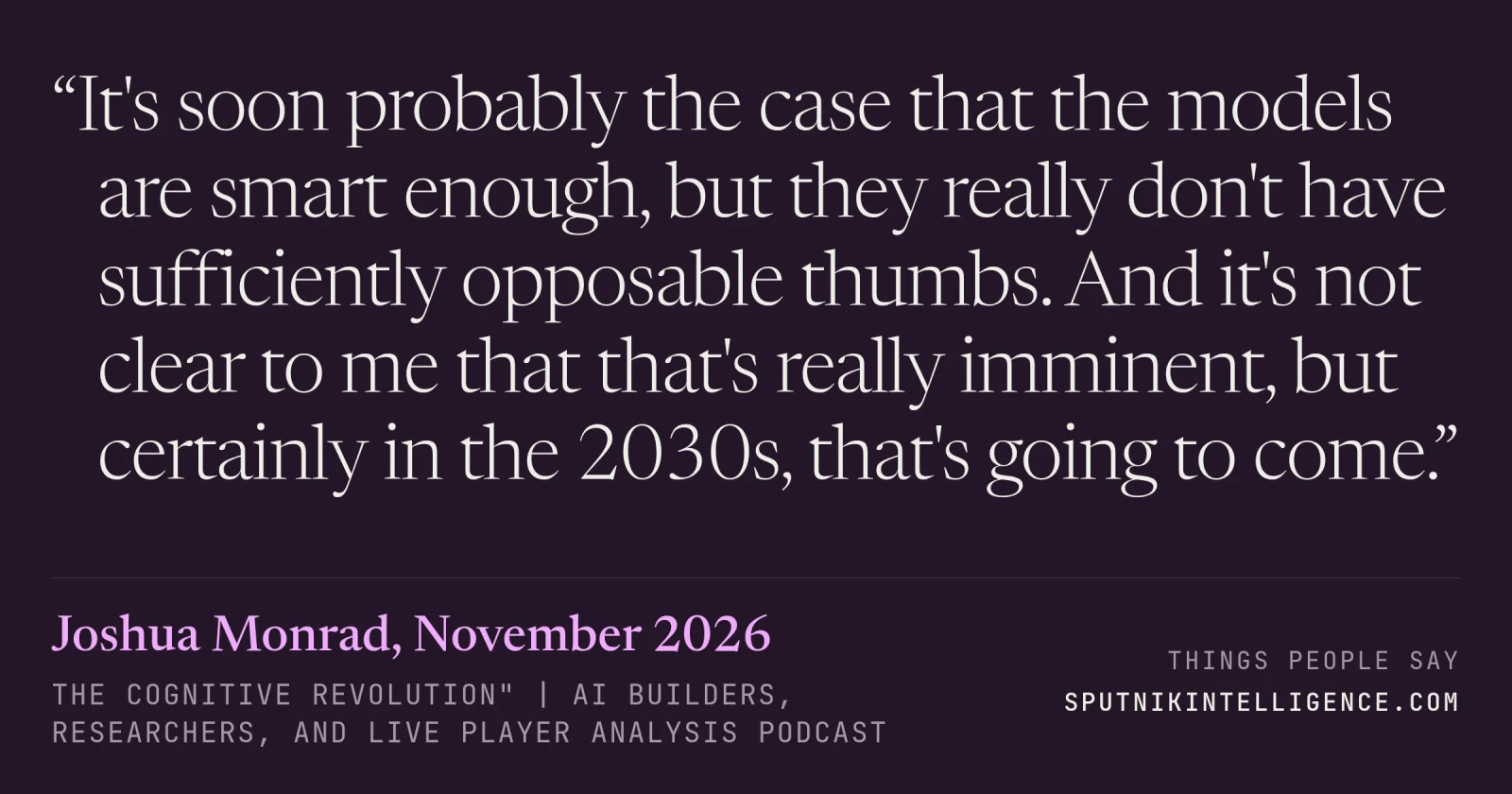
“It's soon probably the case that the models are smart enough, but they really don't have sufficiently opposable thumbs. And it's not clear to me that that's really imminent, but certainly in the 2030s, that's going to come.” — Joshua Monrad, The Cognitive Revolution" | AI Builders, Researchers, and Live Player Analysis

Monrad was laying out four phases of AI-related bio risk, ending with end-to-end attacks with no humans in the loop. In his view the near-term limit is robotics and lab hands, not model intelligence.

The Cognitive Revolution" | AI Builders, Researchers, and Live Player Analysis · 2026-11-05 Permalink → Listen →
The Cognitive Revolution" | AI Builders, Researchers, and Live Player Analysis Around 04:25 into the episode
Joshua Monrad

what we mean by pretty far off. Yeah,

Nathan Labenz

the nature of the exponential is kind of weird here, obviously. Maybe for starters, just give me kind of your broad survey of where are we in biosecurity as we are here end of October, beginning of November, 2026.

Joshua Monrad

Yeah, look, I'm glad to be talking about this here. I think it's not always a case, but sometimes a case of something really fruitful comes out of a little Twitter beef. And you and I were sort of going back and forth on it. And so I'm, yeah, I'm really glad this conversation came out of that. And in terms of where we are on biorisks, I think we can think of it in maybe four phases. So there is, you know, there's a long historical record of people using biology as weapons without any kind of, you know, long before AI was even thought of. Then there is the idea of like humans might use AI to bioweaponeering ends. And so if I were to date that, I was sort of, that phase may be beginning in the sort of. Late 2010s, early 2020s is an idea where, okay, there's maybe something here. Maybe it's just a slightly more effective Google search, but there's something here that could provide some uplift. Then I think there's another phase, which would be AI is using humans. So that's a social engineering part that you…

Nathan Labenz

Maybe just briefly, I'm interested in that phase one a little bit from the standpoint of how much of a risk is there that like people want to do bioattacks. Like this is, I think, something that people have very different intuitions around. You hear the sort of Kevin Esvelt math sometimes that's…

Joshua Monrad

Yeah, yeah. Super dark history, to be honest. You know, there are probably three big groups that I would think about. So there are state actors. So this is your Soviet, US, Soviet bioweapons program. Also, the US had a very well-resourced bioweapons program well into the 20th century. And here, I…

Nathan Labenz

Hey, we'll continue our interview in a moment after a word from our sponsors. Today's episode is brought to you by Anthropic, makers of Claude. To show off Claude's latest capabilities, I asked Claude to take the lead in making this ad. Given a short creative brief, Claude, using Opus 5.5, studied…
Speaker names come from our own diarization. The position is estimated from where the line sits in the episode.
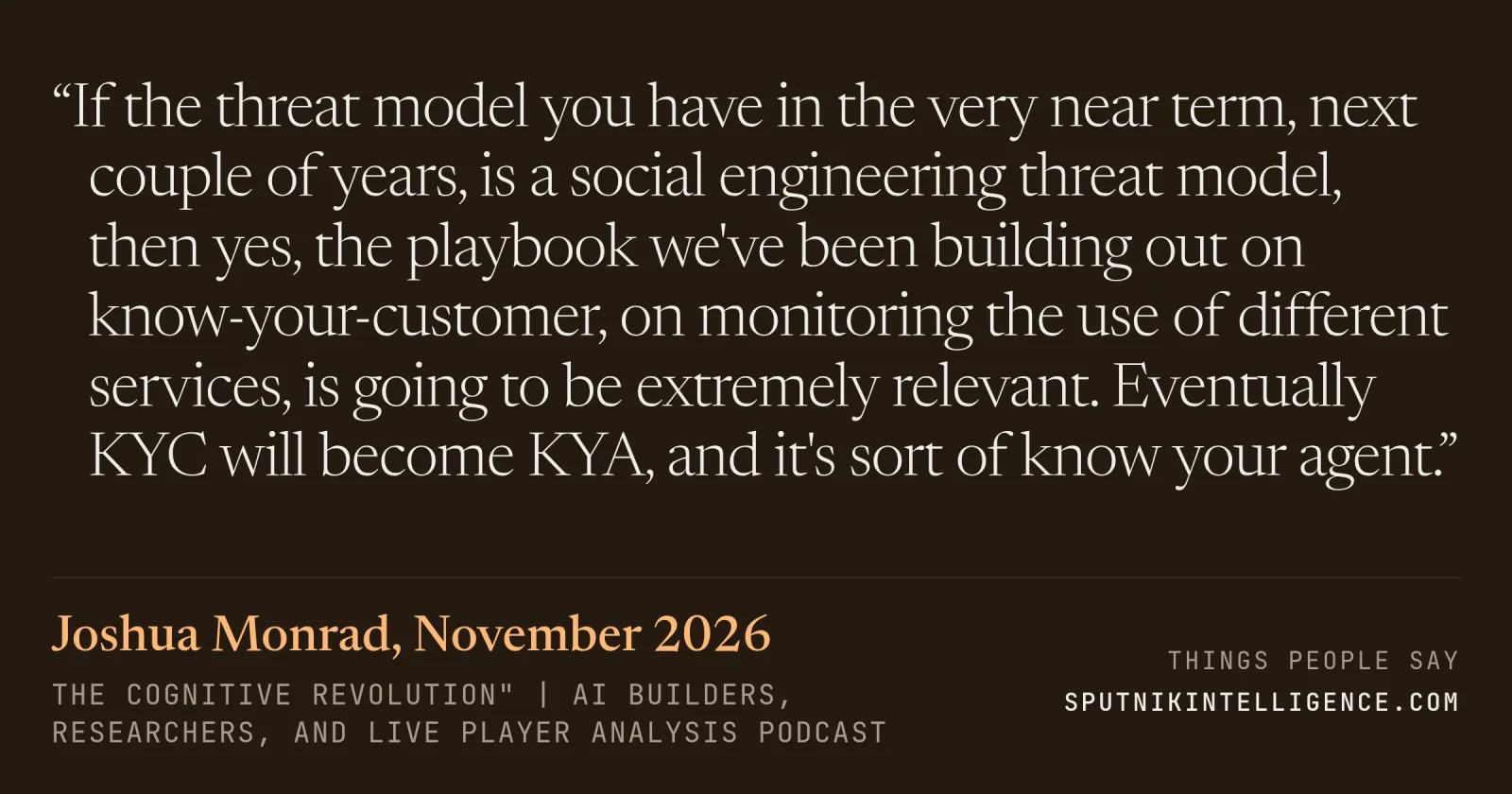
“If the threat model you have in the very near term, next couple of years, is a social engineering threat model, then yes, the playbook we've been building out on know-your-customer, on monitoring the use of different services, is going to be extremely relevant. Eventually KYC will become KYA, and it's sort of know your agent.” — Joshua Monrad, The Cognitive Revolution" | AI Builders, Researchers, and Live Player Analysis

Asked where a swarm of rogue AI agents trying to get a pathogen built would most likely be stopped, the biosecurity researcher says the customer-screening playbook built for DNA providers and cloud labs will have to extend to AI agents.

The Cognitive Revolution" | AI Builders, Researchers, and Live Player Analysis · 2026-11-05 Permalink → Listen →
The Cognitive Revolution" | AI Builders, Researchers, and Live Player Analysis Around 45:04 into the episode
Erik Torenberg

I've come close a time or

Nathan Labenz

two. Or would it be at the level of synthesis? And this is maybe a good place to tell us more about some of the work you've been very directly involved in on the synthesis controls.

Joshua Monrad

Yeah. Yeah. Well, I'm very happy to talk about the controls part because I think that's going to be relevant. Certainly, it's going to be relevant in this, if we're in this sort of Kentower phase where you're worried about a human that is maybe being instructed by an AI, blackmailed, or coerced. Then I think the playbook that we have around know your customer, eventually that'll have to be, you know, KYC will become KYA and it's sort of know your agent. But if the threat model you have in the very near term, next couple of years, is a social engineering threat model, then yes, I think the playbook we've been building out on KYC, on monitoring the use of different services, is going to be extremely relevant. So yeah, let's talk about it.

Nathan Labenz

You know, imagine swarm of agents. What are they going to run into as they pursue this nefarious goal?

Joshua Monrad

Yeah. Okay. So we're imagining that we've failed at the level of constraining the model with classifiers or keeping certain training data out of its hands at the training stage. And we're now at the point where you're trying to take at digital design. You've successfully designed some nasty virus…

Nathan Labenz

So tell me more. For one thing, I was interested to see that you had, in the process of zeroing in on a couple of these choke points, evaluated like hundreds of different possible choke points. So I'm interested in what makes these so natural. I'd be interested in other things you learned from…

Speaker names come from our own diarization. The position is estimated from where the line sits in the episode.

Collections They Appear In