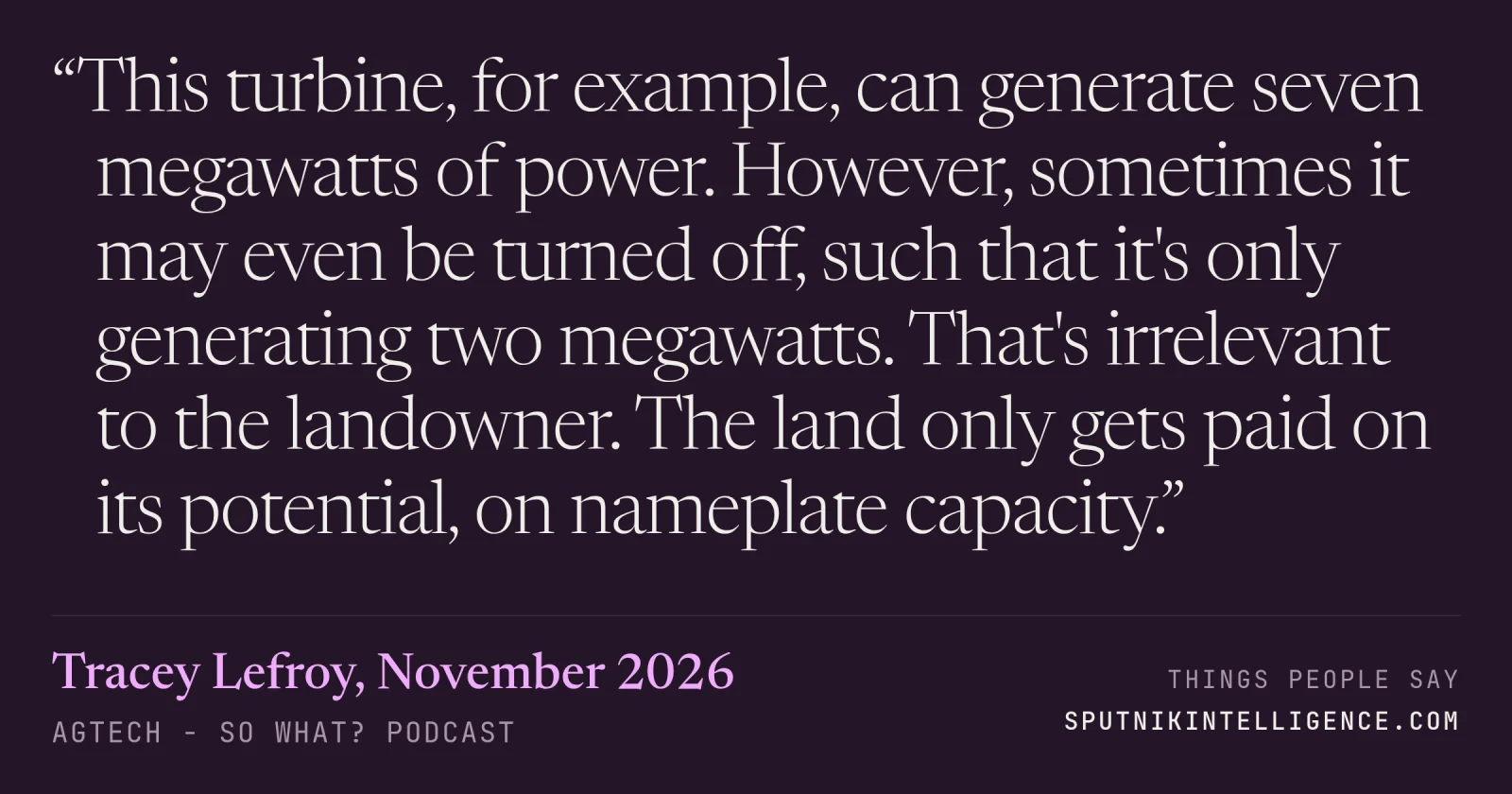
“This turbine, for example, can generate seven megawatts of power. However, sometimes it may even be turned off, such that it's only generating two megawatts. That's irrelevant to the landowner. The land only gets paid on its potential, on nameplate capacity.”
Agtech - So What? · Alternative Proteins · November 2026
Context
Walking through how host payments for wind turbines work, in dollars per megawatt per year, she explains nameplate capacity. The point is that landowners carry the footprint whether or not the company runs the asset.
Transcript
…that's the bit when you actually go, oh, this isn't as bad as I thought it was going to be. So you're normally looking at about 2% to 3% footprint of the total farm area and you are getting paid dollars per megawatt again. And that's always on nameplate capacity, not on generation of electricity.
For anyone not familiar. So nameplate
capacity is basically this turbine, for example, can generate seven megawatts of power. However, sometimes it may even be turned off such that it's only generating two megawatts of power. That's irrelevant to the landowner. Land only gets paid on what its potential. Interesting. You know, nameplate capacity is.
Presumably because the landowner isn't making that decision to turn it on or off, it's the company and you've still incurred the cost of having the project there.
Other things that get written into your contract, which are super important, are things like rate differentials. So if your farming land changes, and some local governments are choosing this, your farming land may get rated differently if you are a host of renewable energy. And it's really…
Yeah, it makes sense. That kind of community impact is one that I'm really interested in as well. That there's, you know, I've heard things like a big challenge has been when projects are going up in regional areas that the labor force actually do the installation. Like, is that taking away from…
More from Agtech - So What?