 Ben Thompson
Writes Stratechery, a subscription newsletter analyzing the business strategy behind tech and media companies, and has built a reputation for framing how platfo...
Ben Thompson
Writes Stratechery, a subscription newsletter analyzing the business strategy behind tech and media companies, and has built a reputation for framing how platfo...
“There's two things to understand about consumers that Silicon Valley has to relearn about every 10 years. Number one, consumers do not want to pay for software. And number two, consumers do not care about being productive.”
Invest Like the Best (Patrick O'Shaughnessy) · Money & Markets · August 2026
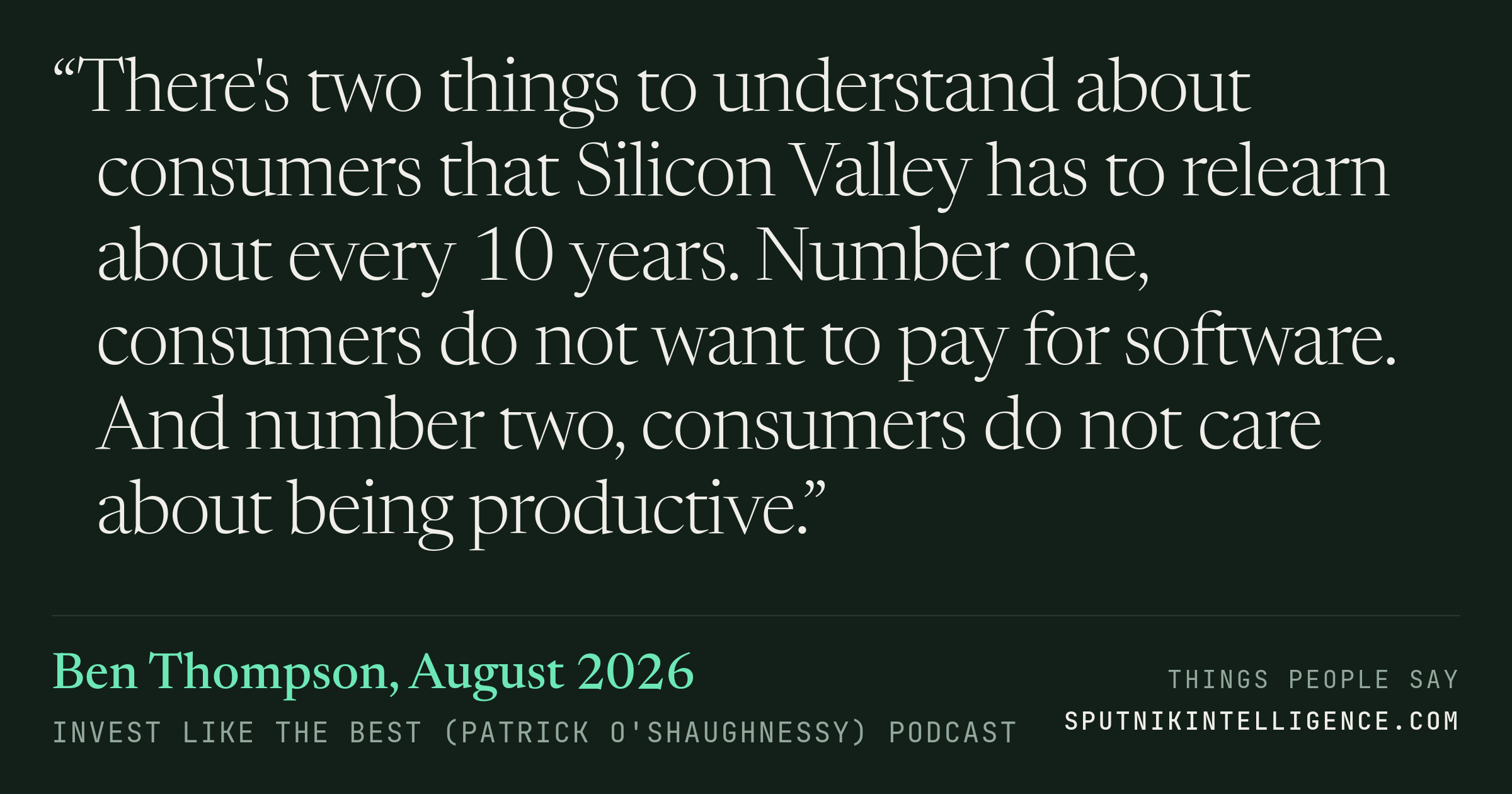
Ben Thompson is explaining why no one has cracked a business model for the low-cost, casual side of AI chatbot usage. He argues Silicon Valley keeps forgetting a basic truth about consumer behavior that free-to-use apps like ChatGPT are running into again.
Transcript
For sure. But you have this incredible spread. So you have people, I think the vast majority of people who are using ad today are using it as basically a Google substitute or like a recipe maker or whatever it might be. And my suspicion is that the cost to serve those people is extremely low and low in the basically similar to serving them a web page. I would imagine it's marginally higher, but not that much higher. Then you have on the other extreme, people who are actually leveraging test time scaling. It used to be we just scale by making the models bigger and bigger. Now you can scale as far as time. How long do you think about the answer? Well, you could think about the answer for days or weeks or months. That is directly marginal costs. Every second longer you're thinking is costing more money, which speaks to like we think about AI and inference as this one question. That's what I was pushing back on you. But actually the marginal cost question for the different user, the user using free Chat GPT and the user trying to solve a math theorem, they're not even remotely in the same universe. And I think you see this challenge actually in the enterprise in a very interesting way. Microsoft recently, they are shifting their enterprise plan. So they come out with like an E7 plan, $100 per user per month that includes some amount of usage, but then they also are charging for usage on top of that. I think this is kind of a fraught position for Microsoft to an extent, because the positive way to think about Microsoft is they do everything you need as a business. Every individual component might not be the best, but you get it all for one price and they all mostly work together. And if you're particularly a small or medium-sized business or even a large enterprise, there's real. That's right. It makes life easy. The moment you start having to think about how much you're paying, it's not just that that's a new decision, number one, that is untethered from headcount. Microsoft got the benefit is when you were hiring a new employee, you would think about the cost of that employee and baked in the cost of that employee is $100 a month or $50 a month for their license. It was kind of a thoughtless revenue stream for Microsoft. Now, if you think about usage, you have to think every single month, how much do I want to spend? That introduces two problems. Number one, most companies aren't set up to do this. They make budgets like once a year. This idea we're going to be thinking about through our budgetary allotment on like a monthly basis doesn't compute. There's an aspect where they're used to thinking about CapEx decisions or one-time costs. And there's a bit where when I'm talking about this employee, like the loaded cost of employee, it's not CapEx, but it's kind of like CapEx. It's like you make the decision up front and you don't think about it. Anymore. The decision is sort of already made. But if you're thinking about usage, you have to do it again. The final thing is, if you're every month looking at your Microsoft bill and how much did I use, you start thinking about what am I paying for? How good is each of these products? Should I actually just start thinking about and spraying this out? And I think they had to do it because that extreme of user who uses a ton of tokens and is actually leveraging AI costs way more to Microsoft than $100 a month. They can't support them, but they want to hold on to this set cost for the vast majority of employees who can fit in that because they need to ask their customers to think a little bit for those extreme employees, but they don't want them to think too much because that breaks the model in very surprising ways. Are you
surprised at all that the recipe builder user that is very low cost to serve, that there hasn't been a great business model that's emerged around them just yet? Google and Facebook are sort of business perfected in this prior era. They haven't seemed to figure this out at all.
I am frustrated, but not surprised. This is obviously a market that should be supported by advertising. That is why advertising is always the consumer business model. Consumers don't want to pay. There's two things to understand about consumers that Silicon Valley has to relearn about every 10 years. Number one, consumers do not want to pay for software. And number two, consumers do not care about being productive. We went through this in early SaaS. The canonical company for this in my mind is Dropbox. So Dropbox, unbelievable product, like especially when it first came out in business school, I was one of the first people to use Dropbox. And that went off like crazy. I have so much storage still, like my free Dropbox because I gave out my code to like so many people. So Drew Houston makes this amazing product so easy to use, just absolutely seamless. He was very clear about this. He wanted to build a consumer company. And there's that famous story of him meeting with Steve Jobs. Apple was interested in acquiring Dropbox and they're like, oh, we want to build a company and Steve's, you know, your feature, not a company, which that plain Jane just file sync. Apple did make a feature as far as like sort of iCloud Drive. And with Dropbox, they grew very fast. And then they had like a two-year lull. And in that two-year lull, what they had to do was basically completely rebuild the app from the bottoms up because not enough consumers are going to pay for it. Enterprises could see the value they would pay. But if you want enterprise, you need permissions. You need control. You need someone else to be able to set all these sorts of things. And their app wasn't even created to do that at all. So they had to rebuild the whole thing and realize the only way we're going to make money is by selling to companies. Why do companies pay? Because companies are paying employees to the extent they can make their employees more productive. They're getting a greater return on their investment. It's the complete inverse of a consumer. A consumer is like, I spent all day working. Why do I want to come home and be more productive? I want to sit on the couch and watch reels. But you see that with AI. And you also have this overarching just skepticism of advertising. I've gotten so much traction on Trotekery by being an advertising appreciator. And I go back and read my early articles about advertising that were kind of directionally correct, but also like were not very good at all. But I got so much traction doing it because I was the only person writing about advertising. In a world of everyone wanted to have a blog and Twitter, no one want to talk about advertising. But even now, there's in Silicon Valley this sort of embarrassment about the fact that the valley is in many respects monetized by advertising. And particularly during the last sort of eight years, there was a Facebook's icky. The
best engineers don't want to go work on this problem.
And so you literally had OpenAI replaying the Dropbox story, but at like 100 exercise, being like, no, we're going to sell subscriptions to consumers. They did. They sold a lot, but they didn't sell enough. If you're going to be in the consumer market, you have to be doing advertising. They're doing advertising now. It's a little weird. They finally pivoted to doing advertising at the same time. They're like, oh, crap, we need to go off the enterprise because Anthropic is kicking our end. So I'm not quite sure what they're doing there. They have been rolling out ad features very rapidly. Things like capy and the connections with retailers. So you know if a purchase went through, so you can do all the tracking and things like that. I'm very interested to see how that goes. There's a bit where had they leaned into advertising immediately as soon as Chat GPT was a hit, I think they would have a killer ad product right now. I think that Google would be in much bigger trouble. I think Meta would be in much bigger trouble because if you have this flywheel, the thing about advertising with consumers is your ability to monetize the consumer
goes up as the bottom line.
More from Invest Like the Best (Patrick O'Shaughnessy)