 Prakash Narayanan
Commentator on AI news with almost 20 years in investment banking and private equity, who took an optimist's view of the technology and co-hosts AI in the AM wi...
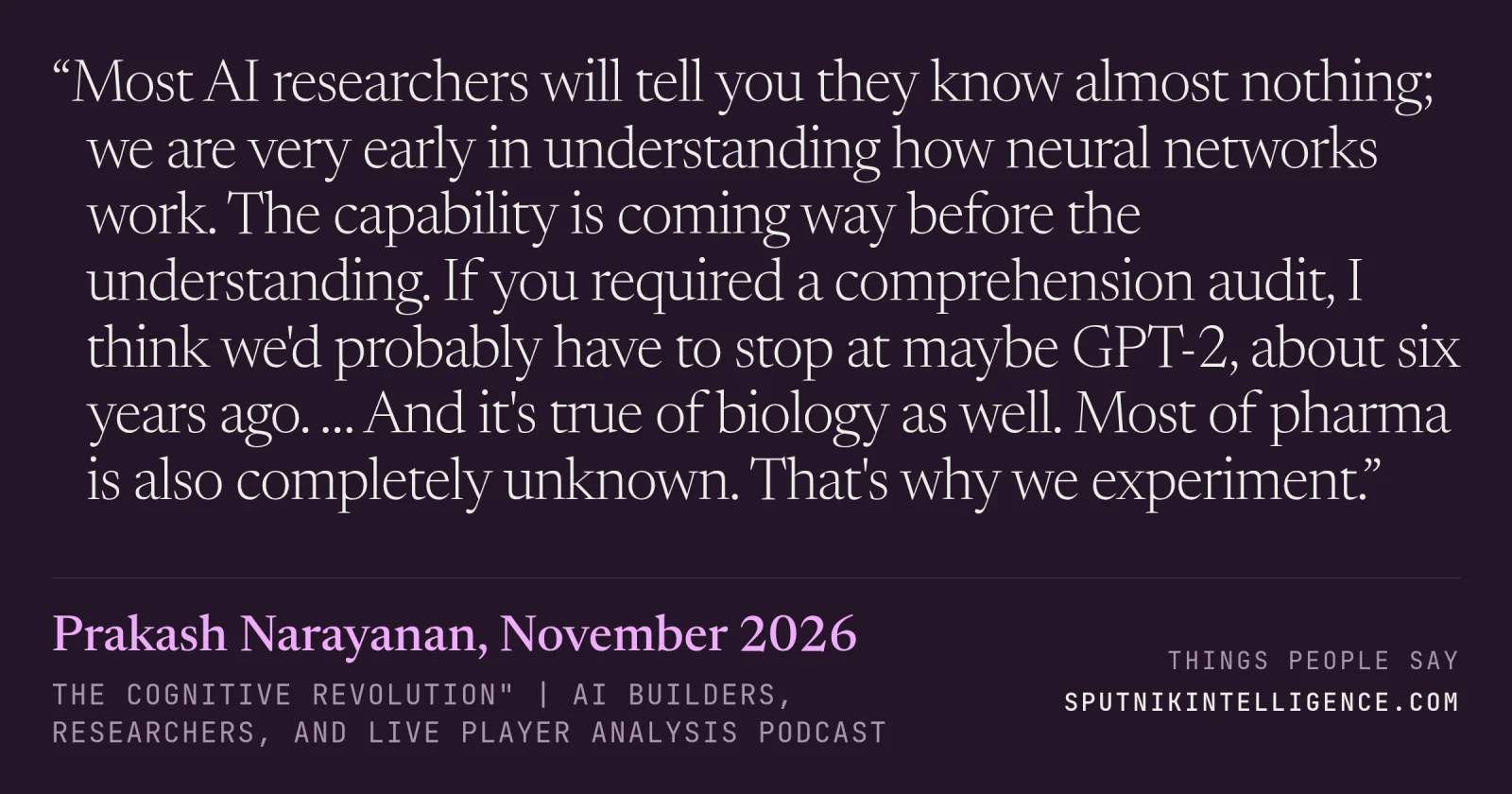
“Most AI researchers will tell you they know almost nothing; we are very early in understanding how neural networks work. The capability is coming way before the understanding. If you required a comprehension audit, I think we'd probably have to stop at maybe GPT-2, about six years ago. … And it's true of biology as well. Most of pharma is also completely unknown. That's why we experiment.”
The Cognitive Revolution" | AI Builders, Researchers, and Live Player Analysis · AI Research & Frontier Labs · November 2026
Context
A guest from the Institute for Law and AI had just described "comprehension audits", where a third party checks whether a lab understands its own AI research process. Prakash objects that by that standard AI would have been frozen years ago.
Transcript
Let's look at the, in October, I think you published a proposal where you would need humans to understand the AI generated research. And that would be kind of a marker to whether that progress could go forward. Could you explain that concept a little bit more?
…how much of a, you know, which of sort of like all the spiky vectors of capabilities, which have gotten better and which ones haven't? I think there's a lot more work to be done to actually instrumentalize this. I don't mean to sort of hand wave away the fact that this is a squishy category. Most
AI researchers will tell you they almost know nothing, that we are very early in like understanding how neural networks work. We have some very early like interpretability and other, very early in the design stage, very early in all of these things. And this is one of the concerns. One of the concerns is that the capability is coming way, way before the understanding. So I think if you required a comprehension audit, I think we'd have to probably start stop at maybe GPT2, probably like probably six years ago. That's about where we are right now, I think. That's about the size of the models that I think we are able to interpret with some degree of certainty. So I think one of the key confusions is how would the legal system deal with the fact that these guys have no idea what they're doing? And also, as some other people have pointed out, that is true of biology as well. Like most of pharma is also completely unknown. You kind of do the, that's why we experiment, because we are unable to design exactly. So we experiment and then we find out these things. And we experiment on humans too. We do human testing, right? So we do human phase one, phase two, phase three trials…
Yeah, that's and that generalizes beyond this field, right? Like, one of the marvels of modern sort of scientific knowledge is that oftentimes we can tell that a thing is true, but have no idea why. And so, you're totally right that if the standard was you need to have some like deep, all-knowing…
Prakash has his own account of why we write rules at all:
intelligence versus rules, right? In a perfect world, you don't need a lot of rules and laws because people just do the right thing, right? And people know intrinsically what the right thing is. The annoying thing is that you often cannot see the right thing because like you don't have this…
More from The Cognitive Revolution" | AI Builders, Researchers, and Live Player Analysis