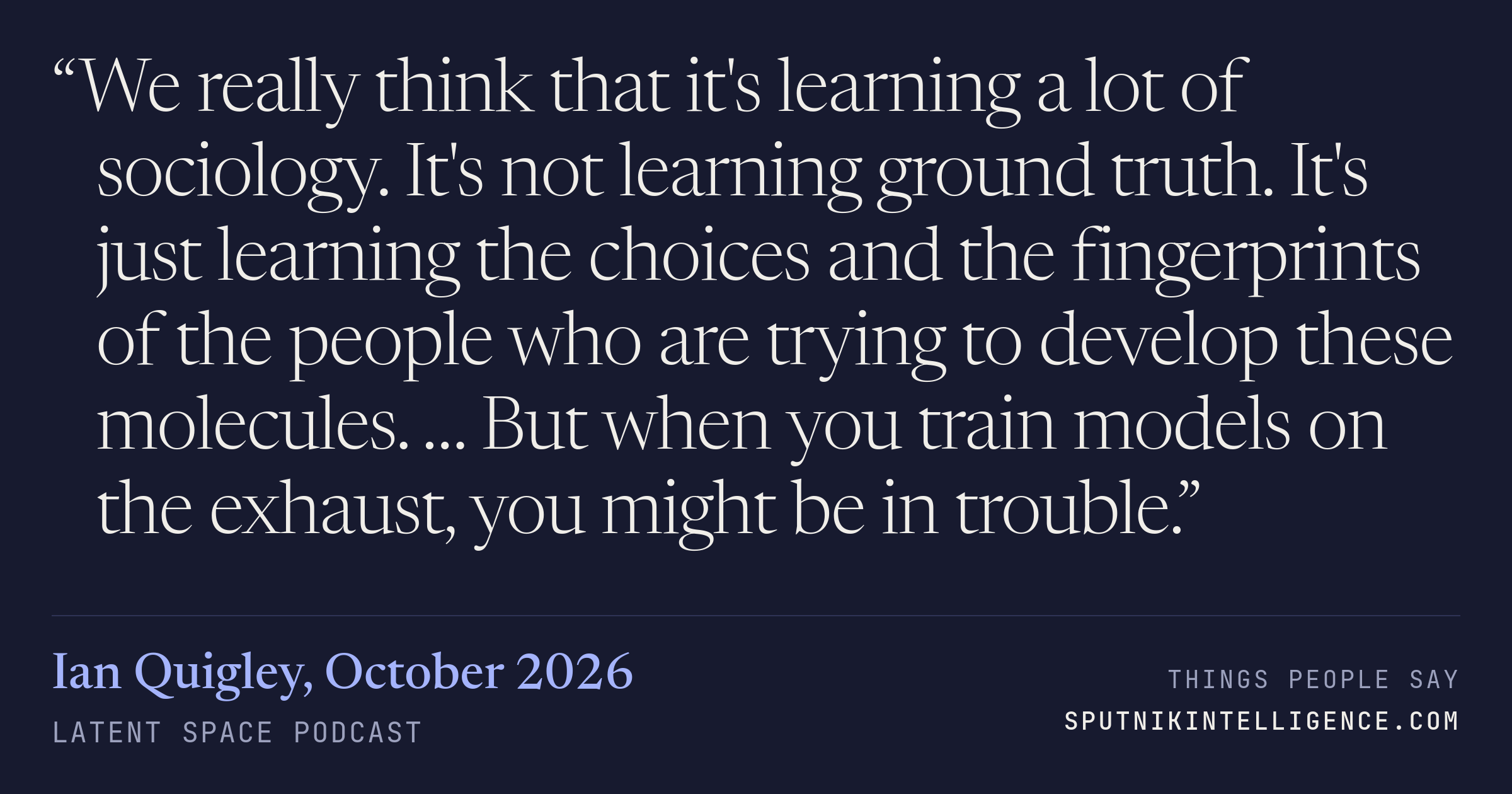
“I say proteins are the building blocks all the time, but actually, I don't believe in it. Proteins are extremely complex. They are disordered. Their shape might change depending on the context. … What we are trying to do is basically someone got a structure, deposited it in the PDB, and we are trying to replicate and get the same structure. That's what we did. And it just so happens that it's useful. But that does not mean that we have understood all of protein dynamics.”
Latent Space · AI Builders · October 2026
On a conference panel, the moderator noted that the news says protein structure prediction is solved while researchers say function, dynamics and design are wide open. Kohli, of Google DeepMind, describes what AlphaFold actually did in modest terms, and finishes by asking that funding for the field not be cut, because the work is just getting started.
Transcript
…and select what is the next batch of information that we actually need. It's more information than data. How do you get that next batch of information that the models need? But then also at every step of the way, at every scale, what is the right architectures then to get the most out of that data?
…Pushmi, what do you think, is there another big leap being made here? Are there blockers in solving these problems? Do we not have the right data yet? Do we not have the right algorithms or ideas? Or is this something that we can see evolving in the future? And it's just kind of a matter of time.
Yeah, I think science, how it sort of operates, is basically by isolating something and then making progress step by step. So when people sort of say the protein folding problem has been solved, at a conceptual level, yes, there might be sort of, yes, there have been some advances. But I think it's also like when you think about that narrative of proteins building, being the building blocks, proteins are not blocks and they're not sort of, they don't act as blocks, right? I say proteins are the building blocks all the time, but actually, like, I don't believe in it, right? Proteins are extremely complex. They are disordered. Their shape might change depending on the context. And like what AlphaFold Didn't, and in fact, like John Jumper and I basically used to sort of discuss this, like what are we trying to solve? We don't know what is the actual true ground state that proteins take and what is the actual distribution of structure that proteins take. What we are trying to do is basically someone got a structure, deposited it in the PDB, and we are trying to replicate and get the same structure. That's what we did, right? And it just so happens that it's useful. But that does not mean that we have understood all of protein dynamics. So I think at the top…
So what do you think the biggest blocker? If there's one thing you could wave a magic wand and say like we have more of blank that would accelerate one of those things, function, dynamics, or design, what would the magic wand be? What would you wave into existence?
Oh, I've basically been, so I'm a machine learning, my background is like quite eclectic. I started as a security researcher, then went into computer vision, Bayesian theory, and finally got into discriminative machine learning and deep learning and so on, and then AI for coding, and then finally…
But you believe that this is a route. This can give you. Yeah, I
More from Latent Space