 Ian Quigley
On Latent Space
“We really think that it's learning a lot of sociology. It's not learning ground truth. It's just learning the choices and the fingerprints of the people who are trying to develop these molecules. … But when you train models on the exhaust, you might be in trouble.”
Latent Space · AI Builders · October 2026
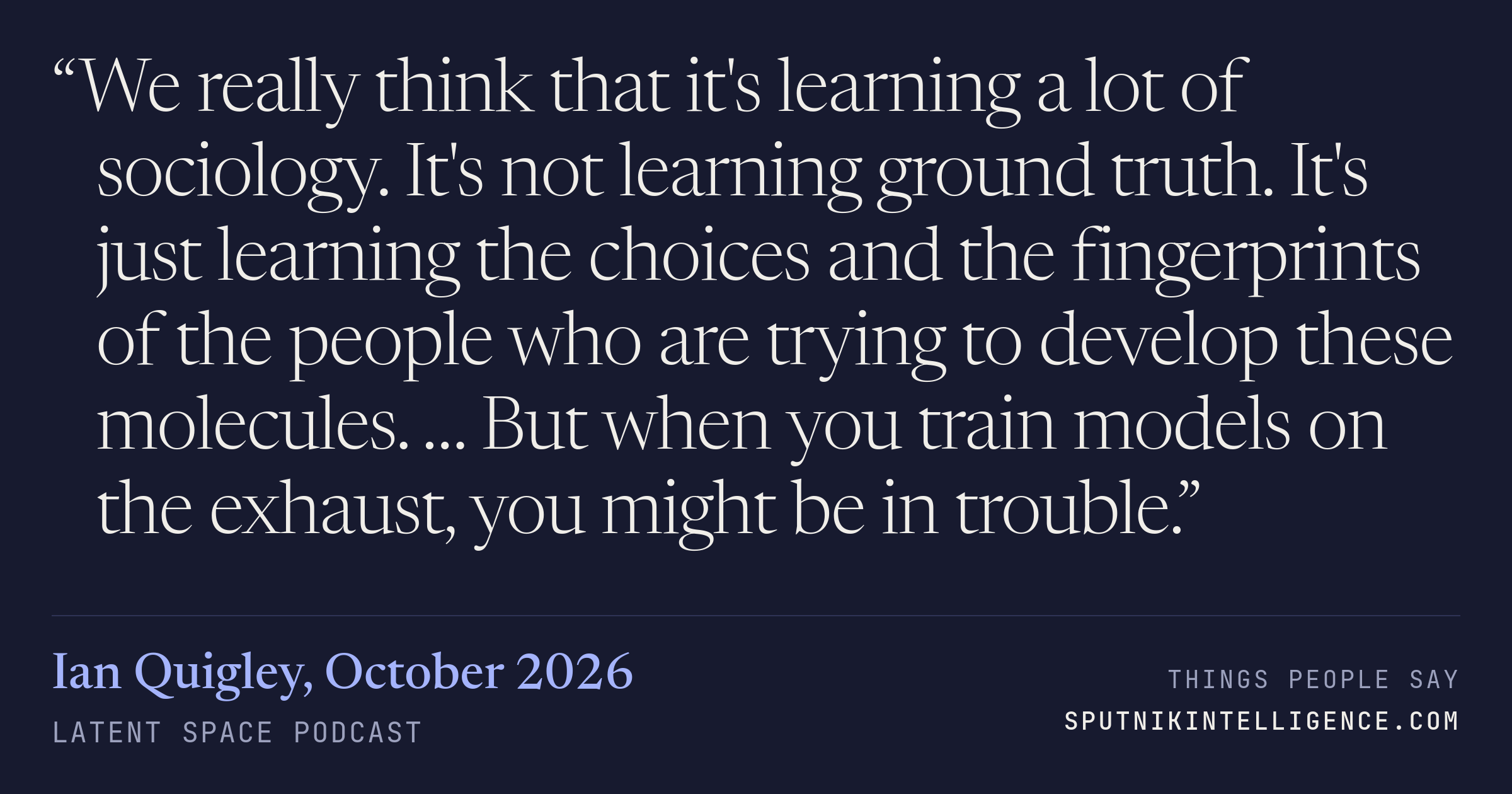
Quigley describes an experiment on public drug-discovery data. A model given only a guess at which chemist made each molecule predicted activity as well as one given the chemical structures. His conclusion is that models trained on this data learn chemists' habits rather than chemistry.
Transcript
yeah,
I bring this up like every single time. Medicine chemists are some of the most superstitious people I've ever met. Right. And so,
…of the probability of creator. So now it's this 1800 element, you know, vector, and it's got some probability of who made it. And you can use that representation and then train a model to predict activity from Kemble. And it does as well as if you use chemical formulas. And if you combine them, according to sociology only. Yes. If you combine them, it doesn't meaningfully better. And so, yeah, we really think that it's learning a lot of sociology. It's not learning ground truth. It's just learning the choices and the fingerprints of the people who are trying to develop these molecules. And it's not a knock on them, right? I mean, that's not what they're trying to do. They're trying to, you know, get to drugs by making the fewest number of chemical series possible. Of course, they're going to do it like that. But when you train models on the exhaust, you might be in trouble. So
this means that this is not a great machine learning training set.
We do not believe so. It's funny.
In my own life, I've had many of these similar lessons. It's well known that things like molecular weight will just, you know, all you have to do is sort by molecular weight. That's like one of the single biggest predictors you can possibly have. Like, wasn't it CAS 16 where it was CAS
More from Latent Space