 Jan Rosenow
Oxford Professor.
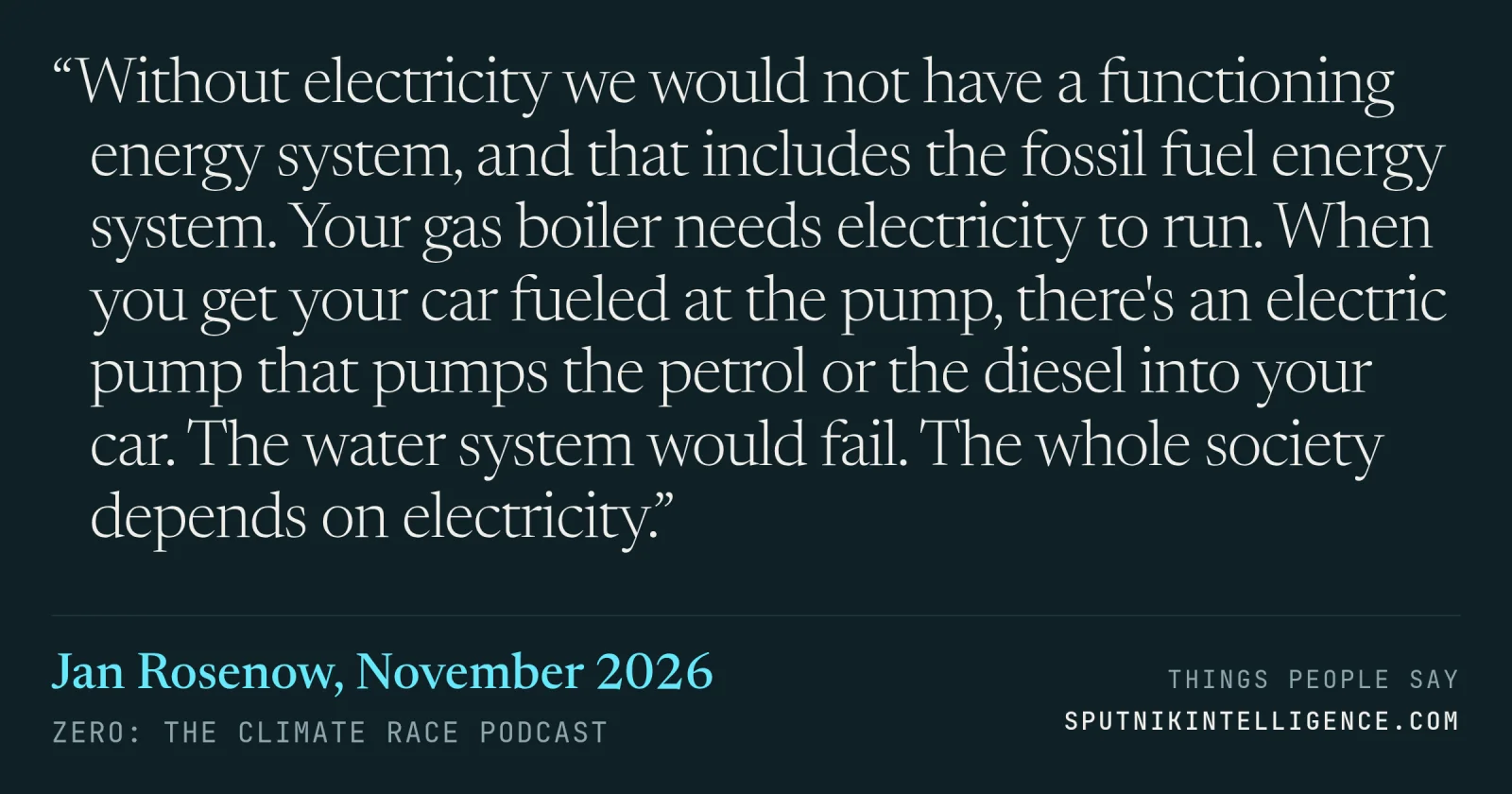
“Without electricity we would not have a functioning energy system, and that includes the fossil fuel energy system. Your gas boiler needs electricity to run. When you get your car fueled at the pump, there's an electric pump that pumps the petrol or the diesel into your car. The water system would fail. The whole society depends on electricity.”
Zero: The Climate Race · Climate & Energy · November 2026
Context
The host raised the argument that an electrified economy is more exposed to cyberattacks and blackouts. Rosenow says the current fossil system already depends on the grid, so the risk is not new, though he calls it serious and says it needs an honest discussion.
Transcript
…the network, connect people? Or is it perhaps to connect new devices to make sure we can go through this transition? And then the question becomes, how do we do that in the most cost-effective way that lowers cost for consumers and that gets us to where we need to get in the fastest possible way?
…digital network, so really open to cyber attacks. And of course, electricity is hard to store. Even if we have batteries, electric ones, or heat batteries, it's just not possible to store energy as we can in, say, an oil reserve or a gas reserve. How do you make an electrified system a secure one?
This is a great question. Let me perhaps comment briefly on the key competing goals of the transition, which have often been framed as the energy trilemma, where you have affordability. have reliability of supply and you have sustainability and I think increasingly those three goals are not in conflict necessarily and there are definitely sweet spots where you can deploy a technology find a solution that delivers simultaneously on all three having said that of course if we electrify we have to think about resilience and we have seen in Berlin for example I think it was last winter that after a deliberate attack on I think it was a substation in the south of Berlin there's been a blackout for extended periods of time and you know other things similar things may happen maybe cyber attacks what I would say though is that without electricity we would not have a functioning energy system that includes the fossil fuel energy system so when you think about your gas boiler that needs electricity to run when you think about getting your car fueled at the pump there's an electric pump that pumps up the the the petrol or the diesel into…
it's already true that the electric system is core to global economics to any country's economics more than any other type of fuel has been you know the oil shocks of the 1970s had a devastating effect on global economies while the oil shock of 2022 or 2026 hasn't quite had the same economic impact…
and there are also examples of cyber attacks or data breaches when it comes to fossil fuel infrastructure you know the examples of pipelines suddenly not working anymore and and and it's not just limited to the electricity sector um but i wouldn't you know i wouldn't want to just brush that away…
let's take uh the framing that you talked about earlier which is more and more countries will use electricity some of these countries are already on that cusp many call them electrostates there is an advantage that comes from it which is if you are generating that electricity at home through…
More from Zero: The Climate Race