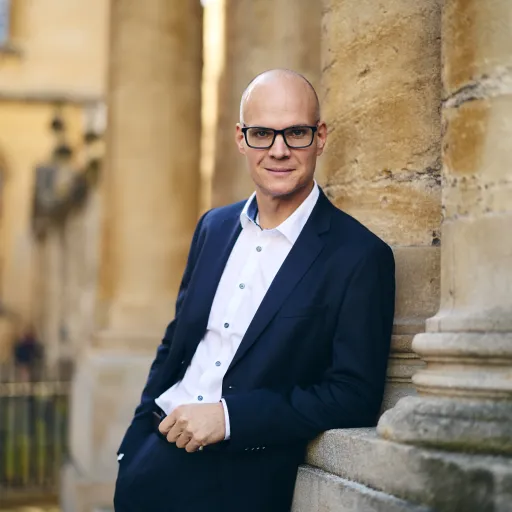
 Jan Rosenow
Oxford Professor.
“I've always been rather skeptical of target metrics. They usually get adopted by politicians who are no longer in power when these targets kick in, and then they're quietly abandoned.”
Zero: The Climate Race · Climate & Energy · November 2026
Context
Still on the proposed 35%-by-2035 electrification target, Rosenow grants the symbolic value of such targets but says he would not be too obsessed with them.
Transcript
…this very clearly: that the expectation is that in most parts of the world, the cheapest way of generating electricity will be a combination of renewables, mainly solar and wind plus storage, even factoring in storage at the same time. It will be cheaper than building new gas-fired power stations.
…electricity by 2035, from about 20-ish percentage. We'll come to the sort of final energy question later, but there is clearly an increase in electricity share of whatever energy is being consumed. Do you think that target should include that the electrification needs to come from clean sources?
…there before. So, yeah, it is the target as it stands is not particularly helpful when it comes to understanding how you deliver on that target and what the benefits will be. I would still say having, you know, there's a huge symbolic value of having an electrification target because it does focus people's minds and it leads to a conversation about electrification. And that's a good thing. But I've always been rather skeptical of target metrics. They usually get adopted by politicians who are no longer in power when these targets kick in, and then they're quietly abandoned. So, I think targets are useful to focus minds and drive the discussion in a certain direction, but I wouldn't be too obsessed with them either.
I suppose you could say the same thing about the Paris Agreement, where there are clear targets about keeping global warming below two degrees Celsius and preferably below 1.5 degrees Celsius. It focuses the mind to actually act on it, even though there is a very real risk that we may even blow…
I think a good way of maybe visualizing this in your mind is to think about the energy flow that we see in the world. And a lot of people have drawn Sankey diagrams. That's a sort of technical term. Captain Sankey, he was, I think, an Irish engineer who wanted to understand how efficient steam…
And so one way to think about it is from the perspective of oil. Like drilling just crude oil is primary energy. Then having refined products in petrol, diesel, or jet fuel is final energy. And then if the fuel is used for motion most of the time, that motion itself, the outcome of that motion, how…
More from Zero: The Climate Race