 Justin Wolfers
Professor of economics and public policy at the University of Michigan, a non-resident senior fellow at the Brookings Institution, and author of a widely used i...
Justin Wolfers
Professor of economics and public policy at the University of Michigan, a non-resident senior fellow at the Brookings Institution, and author of a widely used i...
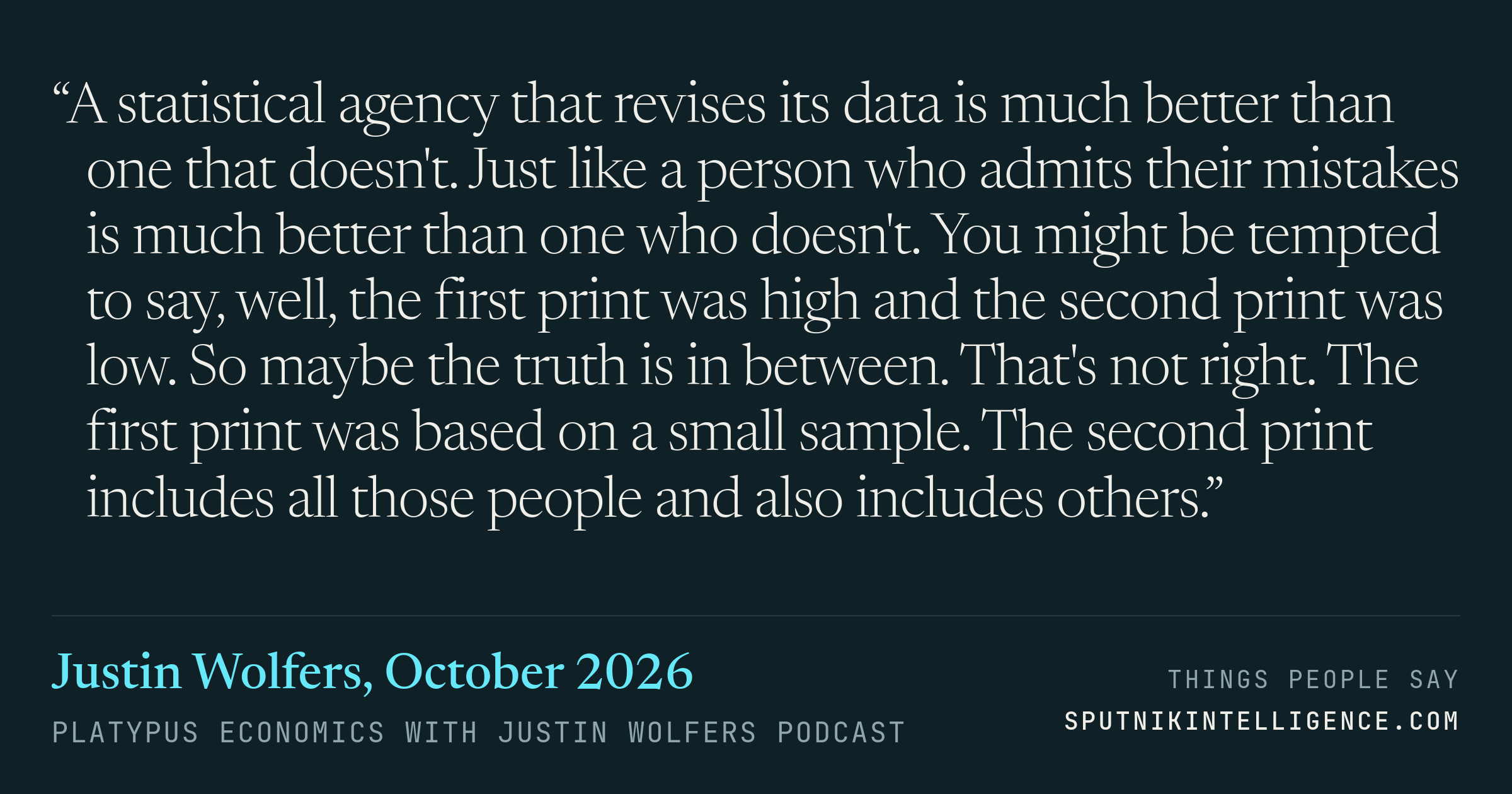
“A statistical agency that revises its data is much better than one that doesn't. Just like a person who admits their mistakes is much better than one who doesn't. You might be tempted to say, well, the first print was high and the second print was low. So maybe the truth is in between. That's not right. The first print was based on a small sample. The second print includes all those people and also includes others.”
Platypus Economics with Justin Wolfers · Money & Markets · October 2026
Wolfers was asked why the monthly jobs numbers get revised, which looks to a non-expert like the report is never right. He explained that a revision is what happens when more employers send back their survey forms.
Transcript
I'm Justin Wolfers. I'm a professor of economics. That's why we call this the professor is in. But what I want you to think about it is this is when Augusta brings me your questions, just like it's office hours. Augusta, coming into my office.
Okay, so let's just dive right in. The July and the August numbers were revised down from previous estimations. Can you talk a little bit about why that was and what that means? Because from the perspective of a non-expert, it's really confusing that like the jobs report is never quite accurate and sometimes it's totally different months later. What are we looking at here?
Yeah. So first, let's go to the really big lesson, which is actually nothing's accurate. Nothing in the world is accurate. I might think that I'm 5, 11 and a half, but it's probably the case that I'm 511.487321 inches. Measuring anything always comes with error. General proposition. Anything we measure about the economy comes with error. We can either get things perfect by lining up 340 million Americans and talking to each and every one of them, or we can talk to a sub-sample, in which case we're doing extrapolation. And the question is, did we talk to the right set of them to be fully representative? So everything comes with error. And in fact, you might learn that in like a high school science class, but it's doubly, triply, quadruply true with economics. Measuring someone's height, just not that hard compared to thinking about an economy of the size, scale, and complexity of the United States with employers maybe who are hiding in the shadows to avoid taxes or workers who are hiding to avoid taxes or immigration authorities and so on. It's an immensely difficult task. Okay. Having said that, the answer to your question is pretty simple. The way we collect the jobs numbers, the main survey, it's called the Establishment Survey, which is essentially the government reaches out to a pretty big sample of businesses and it says how many people were on your payroll in a specific week. And they make sure actually they talk to a big chunk of the really big businesses, which actually means this represents a whole lot of the U.S. workforce. You can think of it as if they send them a letter and they wait for a letter to come back. Of course, this is the 21st century. So in the 80s, they sent them a fax and a fax came back. And today we can wire up the systems to talk to each other a little bit better. But sometimes what happens is the government calls and asks for a number and you think to yourself, I'm busy. That's a pretty reasonable thing to be. And so you say, I'll get to that next week. And if you're at all like me, you actually get to it six weeks later. So what that means is the set of businesses that respond with a true count is just whoever happens to respond. And they do adjust for the fact that some people don't respond. But the guess, they have to guess what the folks who don't respond would have responded if they had responded. And then guess what? A new letter arrives saying, this is how many people were on my firm's payrolls. And so that's what a revision is. We move from having an incomplete sample to a somewhat more complete sample. And then a month later, an even more complete sample. So first thing, there are people who try to undermine the public's faith in government statistics. They do that, I think, because they want to undermine yours and my faith in the idea that there is a truth. I'm deeply dismayed by that. But actually, a statistical agency that revises its data is much better than one that doesn't. Just like a person who admits their mistakes is much better than one who doesn't. You might be tempted to say, well, the first print was high and the second print was low. So maybe the truth is in between. That's not right. The first print was based on a small sample. The second print includes all those people and also includes others. So therefore, there's no extra information in the initial number than in the revised number. The revised number is always and everywhere a better guide to what's going on. So far from being. A weakness of our statistical authorities. It's a strength that they revise. And one of the things we learned this month was that the folks who sent back their forms early last month were the folks who'd done a lot of hiring. When a bunch more forms came in, we found there was a bunch of folks who hadn't done much hiring. And so, in fact, last month and the month before were much weaker than we had thought at the time. We react a lot to these revisions, partly because this is one of the most accurate surveys of what's going on in the economy. And so one way to think about this is you can think about, and this is what I do at least, when the jobs numbers come out, you can think about there being three independent sources of information. There's the household survey, which we haven't talked about. There's this month's payroll survey. Then there's new responses to previous month's surveys, three. And so those are independent at some fundamental level. And this month, the household survey was okay. This month's survey was kind of weak. The revisions were kind of weak. That's why you're seeing me in a, when I've had some time to come to terms with this emotionally, but that's why I'm neither ecstatic nor miserable right now.
Okay, let's talk about healthcare because the story for a long time at this point has been that we're adding jobs in the healthcare sector and it's one of the only places where we're adding jobs. And I just want to pull back from this data and talk about when this huge uptake in healthcare jobs started and why. I mean, I have my own narratives about it, but I would love to hear from you.
Yeah, I think it's an incredibly important thing. So the first thing I want to do, because all professors mutter about their own thoughts first before answering their students' questions, is mutter a little bit. I want you to notice almost all the hiring, essentially all, actually more than all of the hiring under the second Trump administration has been in healthcare, which when you think about our political discourse, I don't think I've heard the word healthcare once. You know, we're talking about tariffs and oil and the Middle East and the military and construction. And no one's actually talking about the only thing that's actually happening, which is healthcare, which I just think is kind of interesting. So the narratives that drive journalists in Washington and politicians are very different sometimes and quite divorced from what really matters and what really matters is healthcare. Let me give you a different answer that I would give if you were my student, Augusta. You're an economist. You might say, no, I'm not. I'm like, I say to my freshman, they're an economist. If you have studied economics, you're doing economics, you're an economist. And my job is to empower you so that you can do it without me. So I would say, Augusta, if you want to know what's happening to healthcare, why don't you go and find out? So there's a little bit of a sponsorship tie in here, which is today's episode is brought to you by Stata. Stata is the statistical software I use to analyze all of this. And Augusta, if you want to know what's happening, I'd say, why don't you crunch the numbers? And so what I'm going to do is in the comments, I'm going to drop a worksheet that shows students how to work through the numbers so that you can play the role of economist. Now, I do this all the time to my students ask me a question. I say, you've got the power. You go figure it out. I'm pretty sure they then go to the next Michigan football game instead of working it out. Is that you, Augusta?
You are always seeing me there, aren't you?
More from Platypus Economics with Justin Wolfers