 David McCloskey
Sunday Times bestselling spy novelist and former CIA analyst who wrote for the President's Daily Brief and served on field rotations across the Middle East.
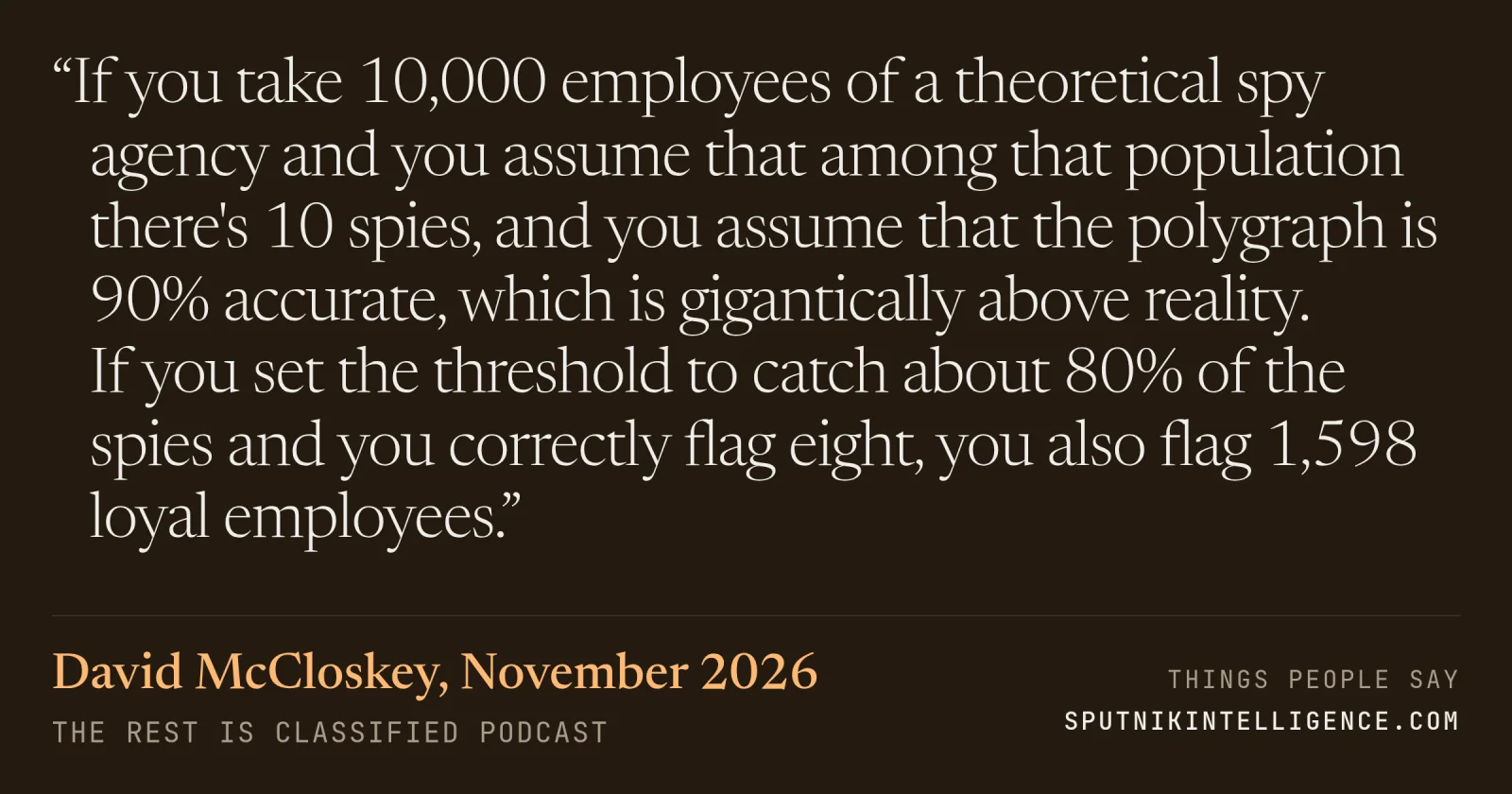
“If you take 10,000 employees of a theoretical spy agency and you assume that among that population there's 10 spies, and you assume that the polygraph is 90% accurate, which is gigantically above reality. If you set the threshold to catch about 80% of the spies and you correctly flag eight, you also flag 1,598 loyal employees.”
The Rest Is Classified · Geopolitics & World Affairs · November 2026
Context
David McCloskey walks through a calculation from the 2003 National Academy of Sciences review of the polygraph. It shows why the machine fails as a broad screening tool: false positives swamp the real spies.
Transcript
…about whether they've been in touch with children or something like that. That very specific incident test will generate a physiological response and allow the polygrapher to render a judgment, you know, with more accuracy than just you asking them the question and sort of staring into their eyes.
But it's not perfect. But
it's not perfect. And basically, all of the studies on this are done in kind of like a lab setting. So the screening accuracy in real life is probably much lower. When you look at lab settings for these studies, the accuracy numbers for the polygraph can look quite high, 80-ish percent. But when you actually get out into the real world and use them, you know, Alder in his book says that in kind of field situations, if you just look at the charts alone, the innocent were called truthful only 53% of the time. And unaided human judgment will get that right about 54% of the time. So almost no difference. Almost no difference between the two. And I think it's very interesting that that NAS study did some very interesting math because it really shows, I think, one of the essential problems with the polygraph, which is if you take 10,000 employees of a theoretical spy agency and you assume that among that population of 10,000, there's 10 spies, and you assume that the polygraph is 90% accurate, which is gigantically above reality. If you set the threshold to catch about 80% of the spies and you correctly flag eight…
And that, I think, is the problem with them, isn't it? Is that if you're using it simply as a kind of broad-scale test, it's not that useful because it's not quite accurate enough. I mean, where it seems to me useful is where you've already got suspicion or an investigation and you are using it as…
So, yes, technically, he does pass the polygraph. So he sits down for, he sits for a polygraph in 86. So this is a year after he started to spy for the Soviets. The FBI does a review of his charts from 1986, and they conclude that there were indications of deception, and they're never resolved. The…
it's an investigation. It's a real molehunt, isn't it?
More from The Rest Is Classified