 David McCloskey
Sunday Times bestselling spy novelist and former CIA analyst who wrote for the President's Daily Brief and served on field rotations across the Middle East.
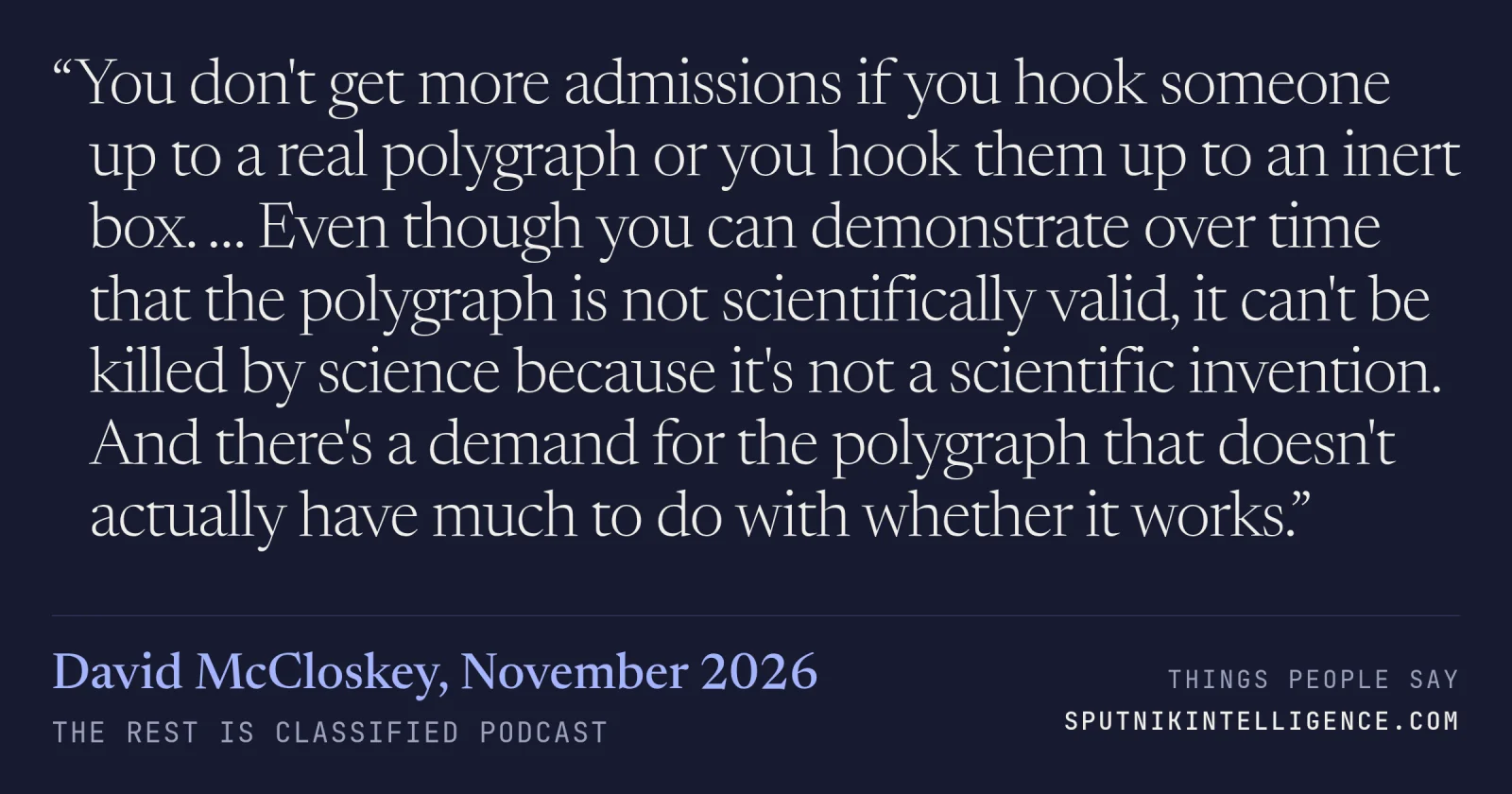
“You don't get more admissions if you hook someone up to a real polygraph or you hook them up to an inert box. … Even though you can demonstrate over time that the polygraph is not scientifically valid, it can't be killed by science because it's not a scientific invention. And there's a demand for the polygraph that doesn't actually have much to do with whether it works.”
The Rest Is Classified · Geopolitics & World Affairs · November 2026
Context
Wrapping up whether polygraphs are useful despite the weak science, McCloskey separates deterrence and usefulness from validity, drawing on Ken Alder's history of the lie detector.
Transcript
…typically they are merged together. So, we're having this conversation about validity, essentially, but it can still be useful and not broadly scientifically valid, right? Because as we've said, the utility derives from beliefs about its validity, which are distinct from its actual validity.
…balance, to get them to confess, to see how they react, to open up leads, to kind of put someone under pressure. That's the value of it, rather than the kind of yes, no, they're lying, they're not, to which it's not necessarily enough in itself to be confident about the result that comes out of it.
And I think, you know, it's useful, I think, for deterrence. You know, for example, like in the Hanson case, right? He decided not to join that team at the CIA in large part because he would have been polygraphed. So, it deterred him from gaining access to even more sensitive information. So, on the utility point, I think, you know, you can make the case, and I think historically the cases bear out that it has some value. But on the validity point, again, you don't get any, you don't get more admissions if you hook someone up to a real polygraph or you hook them up to an inert box, right? So, and as we've discussed, the massive amount now of really deep literature, academic and scientific literature on the polygraph do not show that it is more valid significantly than just unaided human perception, right? So, we sort of have to separate these two things out. And I think, look, you know, Alder in his book, The Lie Detector, makes a great point, which is that even though you can demonstrate over time that the polygraph is not scientifically valid, it can't be killed by science because it's not a scientific invention. And there's a demand for the polygraph…
It's part of American culture and the American story and American, if you like, faith in it that has led to its persistence, despite those questions.
Yeah, I think it is. You could kind of turn the question around and ask not whether it works, but what it means that we Americans keep wanting it to. I think this is maybe the place to leave it here. Is there's a great quote in that Alder book where he's quoting GK Chesterton's father Brown…
Okay, so that's everything you need to know about the polygraph. But now it's the moment you've been waiting for. It's time for us to get strapped into the machine. So come back after the break when David and I will be put to the test to see if we can beat the polygraph or if our deepest, darkest…
More from The Rest Is Classified