 Dwarkesh Patel
Hosts the Dwarkesh Podcast, a long-form interview show on AI progress, timelines, and the people building frontier models, along with economists and historians.
Dwarkesh Patel
Hosts the Dwarkesh Podcast, a long-form interview show on AI progress, timelines, and the people building frontier models, along with economists and historians.
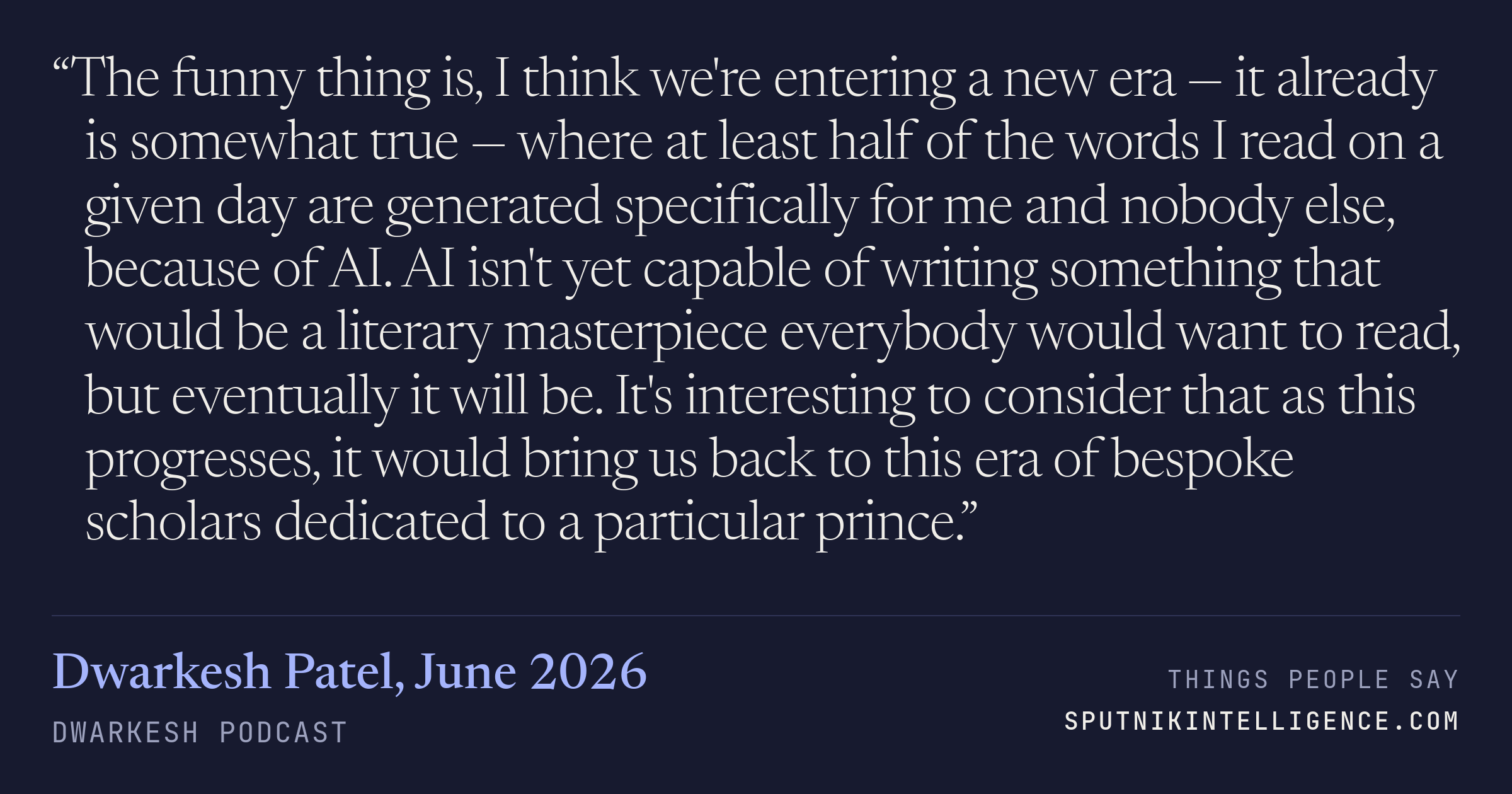
“The funny thing is, I think we're entering a new era — it already is somewhat true — where at least half of the words I read on a given day are generated specifically for me and nobody else, because of AI. AI isn't yet capable of writing something that would be a literary masterpiece everybody would want to read, but eventually it will be. It's interesting to consider that as this progresses, it would bring us back to this era of bespoke scholars dedicated to a particular prince.”
Dwarkesh Podcast · AI Research & Frontier Labs · June 2026
Palmer had just described how hard it is for modern readers to imagine a book written for an audience of one, as Renaissance manuscripts often were. Dwarkesh's observation is that this is no longer a historical curiosity — he already lives that way. Palmer's reply is that bespoke writing never actually went away.
Transcript
That is so fascinating.
Because we have trouble wrapping our heads around the idea of writing a book for an audience of one. It's just not what a book is to us.
Well, the funny thing is, I think we're returning, or not returning, we are entering a new era. Well, that might be once again possible. It already is somewhat true where I think most of the, at least half of the words I read on a given day are generated specifically for me and nobody else because of AI. And obviously, AI is not capable of writing something which I think would be a literary masterpiece that everybody would want to read if they had access to it just yet. But eventually it will be. And so it's interesting to consider that as this knowledge progresses, it would bring us back to this era of bespoke scholars dedicated to a particular prince.
It's sort of important to remember that that never went away. I mean, so two halves of that one, for ages, it's been true that half of the words we read every day are bespoke only for us because they're email.
Yeah.
They're letters. They're the correspondence back and forth, which has the audience of one, the addressee. And that's the majority of what all of us read and write in our lives. It's also always been the case that in the halls of power, there are book-long things with an audience of one or an audience of five, right? There are historians and other scholars and scientists whose job is to provide that 100-page report on here is the history of Syria to be given to a committee of Congress where these nine senators or these nine congresspeople need the background on what's happening so that they can understand a current events thing, right? And they're historian friends of mine who work for the Department of Defense Intelligence who produce these book-length research projects with an audience of five or an audience of eight or an audience of a couple dozen because it is the bespoke proprietary knowledge needed by government in that moment. And sometimes it's technological knowledge, but just as often it's going to be historical knowledge of here are the important rivers where military things are likely to happen, says historian who knows the history of this stuff.
More from Dwarkesh Podcast