 Steve Eisman
Investor known for betting against the subprime mortgage market before the 2008 financial crisis, a story told in Michael Lewis's book The Big Short.
Steve Eisman
Investor known for betting against the subprime mortgage market before the 2008 financial crisis, a story told in Michael Lewis's book The Big Short.
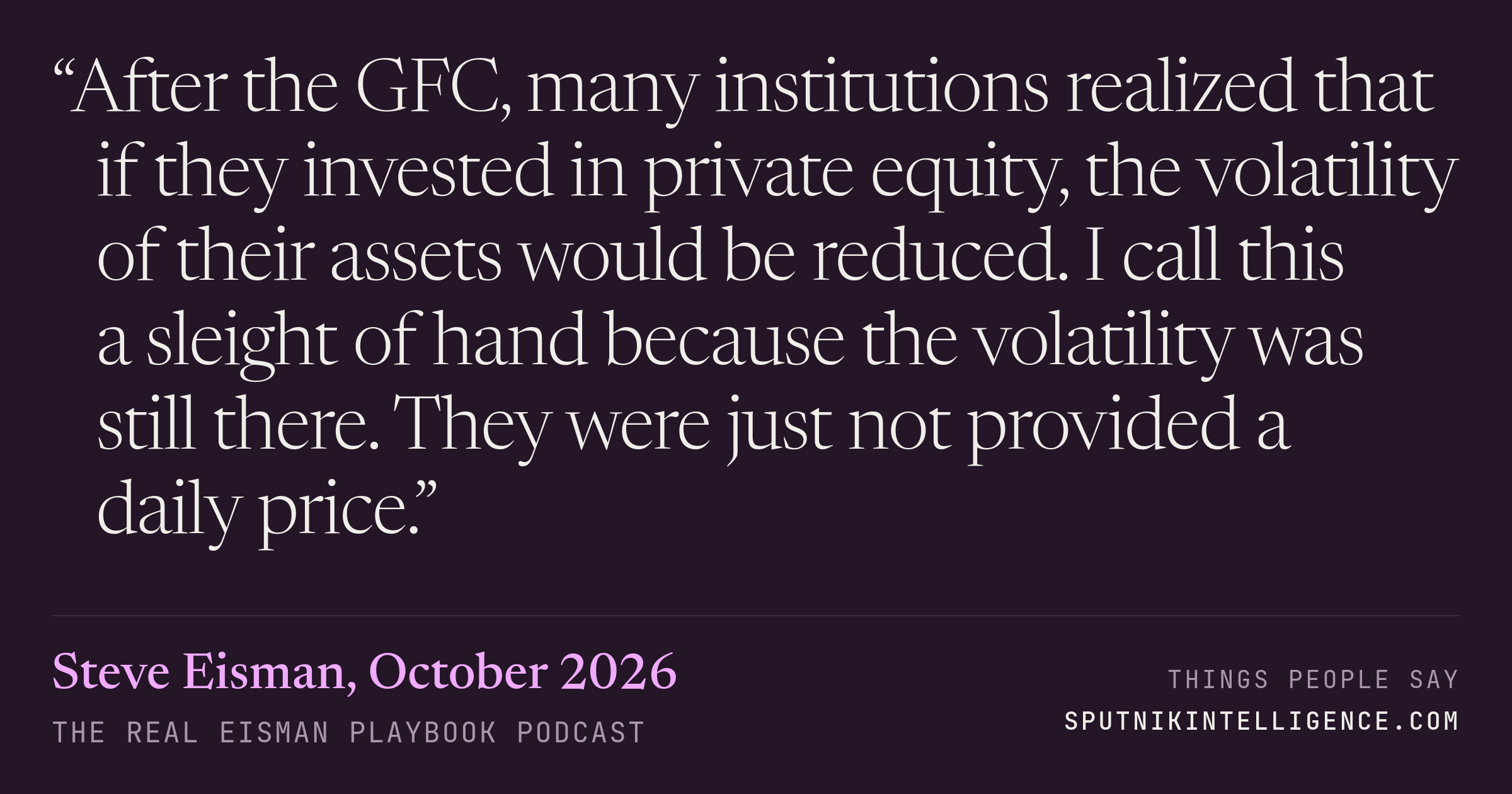
“After the GFC, many institutions realized that if they invested in private equity, the volatility of their assets would be reduced. I call this a sleight of hand because the volatility was still there. They were just not provided a daily price.”
The Real Eisman Playbook · October 2026
From Eisman's weekly monologue on private equity's exposure to software companies. He was explaining why so much institutional money flowed into private equity after the 2008 financial crisis in the first place. He argues that money was then invested with leverage at very low rates, and that the software buyouts it paid for are now in trouble.
Transcript
When you need to build up your team to handle the growing chaos at work, use Indeed Sponsored Jobs. It gives your job post the boost it needs to be seen and helps reach people with the right skills, certifications, and more. Spend less time searching and more time actually interviewing candidates who check all your boxes. Listeners of this show will get a $75 sponsored job credit at Indeed.com/slash podcast. That's indeed.com/slash podcast. Terms and conditions apply. Need a hiring hero? This is a job for Indeed Sponsored Jobs.
Hi, Steve Eisman here. You know those pieces in your closet you find yourself wearing on repeat? The sweater that goes with everything, the perfect pair of pants or the t-shirt you somehow always reach for first. Those are the pieces that make getting dressed easy, and that's what Quince does best. Quince focuses on high-quality wardrobe staples made with premium materials like 100% Mongolian, cashmere, organic cotton, and berino wool. The styles are timeless, versatile, and designed to become the dependable pieces you reach for day after day. And when the temperature drops, Quince makes it easy to build on those everyday staples with premium down jackets and classic wool outerwear, versatile layers designed to keep you warm and comfortable all season long. Everything at Quince is priced 50 to 80% less than similar brands. They work directly with ethical factories and cut out the middlemen. So you're paying for high-quality brand, not brand markup. I bought a terrycloth hoodie through Quince and I wear it almost every day. I love it. Find your next fall favorites at Quince. Download the Quince app for app-exclusive offers or go to Quince.com, get free shipping on your order and 365-day returns. Now available in Canada and the UK too. And when Quince asks you where you heard about them, let them know was the Real Eyes in Playbook. It's the best way to support the show. Let's use a public company, Adobe, as a proxy for the entire software sector. Now, Adobe software is used to create, edit, and manage digital media, including photos, graphics, videos,
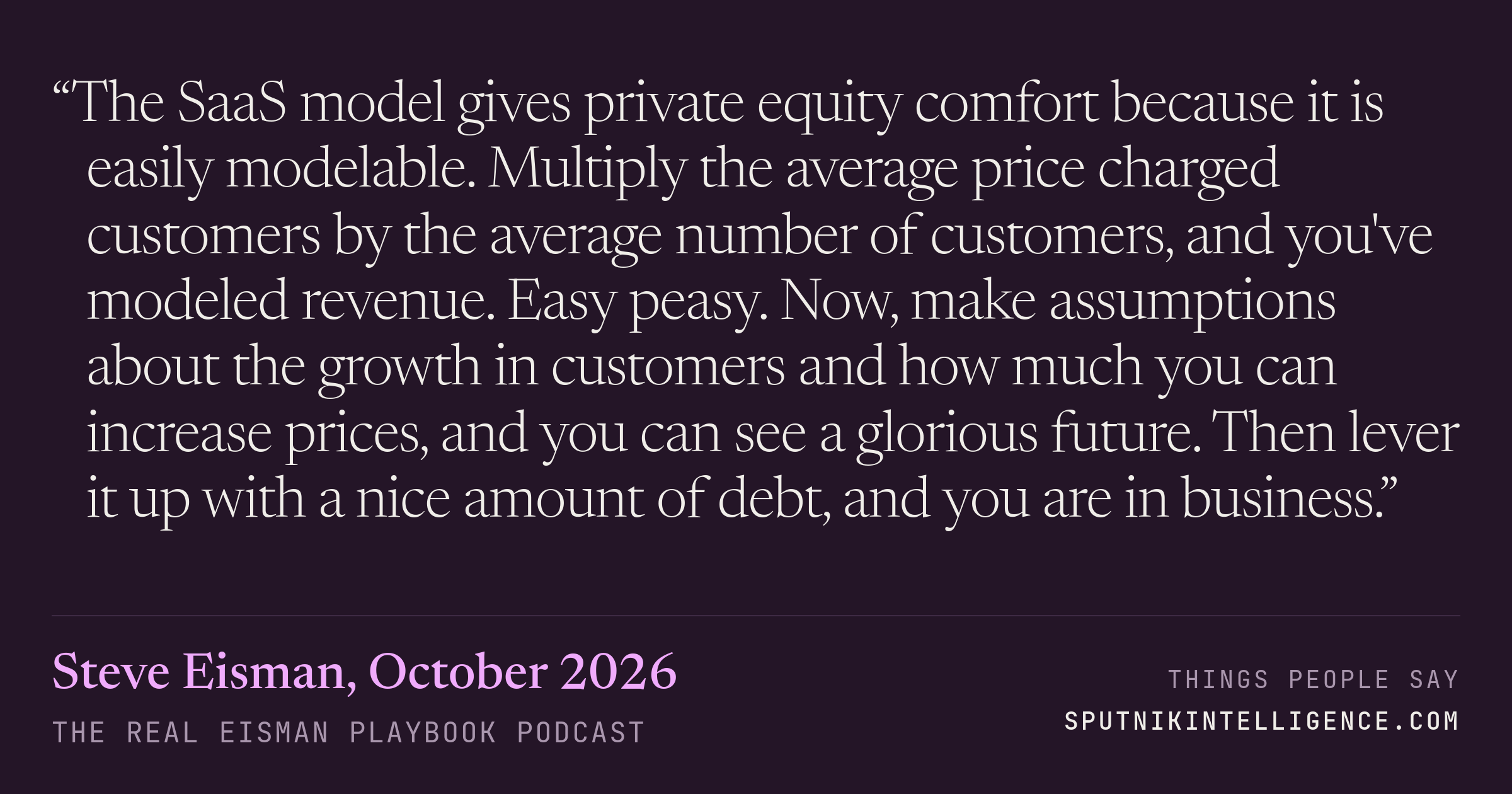
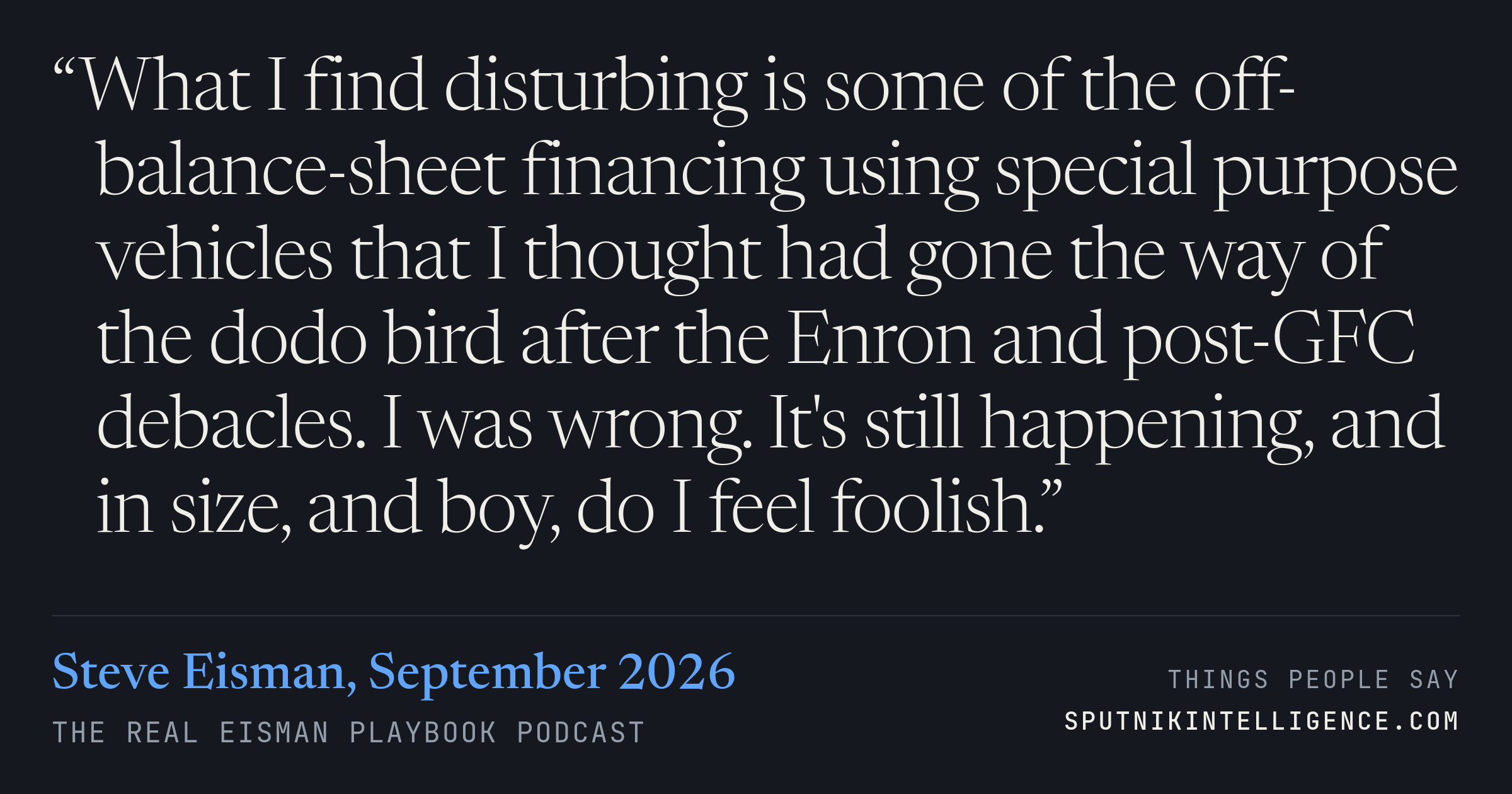
audio, and documents. I'm sure many of you. Have used Adobe. The perception is that Adobe is particularly vulnerable to AI. Now, Adobe hit an all-time high of $630 a share in February 2024. Today, the stock is 240. That is the decline of Get This 62%. Now, Adobe is not the only software company that the market is worried will suffer from AI decimation. But for purposes of our analysis, let's assume that most software companies are down 50-ish percent from their peak, with cybersecurity being a very large exception. The stocks are down not because their business models have fallen apart. They have not. Investors are just worried that they will. The same thought process applies to non-public software companies. The business may look fine for now, but the valuation multiples have been decimating. Note that corporate debt is not like mortgage debt. When you pay your mortgage every month, you pay interest and principal such that when you make your last payment, you have paid off the entire principal. But at a corporate loan, only interest is paid. That means that when the turn of the loan is over, the borrower has to raise new debt to pay off the old debt. Here's the mathematical problem: let's suppose a software company is bought out for $1 billion and 50% of the purchase price is funded by variable-rate private credit debt. Let's also assume that this transaction took place in 2022 and the debt was five-year debt, so that it will be refinanced in 2027 next year. And let's also assume that because of the SaaS apocalypse, the value of the company has declined by 50% since its purchase. Given what has happened to Adobe, that's not a crazy assumption. The fundamentals of the company that we're talking about, this hypothetical company, might still be okay, but the valuation multiple has been cut by a lot. So now, the total value of the company, which was a billion, is only 500 million. The debt does not go down in value until after the equity is reduced to zero. Since the debt is 500 million and the new value is 500 million, equity is worthless. And now, when the private equity firm approaches a private credit firm to refinance the debt, they have to come up with new equity to shore up their balance sheet. Like I said, this company's earnings and cash flow might still be fine and the equity could still be zero. Both can be true. In negotiating a new package, private credit will demand that private equity put in another $500 million. Now, will a private equity firm do that? Maybe, but I doubt it. That would mean that the private equity firm will have put in a billion dollars of its own money for a company that is now worth only $500 million. I think most private equity firms will just walk away. Private Equity's will then own the company, and what they will do then is anyone's guess. So, what are the implications? I don't think this private equity software problem is big enough to sink the economy. It is, however, big enough to seriously damage the reputation of the private equity industry. Not too long ago, a private equity fund would become monetized in three to four years. Because of the weak IPO market of the last several years, that duration has extended to seven years. And I think these software investments are largely debt money, meaning investors are never going to see any return. The duration for private equity monetization is going to keep extending, and many investments will be marked to zero. Soon, some number of investors who piled into private equity deals offering a great potential return will find their investments are worthless. One of the reasons why private equity has grown so much since the great financial crisis is because of what I call a sleight of hand. During the GFC, institutions watched the value of their assets decline every day. It was a painful experience. After the GFC, many institutions realized that if they invested in private equity, the volatility of their assets would be reduced. I call this a sleight of hand because the volatility was still there. They were just not provided a daily price. Private Equity's Software took those assets and invested the proceeds in an exceptionally low rate environment, which was perfect for a strategy employing leverage. Times changed. Rates are now much higher. The days of easy money are over and private equity is overexposed to software companies, which has become extremely problematic. It's going to be years for private equity to work through these problems. We shall see how they do. And by the way, some software deals have already failed. So, for example, in 2024, Blue Owl and other lenders took control of a company called Pluralsight, wiping out Vista's entire equity SIG. This August, Medallia, a Thomas. Bravo deal was taken over by lenders as equity was wiped out as well. It's important to point out that neither of these companies was in cybersecurity. Plural site is an online learning and workforce development platform, and Medallia is a software platform that helps businesses improve customer and employee experiences. I actually looked up what Medallia does, and that's what I found. And frankly, I really have no idea what that means. But it sounds like something AI can do a lot cheaper. And now for the mailbag. First up from Jeremy E. Steve, first of all, a longtime fan, I was one of the random Twitter accounts begging you to start a podcast back in 2023, 2024. Glad you listened and or independently arrived at the logical conclusion to do so. Thank you for your advice. Secondly, the 10-year treasury and inflation question. CPI X energy was 2.4% for August, which was good. Seems most movement, if not all, is from energy, maybe tariffs to a far lesser extent. In any event, how does the Fed raising rates address the core issue? Is this yet another example of the Fed suffering from a man with Hammer syndrome? Hiking seems especially blunt against this context. No? Interesting question. The Fed has zero control over oil prices. So when oil prices are rising and that creates fears of inflation, the Fed raising rates has no impact on oil prices. Now, one could argue, as this viewer does, that the Fed is acting as if everything is a nail. Where it gets more complicated is when, like now, oil prices remain elevated for an extended period of time. Then, higher oil prices start to creep into the overall economy and into overall prices. For example, higher oil prices raise the price of fertilizer, which in turn raises the price of food. There are myriad other examples of this. That's when, like now, the Fed feels compelled to act in hopes that by raising short-term rates, it will slow the economy and bring inflation down. Admittedly, it's a very blunt instrument, but the best we got. Next up from Teddy. Quote: Regarding your comments on CNBC and in the sub stack about AI leaders wanting to create a duopoly through regulation, don't you think that two things can be true at the same time? They do want that, and some type of industry guardrails are needed to protect AI from getting out of hand. How can this be achieved without the Frontier Labs having ulterior motives? Fair question. It's very tempting to say that AI leaders want regulation to foster a duopoly, but also want regulation to create guardrails. I wish that were so. I just, I just don't believe it. The problems that have arisen so far are largely hacking, and that is something that I believe can be dealt with by management and by better oversight, their own oversight. But the idea that AI is going to destroy the world, I think, is just a subterfuge. I really believe they don't believe it at all, even though they have been saying it for a long time. Next up from Wayne. I worked for European Bank during the GFC, and I would skip to the train every day thinking we had zero exposure to the U.S. real estate because I knew it was going to blow, just to know how. I got a lot of calls from old workmates to make sense of mortgage-backed securities because I did that early in my career. And the first deal I was in, we made the bank keep the garbage loan so the MBS could get a good rating and that someday, 15 years later, the banks with the garbage would blow. My Clean European Bank put capital with the investment bank Yahoo's to get a return. They loaded up on mortgage-backed securities. Either way, the head Yahoo that got the bank suck left or was fired and started a hedge fund in Connecticut. There is no justice. I always wondered how you spotted the bad mortgage-backed securities. Was it in the notes of the financials? Two parts to the answer to this question. First, in the 1990s, I was a sell-site analyst covering the financial services sector. Part of my coverage was the first generation of subprime mortgage companies. For reasons we don't need to go into, most of the industry went bankrupt in 1998. The second generation of subprime mortgage companies went public in 2002 and 2003. Funny thing, most of them were run by the same people. They just changed the names. I had seen this play in 1998, and it ended in tragedy. So I was waiting for the same script to unfold. I just did not know when, but felt it was inevitable. Second, I knew through our research process that underwriting standards had deteriorated dramatically. But what gave me the confidence to do something about it was Moody's securitization database. For a fee, anyone could get this data. For every month, every month, every securitization reported all of its credit metrics. We could compare the trajectory of delinquencies of recent securitizations against older ones. What we found was that by the summer of 2006, loans securitized in 2006 were going delinquent and in Incredibly rapid pace, far quicker than older securitizations. That's when I knew. This week, on September 30th, on our premium subscription service, we interviewed Edwin Dorsey, creator of the Bear Cave newsletter.
I believe these prediction markets provide a lot of high-quality value and information, which helps people make better decisions.
Edwin has become an expert in prediction markets, and we focused on those markets and some of their problems. Next week on Premium, on Wednesday, October 7th, we will post an interview with Joseph Carlson, who is a podcaster. We discussed where Joseph, a former software engineer, thinks AI is really impactful and where it is not. This week on September 28th, on our free service, we interviewed Sam Badry, the head of investor relations at Cisco. We discussed how the AI revolution has impacted Cisco's revenue and earnings, and also discussed Sam's view of the durability of the AI narrative. Next week, on Monday, October 5th, we will post an interview with Krishna Guha, the Fed watcher for Evercore. This will release on Sunday, October 4 at noon for premium members. Krishna and I discussed recent moves by the Fed and what Kevin Warsh wants to change. We also discussed Treasury Secretary Scott Besson's attempt to reduce low-term rates, and we went back in history and ranked past Fed shares. The best way to support the Real Eisman Playbook is to subscribe to Substack through steveismond.com. Subscriptions are free, and we greatly, greatly appreciate your support. And that's the round. This podcast is for informational purposes only and does not constitute investment advice. The host and guests may hold positions and stocks discussed, opinions expressed on their own and not recommendations. Please do your own due diligence and consult the licensed financial advisor before making any investment decisions.
More from The Real Eisman Playbook