 Steve Eisman
Investor known for betting against the subprime mortgage market before the 2008 financial crisis, a story told in Michael Lewis's book The Big Short.
Steve Eisman
Investor known for betting against the subprime mortgage market before the 2008 financial crisis, a story told in Michael Lewis's book The Big Short.
“What I find disturbing is some of the off-balance-sheet financing using special purpose vehicles that I thought had gone the way of the dodo bird after the Enron and post-GFC debacles. I was wrong. It's still happening, and in size, and boy, do I feel foolish.”
The Real Eisman Playbook · September 2026
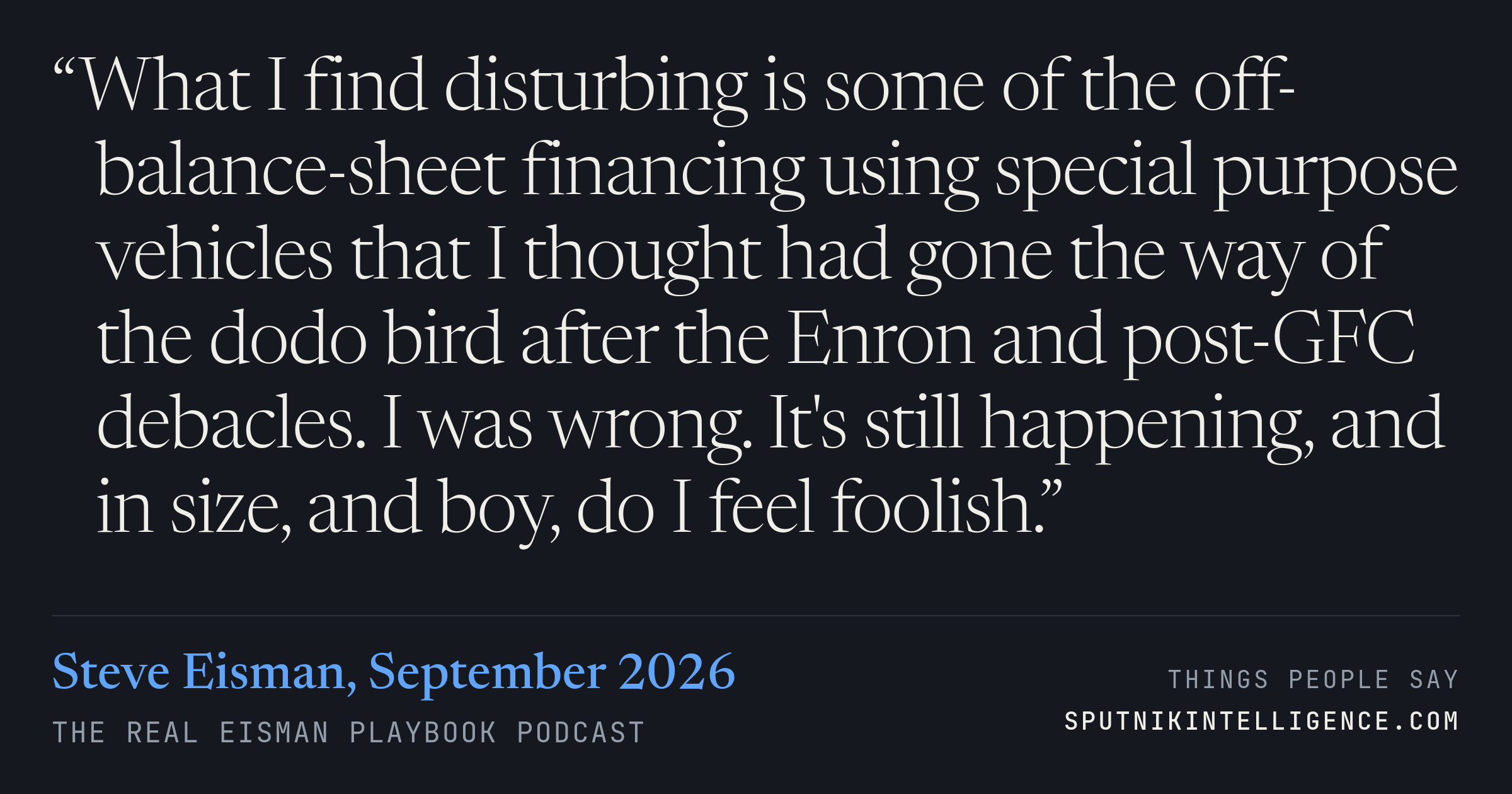
Eisman spends much of this weekly wrap on how AI data centers are being financed, using Meta's $27 billion Louisiana project as his example: the debt sits in a special purpose vehicle Meta owns 20% of, so it stays off Meta's balance sheet even though Meta builds it, rents it for 20 years, and absorbs the overruns. He walks through Enron's SPVs and the pre-2008 structured investment vehicles as precedent, and expects more such deals, "and not just at Meta."
Transcript
The only two variables that matter right now are oil prices and the 10-year yield. Should the 10-year remain above 5%, a correction I think is probably imminent. There was some troubling news from Oracle and Blue Owl Capital. The leverage it has taken on forced SP to downgrade the company's credit rating to triple B minus, which is only one level above junk. What I find disturbing is some of the off-balance sheet financing using special purpose vehicles. Their Debt will not sit on Meta's balance sheet. That's some fancy schmancy footwork that's reminiscent of bad times past. The GFC gave birth to the concept of too big to fail. Are we there again? Are we going to do this all over again? Hiding Their is Steve Eisman, and this is another episode of the weekly wrap. This is for the week ending Friday, September 25th, but recorded Thursday night, September 24th. This last Wednesday, September 23rd, on our premium substack subscription service, we posted part two of how to analyze banks, my master class. I'm providing you in this class with all the tools to understand how banks work and how to think about large cap and small cap and mid-cap and the investment banks as well. This coming Wednesday, September 30th, we will post an interview with Edwin Dorsey, creator of the Bear Cave newsletter.
I believe these prediction markets provide a lot of high-quality value and information, which helps people make better decisions.
Ed has become a real expert in prediction markets, and we spend a great deal of time discussing the value of prediction markets and their problems. Also, we get occasional requests from subscribers to purchase our coffee mugs, pillows, and other merchandise. Go to steveeisman.com, which will bring you to Substack and our merchandise page. On this week's wrap, we will discuss the war in Iran, oil prices, and interest rates, troubling news from Oracle and Blue Owl Capital, Paramount cleared for takeoff, softbank junk borrowing to fund an equity investment, some aspects of AI circular financing that I find particularly disturbing. Meta's beignet, Meta's Muse, now that Agentic AI is cute, is it deflationary and will it make a real difference? And one mailbag about shorting against the box. And now let's get started. I've said this before. This is a tough market, and that the only two variables that matter right now are oil prices and the 10-year yield, neither of which, in my view, is predictable and both of which move the market. War news flips like a pancake, and the 10-year keeps climbing. Earlier in the week, the 10-year declined below 5% for a short period of time, and the market rallied. But on Wednesday, there was some very strong economic data, and the 10-year has now climbed to a multi-year high of 5.10% plus, and the market declined. But later on Thursday, there were reports of a potential deal regarding the Strait of Hormuz, and the market rallied back to flat. However, for now, it looks like 5% is the Rubicon for the market. Should the 10-year remain above 5%, a correction I think is probably imminent. Moving on. There was some troubling news from Oracle and Blue Owl Capital. Blue Owl is developing an AI data center called Project Jupiter for Oracle. Oracle sent a notice citing force majeure, a legal term, to Blue Owl. The notice is an attempt to put off payments. the data center gets derailed and fails to come online on time. Now, the debt tied to Project Jupiter was already trading at stress levels at around 90 cents on the dollar. I'm sure it's under more pressure today, Thursday. Although this shows that Oracle is becoming increasingly nervous about its lack of cash flow, its high debt levels, and its weak credit ratings. This week, Paramount settled the antitrust lawsuit that was brought by 11 state attorneys general. I've always thought this lawsuit was ridiculous. Netflix has a 300 billion market cap. Disney is at 180 billion. And the combined Paramount Warner Brothers company has a market cap of something like 88 billion. In the streaming wars, size matters. So the merger actually improves competition. This case was never about antitrust. The California State Attorney General wanted to place controls on the company. That's why the settlement involves a board overseeing CNN and a requirement that Paramount release 30 films in theaters each year. None of that has anything to do with antitrust. Frankly, I don't find any of these entertainment companies to be good investments. Netflix has hit a growth wall because the streaming wars have stopped being about expanding the pie and become only a food fight for market share. The only way to increase revenue seems to be price increases, but prices are now so high that raising them more risks angering the customer base. Moving on. In AI news, SoftBank really went out on a limb. Masayoshi-san, the chairman of SoftBank, has a history, a very long history, of loving leverage. During the summer, he got a $10 billion bridge loan from a group of banks to fund a $10 billion investment in chat GPT, OpenAI. This week, he is in the process of raising $11 billion in junk bonds to fund that $10 billion investment in OpenAI. The bonds will cancel the bridge loan. This is all really out there on the frontier of risk. It's one thing to invest your own cash. It's another thing to raise junk-rated debt to make an equity investment. Moving on to AI circular financing and why looking from the top down, which is conceptually accessible, needs to be paired with bottom-up analysis of the accounting and specifically the underlying off-balance sheet financing that we're about to talk about. This kind of financing is designed to obscure. Now, many commentators have discussed the circular nature of AI financing. NVIDIA, for example, invests in a company or lends money to a company that in turn uses that cash to buy NVIDIA chips. Now, you may not like it, but it's all out in the open. Easy to understand, NVIDIA is funding their own growth out of their own magnificent cash flow. This is not what I want to address today. What I find disturbing is some of the off-balance sheet financing using special purpose vehicles that I thought had gone the way of the dodo bird after the Enron and post-GFC debacles. I was wrong. It's still happening and in size, and boy, do I feel foolish. Let me take you back and remember Enron. To reduce its balance sheet debt levels, Enron created special purpose vehicles that were owned, get this, by the company's CFO, Andrew Fasto. That's right. Enron transferred billions in debt to an entity owned and controlled by the company's own CFO. You can't make this up. Prior to the scandal breaking, I remember reading Enron's 10Q, where all this was completely disclosed and wondering how the auditors could allow this nonsense. How could the auditors agree that the debt transferred to the special purpose vehicle owned by FASTO meant that said debt was no longer on Enron's balance sheet? I also remember talking to a sales site analyst about it. He shrugged his shoulders and said that it must be okay. After all, it's disclosed and the auditors signed off on it, which just goes to show how gullible any of us can be. After the scandal broke, the U.S. government sued the auditor, Arthur Anderson, for criminal malfeasance. The lawsuit put Arthur Anderson out of business. Fasto went to prison and his illegally gotten gains were wiped out. Bad off-balance sheet stories come in many flavors. Enron is an example of off-balance sheet vehicles called SPVs, which should never have been off-balance sheet. Arthur Anderson was paid a lot of money both for its audit and its consulting, and they sold their souls. Why go through these complex manipulations? The goal. Is to get debt off the balance sheet so the ratings agencies won't penalize the debt ratings. If the debt is gone, the company is less levered, at least technically. Ratings agencies can be myopic, and in rating the company, often only look at the debt that is on balance sheet. It's like the off-balance sheet debt has disappeared. Poof magic, this works until everything goes sideways. When the debt goes bad, like it did in the GFC and Enron, that's when it lands back on the balance sheet and everyone involved theoretically gets held accountable, like Fasto and Arthur Anderson. It's always good to go back in history and recall relevant stories now that off-balance sheet techniques are back with a vengeance in the new world of AI. Before diving in, I'll explain some of the off-balance sheet manipulations during the GFC. The great financial crisis saw a different but similar kind of off-balance sheet tale. Wall Street created a structure called a CIV, SIV, a structured investment vehicle. CIVs were a type of shadow bank, pools of investment assets kept off the balance sheets of major commercial banks to bypass leverage calculations and regulatory capital requirements. Civs played a major role in amplifying the 2007-2008 financial crisis. The business model of a CIV relied entirely on capturing the spread, the difference between long-term investment yields and short-term borrowing costs. The borrowing, short-term debt. Civs raised cash by issuing to institutional investors low-interest, short-term debt instruments like asset-backed commercial paper. This short-term debt had to be constantly rolled over, meaning reissued, as it matured long-term. Banks used that cash from the short-term borrowings to buy higher-yielding, long-term, structured financial products such as mortgage-backed securities and collateralized debt obligations, many of which, you guessed it, were tied to U.S. subprime mortgages. When the subprime mortgage bubble burst, the value of those long-term assets plummeted. Suddenly, panicked investors refused to buy the Civ's short-term commercial paper. This is classic surfing the curve, buying long-term bonds, funding them with short-term paper, and capturing the spread. Now, I never quite understood how a bank could use a CIV to own assets off-balance sheet, but the ratings agencies allowed it. Shame on them. Still makes no sense to me to this day. In the end, however, once the buyers of the Civ short-term paper refused to roll it over, the banks were forced to finance the long-term assets themselves, and the entire Civ came back on balance sheet. Poof magic again. It was quite embarrassing. The supposedly smartest people in the room no longer look so intelligent. But unlike FASTO, no one went to jail for this fraud. The GFC gave birth to the concept of too big to fail. Are we there again? I certainly hope not.
Low energy, unfocused, foggy? You might be dehydrated. Whether it's hot yoga, over 100-degree weather, or too much sun. Gatorlight, with a specialized blend of five electrolytes, was scientifically designed to help move fluids into the body faster for rapid rehydration. Shop now at retailers nationwide. Gatorlight hydrates faster than water. Is it in you? Symptoms noted are signs of mild to moderate dehydration. Consult a healthcare professional if symptoms persist.
Hi, Steve Eisman here. Most people spend days researching a hotel, but life insurance, they take the first quote and move on. SelectQuote shops over 100 policies and finds you a better rate for free in about 15 minutes. You'll save an average of 30%. On $150,000 monthly premium, that's over $10,000 back across a 20-year term. They've been doing this 40 plus years with 11,000 TrustPilot reviews rated excellent. Get your free quote at selectquote.com slash Eisman. That's selectquote.com/slash Eisman. They shop, you save. Now let's look at the off-balance sheet techniques which are back with a vengeance in the world of AI. Their appearance is due to the following: costs are rising. Also, flooding balance sheets with debt will destroy company credit ratings, and bad ratings will increase the costs of the debt. It's a vicious cycle which requires fancy footwork to hide the debt. What costs are rising? Well, NVIDIA's chips are expensive and getting more expensive. NVIDIA just recently raised prices by 15%. And it turns out that a Costs a lot, and I mean a lot, to build an AI data center, and it takes a great deal of time to build them. The combination of all of these cost increases has changed the dynamics of the business models of the large tech companies that are now called hyperscalers, Google, Amazon, Microsoft, and Oracle, and Meta as well. They used to be capital-light businesses that threw off so much cash that they barely knew what to do with it all. This year, the hyperscalers will spend something like $700 billion on AI CapEx, and their cash flow has disappeared. They are raising capital for the first time in decades and a lot of debt. In the case of Oracle, the leverage it has taken on forced SP to downgrade the company's credit rating to triple B minus, which is only one level above junk. That's why off-balance sheet financing is so tempting and has come back in vogue. If you can get some of that debt off the balance sheet, it's possible the ratings agencies will give you credit for it, thereby preserving your credit rating. It's early in the AI off-balance sheet shenanigan story. Last year, Meta dipped its toe in the world of off-balance sheet financing in order to fund a $27 billion data center in Louisiana. Their Debt center is financed, of course, with debt, but the debt is not on Meta's balance sheet. Instead, an off-balance sheet vehicle, a special purpose vehicle, SPV, was set up called Benier Investor LLC SPV. Quite a mouthful. Hat tip to the name, though, as anyone who has spent time in New Orleans knows that Beniets are delicious. Meta wins my vote for cuteness with Muse and Benier, but the financing is less cute. Meta owns technically only 20% of Benyet, with the rest owned by Blue Owl and Pimco. Yeah, Blue Owl again. So even though Meta is building the data center and has promised to rent the data center from Benyet for 20 years and bears the costs of any project delays and overruns, the debt will not sit on Meta's balance sheet. That's some fancy schmancy footwork that's reminiscent of bad times past and it doesn't pass the smell test, at least not to me. Perhaps with the memory of what happened to Arthur Anderson in mind, Ernst ⁇ Jung, Meta's auditor, was not totally comfortable with this masterpiece of off-balance sheet financial engineering. In Meta's 2025 10K, ENY flagged it as a quote, critical audit matter, unquote. I'm going to quote a long section from the 10K. Note that here, the SPV is called a variable interest entity, VIE. It's the same thing. Pay attention to the language in the 10K that I'm going to quote. The takeaway is that sometimes accounting language illuminates and sometimes it obscures. Here, it obscures. And I am quoting the relevant section at length, so bear with me. Quote, as described in Note 5 to the consolidated financial statements, the company entered into an arrangement, the venture, to co-develop a data center campus. The company determined whether it holds a variable interest in the venture, whether the entity in which the company has a variable interest is a variable interest entity, and whether the company is required to consolidate the entity. A VIE is consolidated by its primary beneficiary, which is the party that has both the power to direct the activities that most significantly affect the economic performance of the VIE and a variable interest that absorbs losses or receives benefits from the VIE that could potentially be significant to the VIE. Auditing the company's determination of the primary beneficiary of the VIE was especially challenging due to the significant judgment required in determining the activities that most significantly affect the VIE's economic performance based on the purpose and design of the entity and assessing whether the company has the power to direct those activities. We, meaning Ernst ⁇ Young, obtained an understanding, evaluated the design and tested the operating effectiveness of the controls over the company's determination of the primary beneficiary of the VIE, including controls relating to the determination of the activities that most significantly affect the VIE's economic performance and assessing which party has the power to direct those activities. To test the company's consolidation conclusion with respect to its interest in the VIE related to the venture, our procedures included, among others, reading the relevant agreements related to the VIE to understand the purpose and design of the venture. We audited the company's determination of the primary beneficiary of the VIE, including its determination of the activities that most significantly affect the venture's economic performance and assessing which party has the power to direct those activities. Unquote. Let me translate this accounting language that is designed to obscure into plain English. This is what I think it means. We at Ernst ⁇ Young are very nervous about this transaction, and we are really not sure at all whether this VIE should be off balance sheet. We relied on the company's description of the transaction, but we did not do any real work of our own to determine whether what Meta said about the VIE is really accurate. After all, we want to get paid, and Meta is a big client. That's my slant on the accounting language. Now, admittedly, this VIE is small. It's only $27 billion. But you should expect many more such transactions in the future and not just at Meta. Unfortunately, this entire situation reminds me of a very powerful scene in the original Judgment at Nuremberg movie released in 1961. Maximilian Schell is representing some Nazi judges, and he is cross-examining Judy Garland, who is on the witness stand. He is berating her terribly, just like she was berated years ago in a Nazi courtroom, and she is weeping uncontrollably. At which point, his own client, who was the presiding judge in that prior case, played by Burt Lancaster, stands up in the courtroom and shouts at Maximilian Schell, Herof, are we going to do this all over again? Exactly. Are we going to do this all over again? Moving on. Meta, after long delays, launched Muse on September 8th. And my wife, Valerie, who is my producer, has not stopped using it. In addition to pointing out the cute creature with headphones on a computer, she has managed to score hard-to-get theater tickets and arranged a business trip all while maintaining a full schedule doing other things. Me? I would have given up on getting the theater tickets and said, this can't be done and no point in trying. So now we are going to a lot of theater in the next few weeks. Yet a day later, she was already complaining about Muse's limitations. My larger point is that Agentic AI, when it lands like Muse did, into social media platforms and makes itself extremely user-friendly, has the power to change consumer behavior. The larger questions are, is it deflationary? How will it shift consumer spending? And how profitable can it be? As far as I can see, in the last two weeks, we have spent more money, but we are spending it differently. It's targeted spending matching our specific needs. We bought cheaper theater tickets than usual because Muse scoured every website. With a secure payment link, purchases were made. Now, the internet is crackling with the demise of bookings and Expedia, something we'll talk about in the future. The value of their brands could become diminished. However, Valerie spoke to an international travel agent who opined that Muse is extremely limited in its abilities, at least with respect to international travel. The user needs knowledge. For example, designing a trip in Southeast Asia takes a lot of knowledge, and the travel agent does not see her business under serious threat. Despite its limitations, though, Muse is going to play a role in e-commerce. However, what's also clear is that this is a use case that once again probably lacks moats. Meta is first to market, congratulations, Meta, and has an advantage selling its agent into its social media platform, but other agentic AI creators will follow soon. Meta will probably monetize Muse via ads. But this brings up an interesting point, the risk to the very brands paying for advertising. Andrew Walker from yet another value blog points out that his loyalty to Nike sneakers may be at risk now that his agent can match his specific running needs and foot architecture to a sneaker that will make his running better. There seems to be a race to the bottom with AI cannibalizing existing revenue streams to justify the new technology. For example, if Nike is already advertising on Meta's social media platforms and the platforms are directing people to use Muse, which then suggests alternative sneaker brands, the value of brand advertising could be at risk. I wish Andrew happy running and I'll let you know how I like the place. And now for the mailbag. From Peter. Quote, Hello, Steve. In your last... weekly summary you suggest shorting against the box is a way to hedge a position in NVIDIA for example under IRS rule 1259 shorting against the box is deemed a constructive sale and you will have to pay capital gains taxes you might as well just sell the position just wanted to clarify thanks and regards thank you Peter and others who correctly pointed out the limitations of shorting against the box to be clear I am absolutely not endorsing any tax strategy or investment ideas here. Last week, I shared that I was getting nervous about some of my high flyers with large embedded gains, and it seemed prudent to take down some risks to protect some of my gains. Partially shorting against the box in my own account allows me to do this to some degree with important limitations as stated in the federal tax code. I will only discuss what I plan to do, and I urge anyone who is interested to do their own research and consult an expert. If I close out my short position within 30 days of year end and I hold my full long position for an additional 60 days after closing the short position, my short against the box will have achieved my goal of taking down my risk during the fall season. I will take the risk back on in 2027, unless I decide at some point to actually close out positions. My shorting was a timing decision, not a final decision on the underlying investments. This is a legally allowed way of controlling risk. It's worth pointing out that for individuals, risk control is allowed in an extremely limited manner. For institutions, the sky seems to be the limit. This last week on Monday, September 21st, we dropped an interview with George Noble, former PM at Fidelity and now a Substack newsletter writer and podcaster. We discussed interest rates, gold, Tesla, and SpaceX, the precarious nature of the AI revolution, and what would cause this market to unwind. This coming Monday, September 28th, we will drop an interview with returning guest Sam Badry, head of investor relations at Cisco. We discuss how the AI capex cycle has dramatically changed Cisco's revenue and earnings trajectory. And we also discussed the AI revolution from Sam's and Cisco's perspective. So please tune in. The best way to support the Real Eisman Playbook is to subscribe to Substack through steveeismond.com. Subscriptions are free, and we appreciate your support. And that's the wrap. This podcast is for informational purposes only and does not constitute investment advice. The host and guests may hold positions and stocks discussed. Opinions expressed on their own and not recommendations. Please do your own due diligence and consult a licensed financial advisor before making any investment decisions.
I see you.
More from The Real Eisman Playbook