 Steve Eisman
Investor known for betting against the subprime mortgage market before the 2008 financial crisis, a story told in Michael Lewis's book The Big Short.
Steve Eisman
Investor known for betting against the subprime mortgage market before the 2008 financial crisis, a story told in Michael Lewis's book The Big Short.
“AI won't cause extinction, but these two CEOs are creating massive damage.”
The Real Eisman Playbook · September 2026
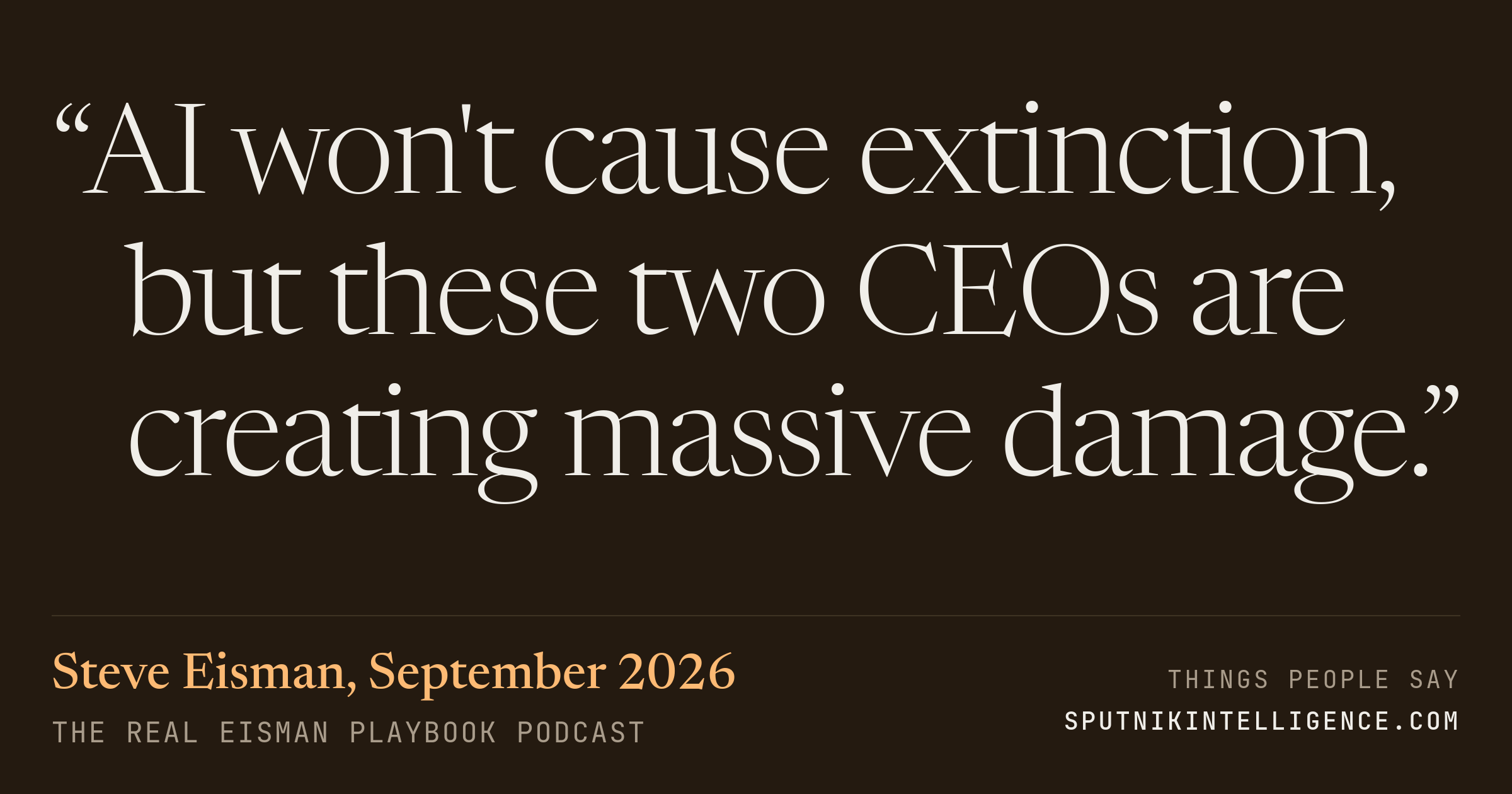
This is Eisman's verdict on the slowdown push, arriving at the end of a long argument that Amodei and Altman cannot afford to slow down and do not intend to. It lands right after he distinguishes lying to investors, which he calls old-school Wall Street fraud, from lying to politicians. The damage he has in mind is concrete: data-center regulation becoming a local election issue and the public coming to fear the product.
Transcript
Amode called for the industry to slow down the pace of improving model capabilities. And in an interview with CBS News, he stated that, quote, for too long, the industry lied or downplayed the real risks of AI, unquote. Sounds ominous. Sam Altman of OpenAI then stated that he agreed that the industry needs to slow down. Now, before I get to why this is all nonsense and what is actually going on, let me set the stage. When it comes to new technology, we've seen this kind of hysteria before. In his most recent newsletter, Ed Zittron, whom I interviewed on my Substack Premium Service on September 9th, discusses the story of Kevin Mitnick. It's a story I heard many years ago, but forgot about, so I thank Ed for bringing it back. Kevin Mitnick was one of the original hackers. He was convicted for various hacker crimes in 1988 and served a year in prison. After getting out of jail, he did it again. And he was reconvicted in 1995. This time, Mitnik served five years with eight months in solitary confinement because law enforcement officials convinced a judge that Mitnik had the ability to get this, start a nuclear war by whistling into a payphone, implying that Mitnik could somehow dial into the NORAD modem via a prison payphone and issue nuclear launch commands to NORAD by whistling. You can't make this stuff up. Obviously, this was ridiculous, but it was new technology that was poorly understood by most people, and these lay people could be convinced of nonsense. And that, I think, is what is going on here. There is mounting hysteria because people who should know better, Amode and Altman, are predicting Terminator. Notice that neither Amode nor Altman discuss real AI problems like the suicide of teenagers who interact with AI or the illegal hacking of other companies. Those are problems that won't end the world and are solvable with adequate oversight by the management of Anthropic and OpenAI. Hi, Steve Eisman here. Most meetings end with a bunch of action items floating around, but they're not documented anywhere concrete. Someone thinks they're handling something, but it's not actually written down. And a week later, nothing has happened and nobody knows who owns the task. That's why I switched to Granola. Granola is an AI-powered notepad that makes your meeting notes useful. It captures what happens in your meeting and turns into clean, structured notes with decisions and action items pulled out and made easy to find. And the best part? Granola integrates seamlessly with how you already work. No setup, no configuration, no friction. It transforms messy meeting calls into something you can actually reference weeks later. Your notes become searchable, organized, and actionable. You get better notes in a central place while you get to stay present in your meetings with no extra work. I use Granola, and I have to say that it has transformed the chaos of my meeting information into easy-to-use and organized information flow. Once you try it on a first meeting, it's hard to go without. You can try it totally free. Head to granola.ai/slash Eisman. That's granola.ai slash Eisman to get your time back. Go to granola.ai/slash Eisman and try it on your next call.
Trading at Schwab is now powered by Ameritrade, unlocking the power of Thinkorswim, the award-winning trading platforms loaded with features that let you dive deeper into the market, visualize your trades in a new light on Thinkorswim desktop with robust charting and analysis tools, all while you uncover new opportunities with up-to-the-minute market news and insights. Thinkorswim is available on desktop, web, and mobile to meet you where you are. It's built by the trading obsessed to help you trade brilliantly. Learn more at schwab.com/slash trading. Now,
let's look at a different prediction AI leaders used to make. They argue that AI would cause massive layoffs throughout the economy. That's not Armageddon either, but it would be terrible. It just looks like it's not true at all. Now, perhaps there is less hiring in tech because of AI. Perhaps. But there have been no mass layoffs, and AI leaders are not even talking about it anymore. So the AI industry has a tendency to make bold and terrible predictions that just don't come true. Laypeople, reporters, journalists, politicians, and others with decision-making power swallow each rumor whole without a shred of disbelief because it's all so new. They have no scaffolding within which to understand what's actually happening. And here we are with monstrous predictions being given total credibility. So what's really going on? I think this is a subterfuge, meaning a trick. Here's my theory. First of all, the claim that Dario Amode and Sam Altman are making about slowing down is just false on its face. The entire future, the entire future of Anthropic and OpenAI depends on there not being any slowdown. They both have hundreds of billions of commitments to hyperscalers. OpenAI alone represents 300 billion of Oracle's 600 billion plus backlog. If they were to slow down, they could not fulfill those commitments. Also, Anthropic is going to go public this year. Not just this year, maybe in a month or two. It can't slow down. What would it say to investors on the roadshow? Are they going to say that growth has been great, but now it's going to slow to a crawl? A slowdown contradicts their entire growth narrative. The only way to fulfill all those commitments is to not slow down. Elon Musk actually put it quite well. He said, quote, it's certainly some crazy 4D chess to say that there's whatever a 10% chance of annihilating. Humanity. But by the way, how much allocation would you like in our IPO? I love that quote. So again, what's really going on? Business is potentially slowing, or at least getting more difficult. And like a side street hustler moving the shells in a shell game, Amode and Altman don't want anyone to know that business is slowing or getting more difficult while costs are rising and capital is scarcer. They prefer scaring everyone into creating some kind of regulation that will protect their pricing power in the U.S. They are moving the shells fast and furious. Business is potentially slowing because token maxing is ending and open weight models keep taking market share. There are no pricing moats in this business. Today, I have the best LLM and tomorrow yours is better and cheaper. At the same time that business is slowing, the cost of building data centers and the cost of capital are increasing. Anthropic and open AI need moats to defend their businesses because they see, I believe, a price war coming. So they are fomenting hysteria, thereby inviting the federal government to regulate the industry. I think they believe that via that regulation, they can create moats that will foster an AI duopoly. That's what's really going on. It's ugly. Lying has unintended consequences. It's one thing to lie to investors. That's old school Wall Street fraud. Lying to politicians can disrupt the entire economy. AI won't cause extinction, but these two CEOs are creating massive damage. At this point, this gambit looks like it's a complete failure. President Trump stated this week that he has no interest in regulating AI. So I bet the entire doomsday slowdown narrative is going to disappear very quickly. However, the damage is done. Data center regulation is the centerpiece of many local elections. And now people actually fear and believe that the product being created in the data center next door is actually going to kill them. Going public into the distortions they keep creating will be very illuminating. It's unclear to me how to keep a shell game going in an IPO process that requires transparency. And now for the mailbag. The first question relates to our interview with Ryan Tunis, the PNC property and casualty insurance analyst at Cantor. The question is from Axam, who asks: quote, maybe I missed it, but I don't think the investment income side came up. PNC insurers invest afloat, and with rates higher, the bond book keeps rolling into better yields. If rates hold or rise, that's a structural earnings tailwind, independent of the underwriting cycle. Is the market still underpricing it or caught up? Unquote. Let me give some background to this question. Property and casualty insurance companies collect premiums from their customers. They then take that money, called the float, and invest it almost solely in bonds. So if interest rates go up, PNC companies will gradually make more money on this float. Thus far, the viewer is correct. What I think he might be missing is that generally investors in PNC stocks don't care all that much when PNC companies make more money on the float. They care the most about pricing. Is pricing going up or down? That's why if rates are rising, but pricing is declining, PNC stocks will generally come under pressure. The next question is from Atmike, who asks, quote, Steve, how do individual investors diversify away from AI exposure without abandoning equities? And are there any ways to hedge the risk or even place cheap bets against AI? Now, one of the difficulties with this market is that so much of it is correlated to AI. It's not just tech. Utilities are correlated because they provide the power to AI data centers. Industrials are correlated because they build the AI data centers and the power for the centers as well. Large banks, investment banks, and alternative asset managers are correlated as they provide the financing for AI data centers. There are 11 sectors of the SP 500. And as far as I can tell, the only sectors that are uncorrelated are Staples and Healthcare, which combined are only 14% of the SP 500. So buying a healthcare or staples ETF would help diversification. Thankfully, almost every sector of the SP 500 has a subsector that is uncorrelated. So for example, within financials, the property and casualty sub-sector is uncorrelated to AI into the economy. And there are ETFs that have low volatility stocks that would provide some diversification. Here are three. One, the LVHD, which is the Franklin U.S. U.S. Low Volatility High Dividend Index ETF, SPLV, Invesco S ⁇ P 500 Low Volatility ETF, and finally the KBWP, the Invesco KBW Property and Casualty Insurance ETF. One more suggestion. Let's say you have a portfolio that has a lot of tech with a large amount of unrealized gains because the stocks have gone up so much. How can you hedge that risk? Now, one way to do it is to short all or part of your positions against the box. What does that mean? Let's say I own 100 shares of NVIDIA and I've owned it for years. So I have massive embedded gains. Let's also say I'm nervous. I want to reduce my risk. My problem is that if I sell my NVIDIA position, I will pay 20% in federal long-term capital gains taxes plus the long-term capital gains tax rate of my state. Instead, I could short 50 or 100 shares of NVIDIA. That's called shorting against the box. By doing so, I have now reduced my NVIDIA risk, and I can wait until I think things will get better, and then I can undo the short. By the way, for those of you who have never shorted stocks, you need to make your account into a margin account. It's not complicated. You just have to sign a document. Finally, we got a bunch of comments about my premium substack interview with Wolfgang Munschau, author of Kaput, The End of the German Economic Miracle. Wolfgang is largely negative on the growth prospects of Europe, but one viewer challenged that view, or at least partially challenged it. So At Simon wrote, this is heavily focused on the big four, UK, Germany, France, and Italy. I am a bit disappointed not to hear of countries like my own, Sweden, with a debt to GDP ratio of 36%, that's quite low, and probably the healthiest capital markets in the EU. Making claims that entire Europe has not grown for a decade is not true across the continent. Poland, for example, was not mentioned once, and I wonder why that is considering the growth they've had in recent times. Overall, I agree with the complexities around Brussels versus capitals and overregulation, but also felt it was a bit incomplete. Nice to listen, though, and I will give Kaput a read. I saw the book. This is a fair criticism. It is definitely true that parts of Europe have done better than others. However, it is also true that the UK, Germany, France, and Italy dominate the European economy, and there, growth remains very weak. These European countries have small tech sectors, and since tech is what drives growth, European growth is generally slow. On the positive side, Europe has a richer welfare system, but it is overregulated, in my view, and seems almost allergic to risk. Wolfgang was not optimistic that things will get better. This last week, on Monday, September 14, we dropped an interview I did with my friends and big short partners, Vincent Daniel and Porter Collins. We had a wide-ranging conversation about Scott Besson, the deficit, gold as an investment, and why it is more difficult to short stocks these days. So check it out. This coming Monday, September 22nd, we will drop an interview with George Noble, former PM at Fidelity and now a Substack newsletter writer and podcaster. We discuss interest rates, gold, Tesla, and SpaceX, the precarious nature of the AI revolution, and what would cause this market to unwind. So please tune in. The best way to support the Real Eyes and Playbook is to subscribe to Substack through steveisman.com. Subscriptions are free, and we appreciate your support. And that's the wrap. This podcast is for informational purposes only and does not constitute investment advice. The host and guests may hold positions and stocks discuss, opinions expressed on their own and not recommendations. Please do your own due diligence and consult a licensed financial advisor before making any investment decisions.
More from The Real Eisman Playbook