← Things People Say on Podcasts

Hands-On Engineering Podcasts · August 2026
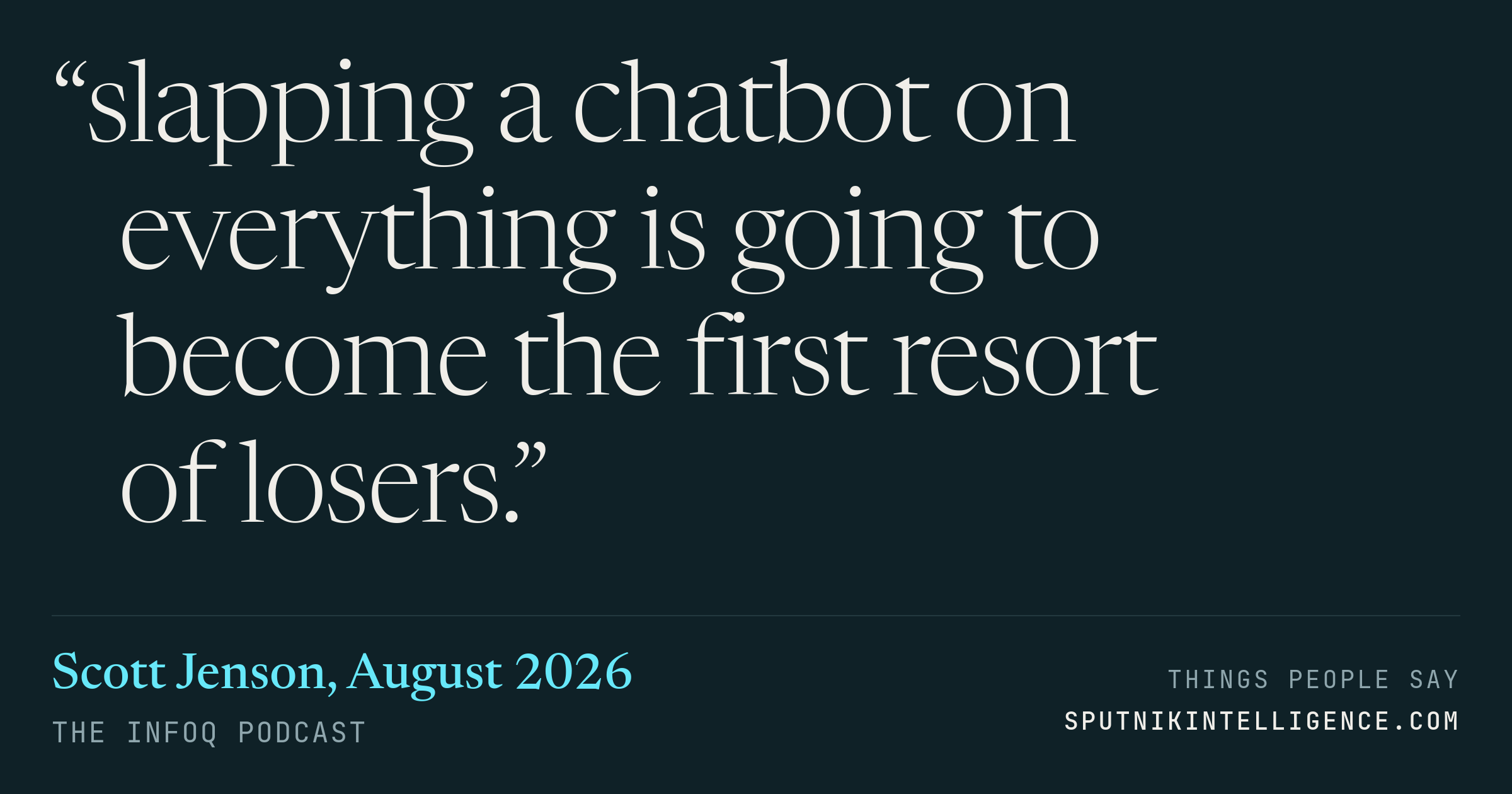
“slapping a chatbot on everything is going to become the first resort of losers.” — Scott Jenson, The InfoQ Podcast

Asked whether every interface is heading toward a single chat window, the longtime Apple and Google UX designer opened with "the short answer is hell no." His case is that intelligence is a social construct rather than a mathematical one, and that most real work is too full of context to survive being flattened into a prompt box. The line separates bolting a chatbot onto a product from doing the harder work of building the model into the problem.

The InfoQ Podcast · 2026-08-31 Listen to the episode → More from Scott Jenson →

Transcript

The InfoQ Podcast Around 25:35 into the episode
Scott Jenson

No, I completely agree. And there's multiple forces involved. So we talked just a few minutes ago, we talked about the role of governments to kind of force these things, but also there's the role of technology, right? Like, for example, what's going on right now with LLMs and the big data centers and so forth. There is likely going to be a technological force that's outside of the governments, which is to say we're going to, over the next five years, have machines that are significantly more powerful. And we're going to have open source, local models that can run locally. And this mirrors what's happened throughout the history of technology, whether you're going server-side or, you know, we went from mainframes to laptop mini computers. And from mini computers, we went to kind of cloud. And we went back to phones. And so this idea of going cloud and local and cloud and local has repeated itself throughout history. And I think we'll see the exact same cycle with LLMs. Just yesterday, I was trying to do some coding using a local model. And it was pretty terrible, but I had to try, right? But I did switch to an open coding agent, and I used DeepSeq. And it was shockingly good. Now, DeepSeek has its own issues. I'm not trying to say it's perfect, but I mean, I'm saying we can see the vector, right? And so as we get a more ethically trained model, which still I don't think that mark has been hit. They all have ethical issues right now. But the point is, if we get an open source model that we can run locally, that provides, I think, a fantastically interesting opportunity to switch power away from these big guys, too. So there's lots moving that's interesting.

Speaker 2

Thank you, Scott, for moving the direction towards LLMs, because I know your opinion and I align with that because they are points immoral and they are a terrible disaster for the green part, but they are very useful at this point and they will be able to accelerate it. And now as you open Pandora's box, I have to ask. The guys from Google tried to make everything a web page with Chrome OS. Well, that didn't take off. Now, the guys from OpenAI want to make a small box with just one button, and that's it. Is the discussion that we just had useful in the context that everything will be a A chat window and everything else would be just typing in.

Scott Jenson

Okay. How much time do you have? The short answer is hell no. And I think as a UX designer, I mean, I actually, again, I try to write my thoughts down. So on my blog, I've got a post called Boring. It's all about LLMs are boring is good. And I think that there is a lot of ways in which we can use LLMs that are smaller and easier. But also, we need to understand that intelligence is inherently social. It's a construct that you and I agree on as to what is intelligent. And so much of what we do that is work is actually part of our cultural construct. It's not a mathematical concept of intelligence. It's something that we share as a society. And the same thing applies to LLMs and work. So much of the work is more nuanced. It's got context. And so I do believe that we're going to get more LLM-based support, but it will move towards the problem. And slapping a chatbot on everything is going to become the first resort of losers. I mean, it's just, it's, yes, you can do it. And there is some value to it. But I do believe that having the LLM built into your problem is more work, but it will allow you to do far more interesting work. So I've written about, I don't want to go into the details of the specifics, but I do believe that we will get past this chatbot phase as more and more apps are written. But to be clear, it's not as easy, right? It's cheap to throw a chatbot on.

Speaker 2

Okay. In my evil moment when I was working for a company where Dollar was king or, well, Euro was king, I was trying to frame the offer of the company during the takeoff of the LLM. And what I was pushing for was augmented user experience, augmented interfaces. So at points, as you mentioned in our previous conversation, where I don't know, you want to find the right temperature balance with the voice interface, that can be quite problematic when you can be a knob, like just going left and right, a bit more, a bit less. It could be frustrating. And that's the feeling also with LLMs at points. But what I think an LLM can do is provide the mechanism at a given point of time where you want to fast onboarding. Let's say you have an accountant, 20 years of experience, he worked his whole life into a given tool, a given software. He's used only with that. He knows what to do. He moves

Speaker 1

the next

Speaker 2

day to another one and he doesn't know what to do, but he knows exactly what he should ask. So that, from my perspective, is a good way of looking at it. And it can be voice, it can be a couple of buttons, it can be a chat window. And that's a good way of interacting with an LLM that will provide you the exact tables and charts that you would imagine. And that would be a lot faster than Lokud from my perspective.

Speaker names from our own diarization · position estimated from where the line sits in the episode

More from The InfoQ Podcast