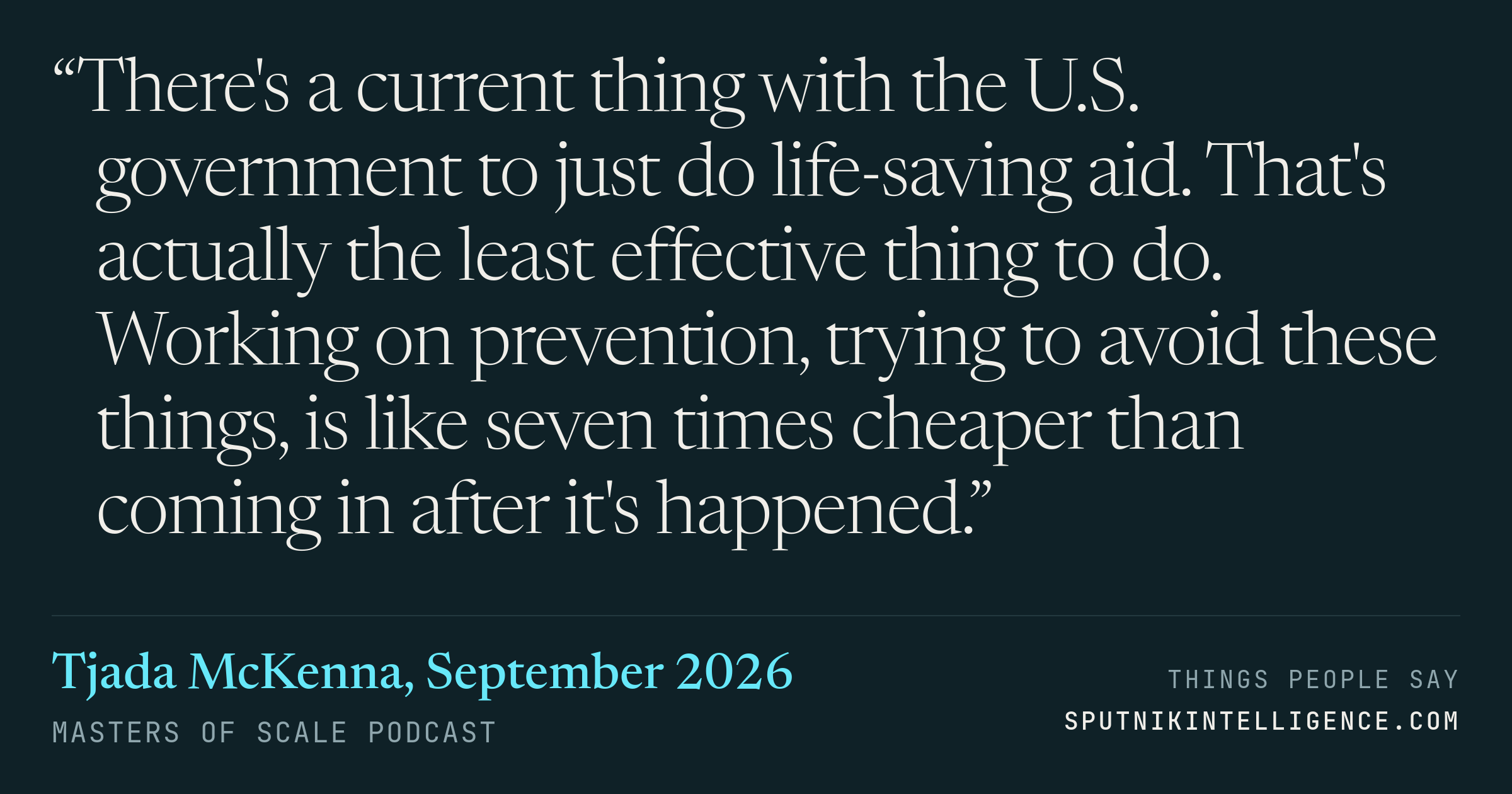
“There's a current thing with the U.S. government to just do life-saving aid. That's actually the least effective thing to do. Working on prevention, trying to avoid these things, is like seven times cheaper than coming in after it's happened.”
Masters of Scale · Startups & Venture · September 2026
McKenna is CEO of Prosper Global, the humanitarian organisation that was Mercy Corps until its rebrand. Asked on Masters of Scale how she handles the sheer number of simultaneous crises — Ukraine, Sudan, Gaza — she argued that the money being cut is the preventive kind. Her example elsewhere in the episode: fuel and fertiliser costs during Sudan's short planting window, where missing one season crippled the next one's food supply.
Transcript
we have a very large programming presence in Ukraine. I was in Ukraine in December. The reality is the nature of that war now: Russia is increasingly attacking civilian and economic infrastructure. There have been increasing attacks on ports, but also, especially with drones, on grain silos, on storage facilities. So, even the farmers, there actually was a good harvest this year. But if you bombed out the silos and storage for people to store them, or if you've bombed the roads and the ports to move those grains out, then you've lost the income from that time period. And there are just deliberate attacks on this kind of infrastructure. And so, we have been doing things like providing sleeveless grain storage, working with farmers, helping with demining because Ukraine was a breadbasket for a lot of the world, and it needs that food to care for itself in its own economy. When we talk about Prosper Global and like helping people to not only survive the immediate, but to really build their future, that's exactly the kind of support. You know, a lot of people have lost farm equipment, like helping people to rebuild or figure out alternative paths.
I wanted to ask you about Gaza, but I'm also struck by like I'm just going from one crisis to another, which I know is your life. But for a lot of folks listening, like they might feel like, oh my gosh, that is overwhelming.
The number and the severity of crises, you've never had so many at one time. The need is relentless, and we have to be relentless in pursuing support. There's a current thing with the U.S. government to just do life-saving aid. That's actually the least effective thing to do. Working on prevention, trying to avoid these things is like seven times cheaper than coming in. After it's happened.
In your work, you're used to dealing with hostile political environments, but it is a little different when it happens in the U.S.
Yeah, like the pushback and just the misinformation about what aid is. You know, we were prepared to do this rebrand of Prosper Global before the beginning of the Trump administration. We put it on hold just to figure out where things were. In the midst of a crisis where there have been like, you know, some funding has gone away, like the sector is in a tough place. We've really like doubled down to help the American people really understand like the nature of humanitarian needs and what aid looks like today, right? And to correct a lot of misinformation or just things that people have been saying about it. I think the important leadership moment there is like being intentional. So there may be things that we have let go or not done, but like what are we building on? And building on that belief, like our core belief that people deserve the right to prosper. And we do basic survival, but that's the minimum and we shouldn't accept the minimum. And there's a cost to doing that that long term leaves us worse off.
Jada doesn't sugarcoat the challenges, but she's also optimistic that better outcomes are possible. So how will she use this year's UN General Assembly meeting to advance that goal? And could AI firms provide Prosper Global with a secret weapon? We'll talk about that and more after the break. Stay with us.
More from Masters of Scale