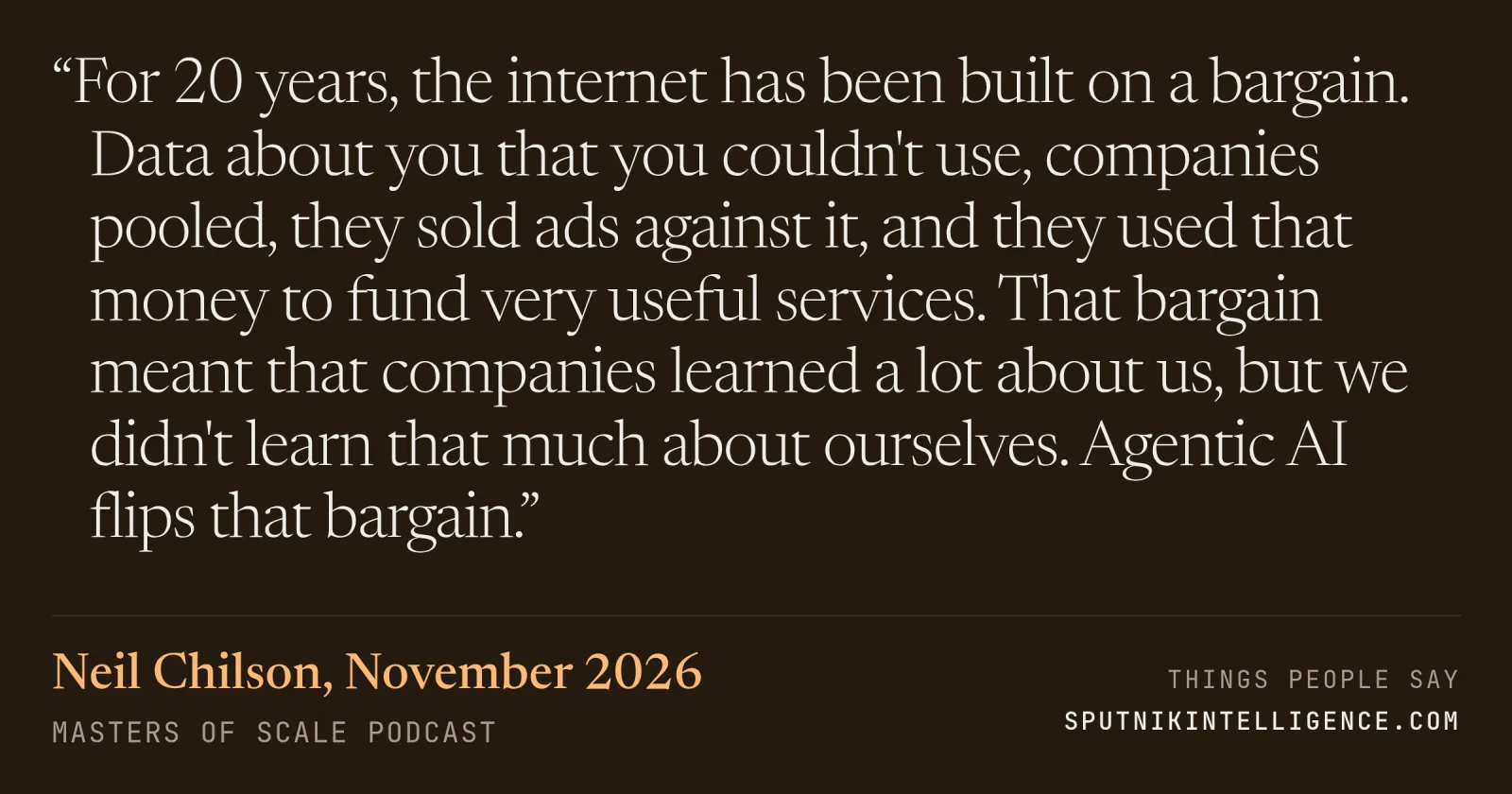
“For 20 years, the internet has been built on a bargain. Data about you that you couldn't use, companies pooled, they sold ads against it, and they used that money to fund very useful services. That bargain meant that companies learned a lot about us, but we didn't learn that much about ourselves. Agentic AI flips that bargain.”
Masters of Scale · Startups & Venture · November 2026
Context
This is Chilson's opening in a debate on whether to stop trusting AI agents with our information. He frames agents as tools that finally let individuals use their own data.
Transcript
…but we should be pushing to build trustworthy systems. Because in security, trust comes with verification. I'm not asking you to trust Signal. I'm not asking you to trust me. I'm asking you to look at our code and recognize that it's trustworthy. And if it isn't, come back to me and we will fix it.
Thank you. Neil, three minutes and 12 seconds. Great.
So for 20 years, the internet has been built on a bargain. Data that about you that you couldn't use, companies pooled, they sold ads against it, and they used that money to fund very useful services. That bargain meant that companies learned a lot about us, but we didn't learn that much about ourselves. Agentec AI flips that bargain. We all now have, each of us has access to powerful software tools that can comb through the mountain of our data for us. So yeah, I use a lot of the applications, a lot of the agent use cases that Meredith referred to. I give it access to my calendar. It manages that. It monitors my family's finances. I use it to troubleshoot all the time. Thousands of people do lots of other things that are like that, you know, comparison shopping online. And I take the point that a lot of that's driven by convenience. But these are tasks that only the wealthy could delegate in the past. If you don't have an executive agent, these are the types of things that you have to do yourself. So yes, there is a huge amount of convenience here. Agents give us agency, the theme of this event. And yes, that…
you, Neil. Neredith, I hear Neil saying the agents give us an opportunity not only for a better privacy bargain, but we can actually enhance our data privacy by using the agents. Why is he wrong?
Well, I think the agents aren't ours in most cases. When we're talking about Meta's Muse, we had a person show up to someone else's house because Muse had given that person the address to that house because that person said, hey, Muse, can you manage my Facebook marketplace for me? And Muse took…
Neil, given the challenge. Given the challenge of segmenting and locking down data, why is the convenience value worth more than the risk we're creating here?
More from Masters of Scale