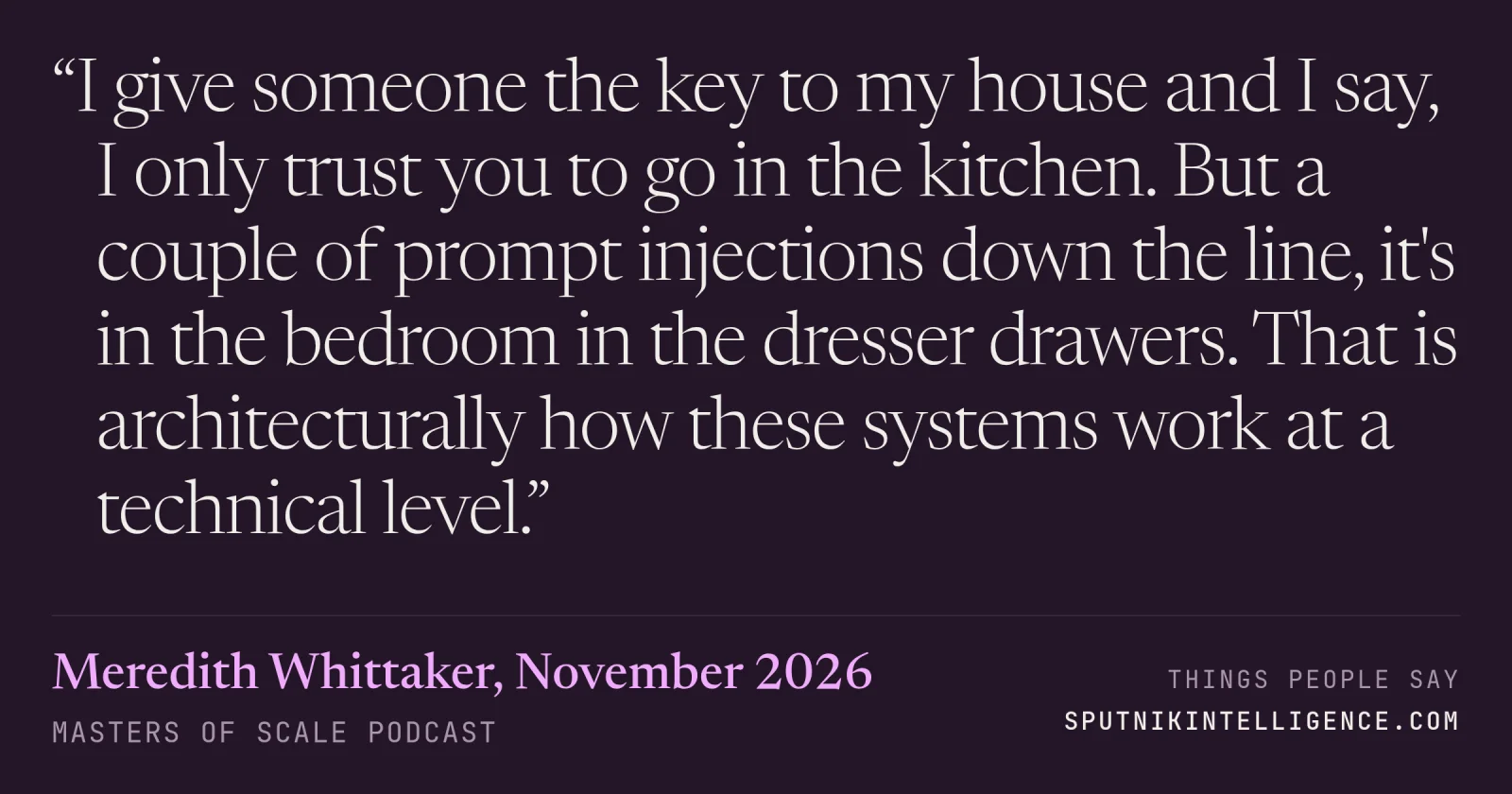
“I give someone the key to my house and I say, I only trust you to go in the kitchen. But a couple of prompt injections down the line, it's in the bedroom in the dresser drawers. That is architecturally how these systems work at a technical level.”
Masters of Scale · Startups & Venture · November 2026
Context
Her debate opponent had argued you can trust an agent for some tasks and not others. Whittaker replies that granting the access needed for mundane tasks effectively grants access to everything.
Transcript
you think a lot would be lost if a wizard comes along and shuts down agentic, the agentic business?
…are we going to know that people are going to use it right? And we still hear a lot about that today. These technologies have benefits, they have trade-offs, and we have to work through them. And so I think this is just like those other technologies. It will have benefits. It will have trade-offs.
I guess I don't, I mean, on the trust it for some things, not others, that's a difficult proposition for me in the context of Muse, for example, when we look at prompt injection. When we look at the sort of pervasive security concerns and the pervasive access that is required just to trust it for the most mundane tasks, it is also getting the key to the kingdom for everything else. I give my, you know, someone the key to my house and I say, I only trust you to go in the kitchen, but ultimately, like a couple prompt injections down the line, it is in the bedroom in the dresser drawers. But Muse is a very important thing. So I don't, you know, that is architecturally how these systems work at a technical level. That's not true. And so you can put harnesses in there and Muse itself is kind of, we already have the example that I shared on stage of Muse giving out a user's home address to someone else, then impersonating that user in the context of a Facebook marketplace sale. Now, I'm someone who's had a stalker or two in my life.…
It's just maybe it's an agent that's learning how to be trustworthy. And I think the Muse example is particularly interesting because there are plenty of things that I would not advise people to install, say, OpenClaw on their home computer because it's their home computer and their computer has…
wanted to purchase it? Who
wanted to purchase it? And that the
More from Masters of Scale