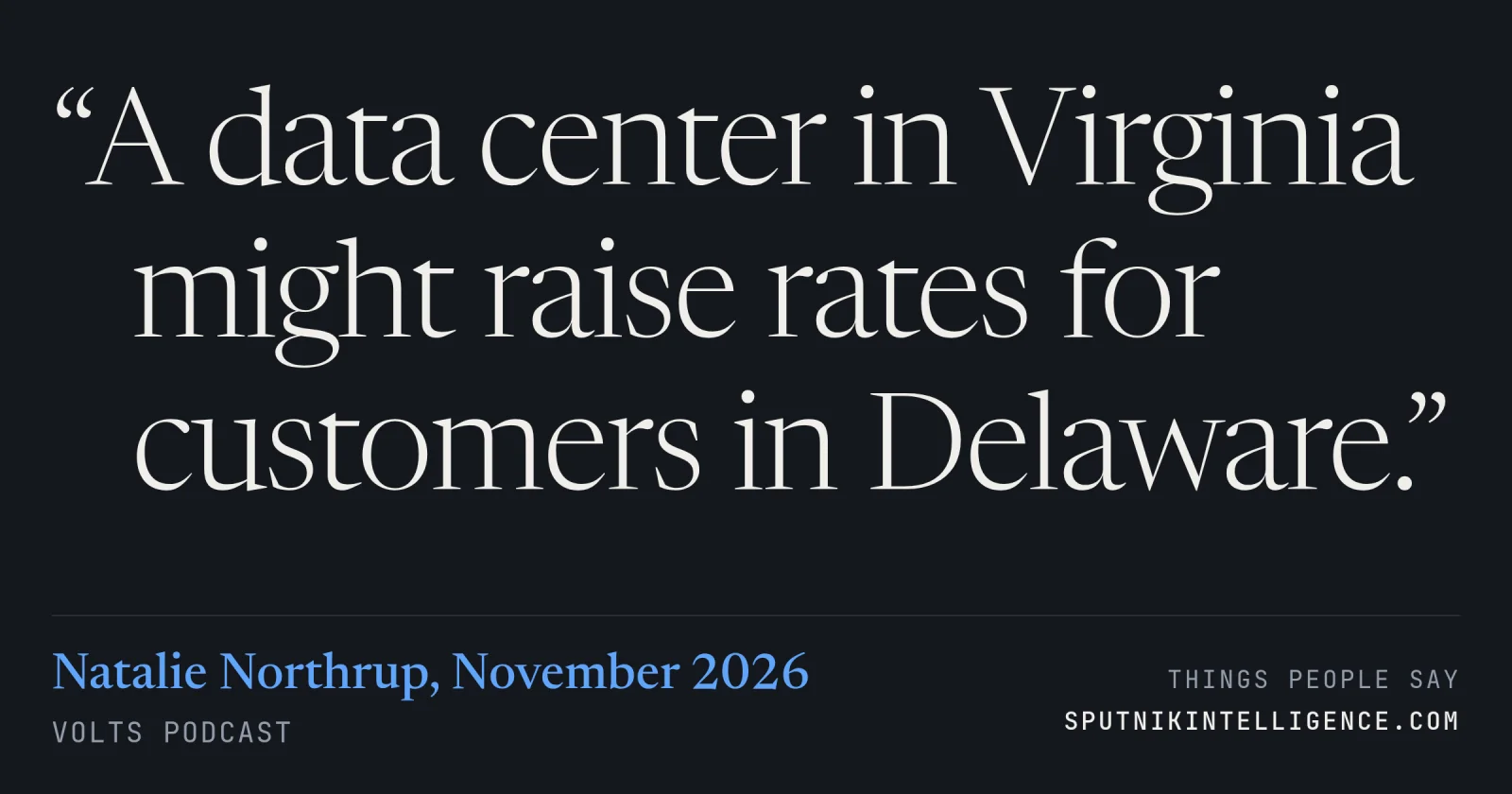
“A data center in Virginia might raise rates for customers in Delaware.”
Volts · Climate & Energy · November 2026
Context
Northrup was explaining that in PJM, a multi-state power market, utilities pay the regional capacity price. David Roberts asked whether a new large load raises rates across the whole region, and she confirms it with this example.
Transcript
…or long-term contract, that every year they have to pay for all of the generation capacity to serve all of their customers. And if that price increases, everyone's paying more and not just in the utility that's serving the large load, but all of the other utilities exposed to that regional price.
Right, right, right. So a new load can raise rates for in PJM, dozen utilities, a dozen, whatever. I don't know how many states PJM is, eight, something like that. They raise rates for everyone.
Yes. So a data center in Virginia might raise rates for customers in Delaware.
Right, right. As opposed to if I just am in a utility territory with a vertically integrated utility, all those costs, in a sense, are internal to the utility area. If you're in a regional market, what's the significance of that? Is it worse to be in PJM then somehow because you're, in a sense…
I'm going to go back to the unsatisfactory, it depends. The downside risk that costs increase, there are two pieces of it. One is that you're exposed to costs from other utilities serving large loads. So the cost exposure risk is higher. And it changes what policies and tariff mechanisms are most…
Right, right, right. A large load comes along in a particular utility territory. What you need to build to accommodate that new large load is pretty clear and pretty contained and under your control and can be assigned to the new load, technically. Like you could just charge it to the new load.…
More from Volts