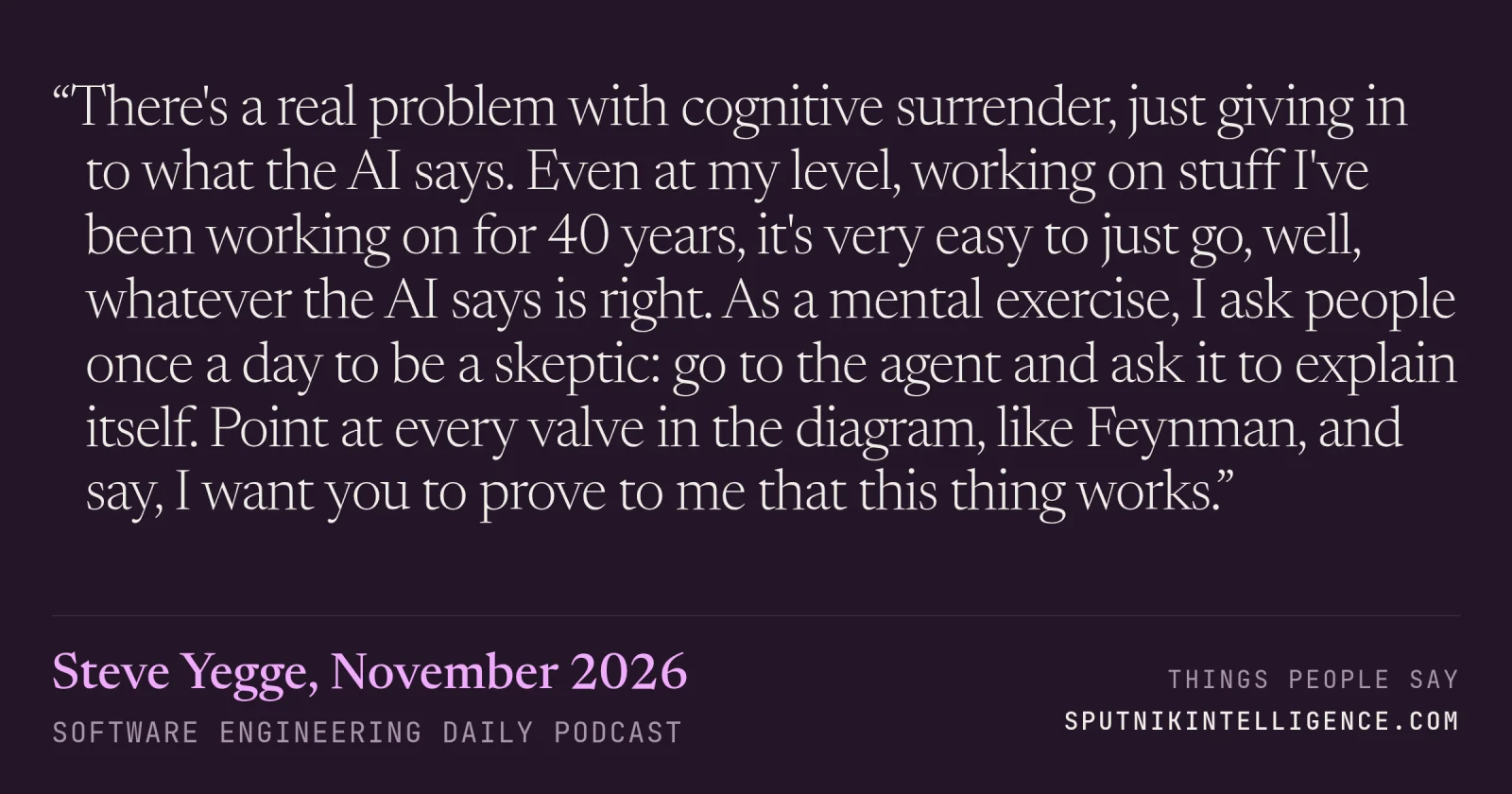
“There's a real problem with cognitive surrender, just giving in to what the AI says. Even at my level, working on stuff I've been working on for 40 years, it's very easy to just go, well, whatever the AI says is right. As a mental exercise, I ask people once a day to be a skeptic: go to the agent and ask it to explain itself. Point at every valve in the diagram, like Feynman, and say, I want you to prove to me that this thing works.”
Software Engineering Daily · Hands-On Engineering Podcasts · November 2026
Context
Agentic development tends to produce complicated solutions. Steve Yegge says he refuses any solution he can't understand, and gives this daily habit as advice to people worried about AI taking their jobs.
Transcript
…us together collectively struggle to understand the systems, even the super intelligences. Our ambition is always going to, you know what I mean? We'll just get more ambitious, right? Because the software can always be better until everything is perfect and everything will never be perfect, right?
…to me. That I'd be curious your thoughts on. I find Agentic development is really good at complex solutions to complex problems and pretty poor at finding simple solutions to either simple problems or complex problems. I'm curious if you found a way around that, or is that also your observation?
I don't accept any solutions I can't understand. I'm like, no, I don't understand that. You know, come up with a better solution. And usually I won't understand it because I'll just be like, I'll be looking at some failure mode for the solution, you know, down the road that they hadn't thought of that just is nonsensical, right? Complex solutions usually lead to complex failure modes, right? So it's usually, you know, it's not very hard to pull a Richard Feynman and walk in and point at one point just point at the valve and find that the whole system breaks when they come up with a complex solution. So yeah, hold them accountable for everything. You know, when people ask me for advice, young people ask me for advice pretty often. They're like, well, what should we do? Or people who are in a job that they're worried AIs come in and they're like, how do I prep? You know, it's really interesting that like, there's a real problem with cognitive surrender and sort of just giving into what the AI says. Even, you know, at my level, when you're working with stuff that I've been working on for 40 years, it's very easy to just go, well, whatever the AI says is right, you know? And that actually like, that's a disservice…
So that's cognitive surrender is bringing up something I wanted to dig in. So I think it was around when we spoke last time you wrote an article about the AI vampire and the way that working intensively with AI tools was kind of drawing energy out of people. And I think you were highlighting taking…
Not even a little bit. I can tell you it comes and goes. It's cyclic and it is absolutely tied to how much I personally get to engage the agents, the thing they're asking for. So the quality Steve time is what knocks me out. And it's because right now the factory is working, but it's working on…
Impressed you can do it all day. I feel like I get knocked out trying to do that for like four or five hours. And I'm like, okay, I need something that's less intense.
More from Software Engineering Daily