SY

Steve Yegge

Things Steve Says on Podcasts

Where to Find Them

Steve Yegge writes Latent Space . They have also been a guest on The Pragmatic Engineer (3 times) , Software Engineering Daily (2 times) , The Changelog (2 times) , The Data Exchange with Ben Lorica , Hanselminutes with Scott Hanselman and Software Misadventures .

Recently: “Steve Yegge on Building Software Factories” on Software Engineering Daily (November 2026); “From IDEs to AI Agents with Steve Yegge” on The Pragmatic Engineer (March 2026); “Gas Town, Beads, and the Rise of Agentic Development with Steve Yegge” on Software Engineering Daily (February 2026); “Steve Yegge on AI Agents and the Future of Software Engineering” on The Pragmatic Engineer (February 2026); “The AI Vampire with Gas Town's Steve Yegge” on Hanselminutes with Scott Hanselman (February 2026); “Steve Yegge's Vibe Coding Manifesto: Why Claude Code Isn't It & What Comes After the IDE” on Latent Space (December 2025).

What They Said

“There's a real problem with cognitive surrender, just giving in to what the AI says. Even at my level, working on stuff I've been working on for 40 years, it's very easy to just go, well, whatever the AI says is right. As a mental exercise, I ask people once a day to be a skeptic: go to the agent and ask it to explain itself. Point at every valve in the diagram, like Feynman, and say, I want you to prove to me that this thing works.” — Steve Yegge, Software Engineering Daily

Agentic development tends to produce complicated solutions. Steve Yegge says he refuses any solution he can't understand, and gives this daily habit as advice to people worried about AI taking their jobs.

Software Engineering Daily · 2026-11-24 Permalink → Listen →
Software Engineering Daily Around 42:19 into the episode
Steve Yegge

…us together collectively struggle to understand the systems, even the super intelligences. Our ambition is always going to, you know what I mean? We'll just get more ambitious, right? Because the software can always be better until everything is perfect and everything will never be perfect, right?

Kevin Ball

…to me. That I'd be curious your thoughts on. I find Agentic development is really good at complex solutions to complex problems and pretty poor at finding simple solutions to either simple problems or complex problems. I'm curious if you found a way around that, or is that also your observation?

Steve Yegge

I don't accept any solutions I can't understand. I'm like, no, I don't understand that. You know, come up with a better solution. And usually I won't understand it because I'll just be like, I'll be looking at some failure mode for the solution, you know, down the road that they hadn't thought of that just is nonsensical, right? Complex solutions usually lead to complex failure modes, right? So it's usually, you know, it's not very hard to pull a Richard Feynman and walk in and point at one point just point at the valve and find that the whole system breaks when they come up with a complex solution. So yeah, hold them accountable for everything. You know, when people ask me for advice, young people ask me for advice pretty often. They're like, well, what should we do? Or people who are in a job that they're worried AIs come in and they're like, how do I prep? You know, it's really interesting that like, there's a real problem with cognitive surrender and sort of just giving into what the AI says. Even, you know, at my level, when you're working with stuff that I've been working on for 40 years, it's very easy to just go, well, whatever the AI says is right, you know? And that actually like, that's a disservice…

Kevin Ball

So that's cognitive surrender is bringing up something I wanted to dig in. So I think it was around when we spoke last time you wrote an article about the AI vampire and the way that working intensively with AI tools was kind of drawing energy out of people. And I think you were highlighting taking…

Steve Yegge

Not even a little bit. I can tell you it comes and goes. It's cyclic and it is absolutely tied to how much I personally get to engage the agents, the thing they're asking for. So the quality Steve time is what knocks me out. And it's because right now the factory is working, but it's working on…

Kevin Ball

Impressed you can do it all day. I feel like I get knocked out trying to do that for like four or five hours. And I'm like, okay, I need something that's less intense.

Speaker names come from our own diarization. The position is estimated from where the line sits in the episode.
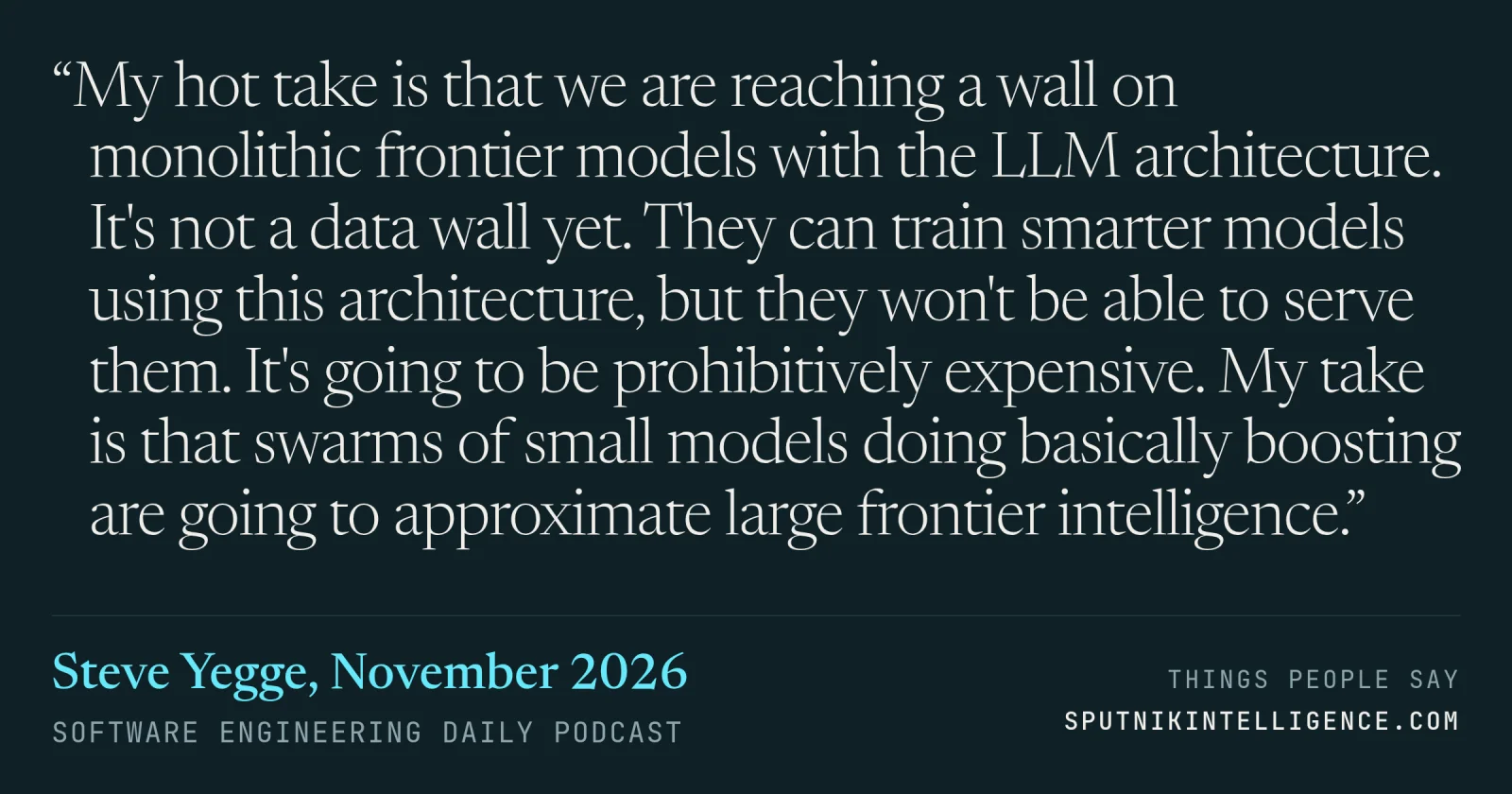
“My hot take is that we are reaching a wall on monolithic frontier models with the LLM architecture. It's not a data wall yet. They can train smarter models using this architecture, but they won't be able to serve them. It's going to be prohibitively expensive. My take is that swarms of small models doing basically boosting are going to approximate large frontier intelligence.” — Steve Yegge, Software Engineering Daily

Asked whether the end of falling token prices is lasting or a temporary squeeze, Steve Yegge says it's structural. The biggest models can be trained but not served at an affordable price.

Software Engineering Daily · 2026-11-24 Permalink → Listen →
Software Engineering Daily Around 56:44 into the episode
Steve Yegge

Despite trillions and they're being built everywhere, but it still takes, you know, like a year or more. And that's a year is like a very, very long time in model space. And so they hit a Squeeze. They hit a wall.

Kevin Ball

So that is one question I have: is like, do you think this is a is this an ongoing change to the shape? Have we ended the eras of shrinking token costs or is this a temporary supply squeeze?

Steve Yegge

My hot take is that we are reaching a wall on monolithic frontier models with the LLM architecture. And it's not the wall. So we're not hitting a data wall yet. They can train smarter models using this architecture, but they won't be able to serve them. It's going to be prohibitively expensive. They won't be able to serve them. Not in any way that we will be able to experience or take advantage of. It'll be very expensive. Okay. My take is that swarm intelligence is going to fill that gap and that swarms of small models doing basically boosting are going to approximate large frontier intelligence. And that's going to be our cause. That's our way through. And swarm intelligence is scary because it's even less governable than models are. But I think that's where it winds up. And I think factories are our earliest, earliest forays into that space. So open weight models have a place and small models have a place, right? Bespoke custom models. The bitter lesson is an unstoppable force. Okay. Richard Sutton. And Moore's Law, the exponential growth of intelligence. It's an unstoppable force, but resource constraints are the immovable object. That's why inference…

Kevin Ball

Yeah. Well, and it's interesting, right? Because today's small models are like the frontier models of a year ago.

Steve Yegge

They are, but I do think that the frontier, the actual visible frontier to us slows down. Like, I think Fable class, or maybe just a little better, one generation better is like, that's what we'll have to work with. I mean, look at me. Like, Fable is as good as it gets. And I'm spending, what…

Kevin Ball

That is a good place to stop. I'll head it.

Speaker names come from our own diarization. The position is estimated from where the line sits in the episode.
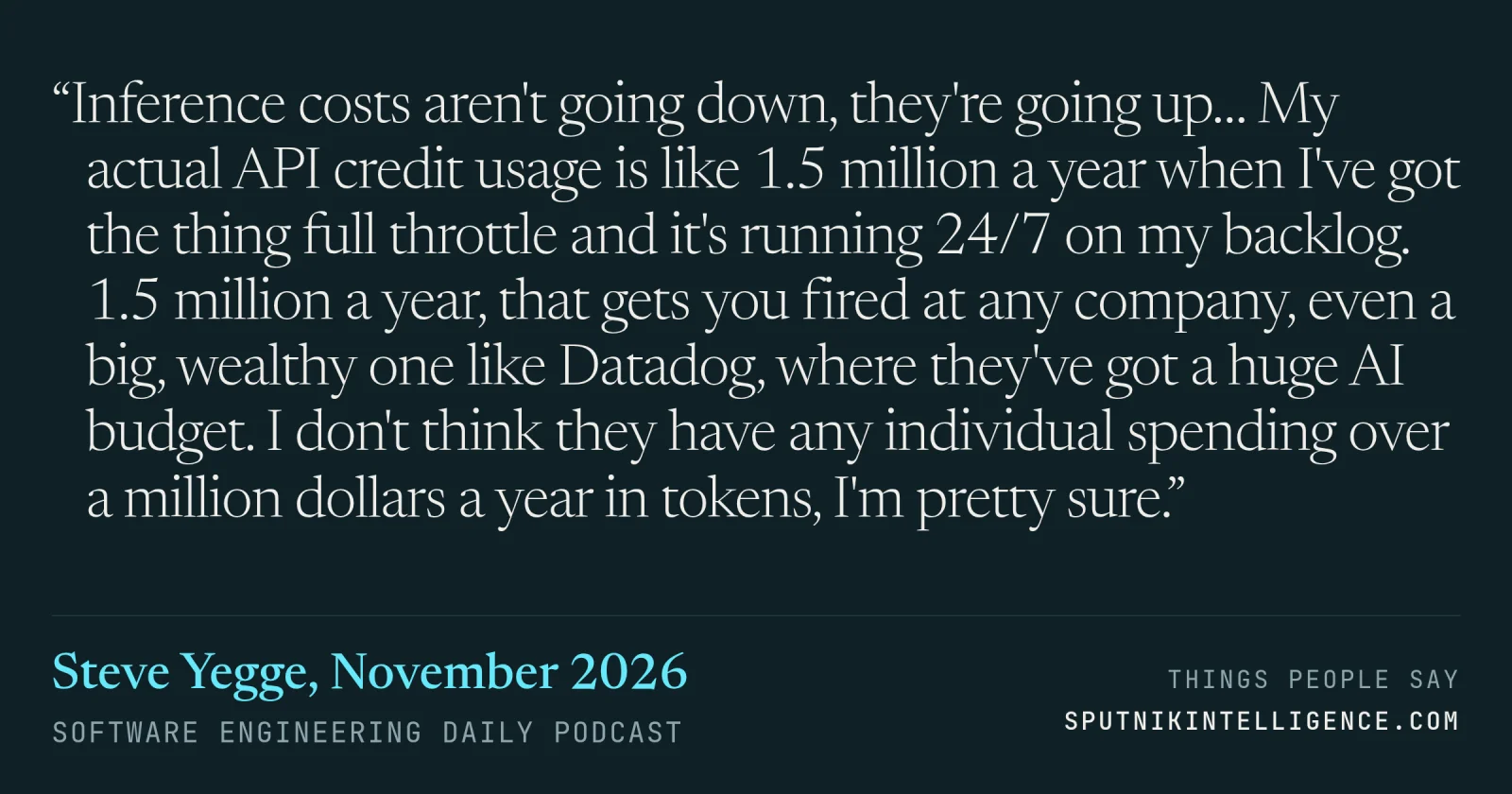
“Inference costs aren't going down, they're going up… My actual API credit usage is like 1.5 million a year when I've got the thing full throttle and it's running 24/7 on my backlog. 1.5 million a year, that gets you fired at any company, even a big, wealthy one like Datadog, where they've got a huge AI budget. I don't think they have any individual spending over a million dollars a year in tokens, I'm pretty sure.” — Steve Yegge, Software Engineering Daily

Steve Yegge describes the "fuel crunch" of keeping a large agent factory running around the clock. The dollar figure is his own estimate of his token bill at full throttle.

Software Engineering Daily · 2026-11-24 Permalink → Listen →
Software Engineering Daily Around 38:43 into the episode
Steve Yegge

…your company and who does what. Before they can actually be sort of trusted to make their decisions, right? And so that's why I think TPM agents swarming your company is actually good. And I tweeted this like, I don't know, a couple of days ago. I think this is a way to really get it kickstarted.

Kevin Ball

…going to start at your 20 AI employees that you have right now. First, no wonder they're asking for your attention. Like, I can barely send enough attention to five or six reports, right? You talk about 20. That's a lot. So, how are you allocating your attention across these different agents?

Steve Yegge

…but we haven't really rebuilt trust on my side. And I am still insisting that we fix the factory to be really solid. And recently, that's all been about fuel consumption. If I showed you a picture, my little graph is so sad. It looks like lava. It's all flat and red and yellow. I have 21 accounts, and only one of them has any juice in it, right? So, like, until I solve the fuel problem, because inference costs aren't going down, they're going up. Every problem is a fuel problem. If I have 18 seats and they're all getting woken up periodically to see, oh, you know, are you pulling lane work or whatever? Has anything happened recently in your lane that costs money? And so, if I have 18 seats, that's costing a fixed cost, right? And I have to manage their context. And so, like, I put a bunch of them into Fuel Park, and that was a new…

Kevin Ball

It's interesting because, I mean, now we're going a little bit into the sort of philosophy, but very few of us actually want to be CEOs. Like that job kind of sucks, honestly.

Steve Yegge

It does. It does. It does. And, you know, I'd like nothing more than a factory that I can just ask stuff of and get answers from. But, but that's not the world we're in right now. The reality is that getting results out of coding agents, getting good outcomes out of coding agents is still a…

Kevin Ball

Yeah. I think another thing that's been interesting to me. That I'd be curious your thoughts on. I find Agentic development is really good at complex solutions to complex problems and pretty poor at finding simple solutions to either simple problems or complex problems. I'm curious if you found a…

Speaker names come from our own diarization. The position is estimated from where the line sits in the episode.
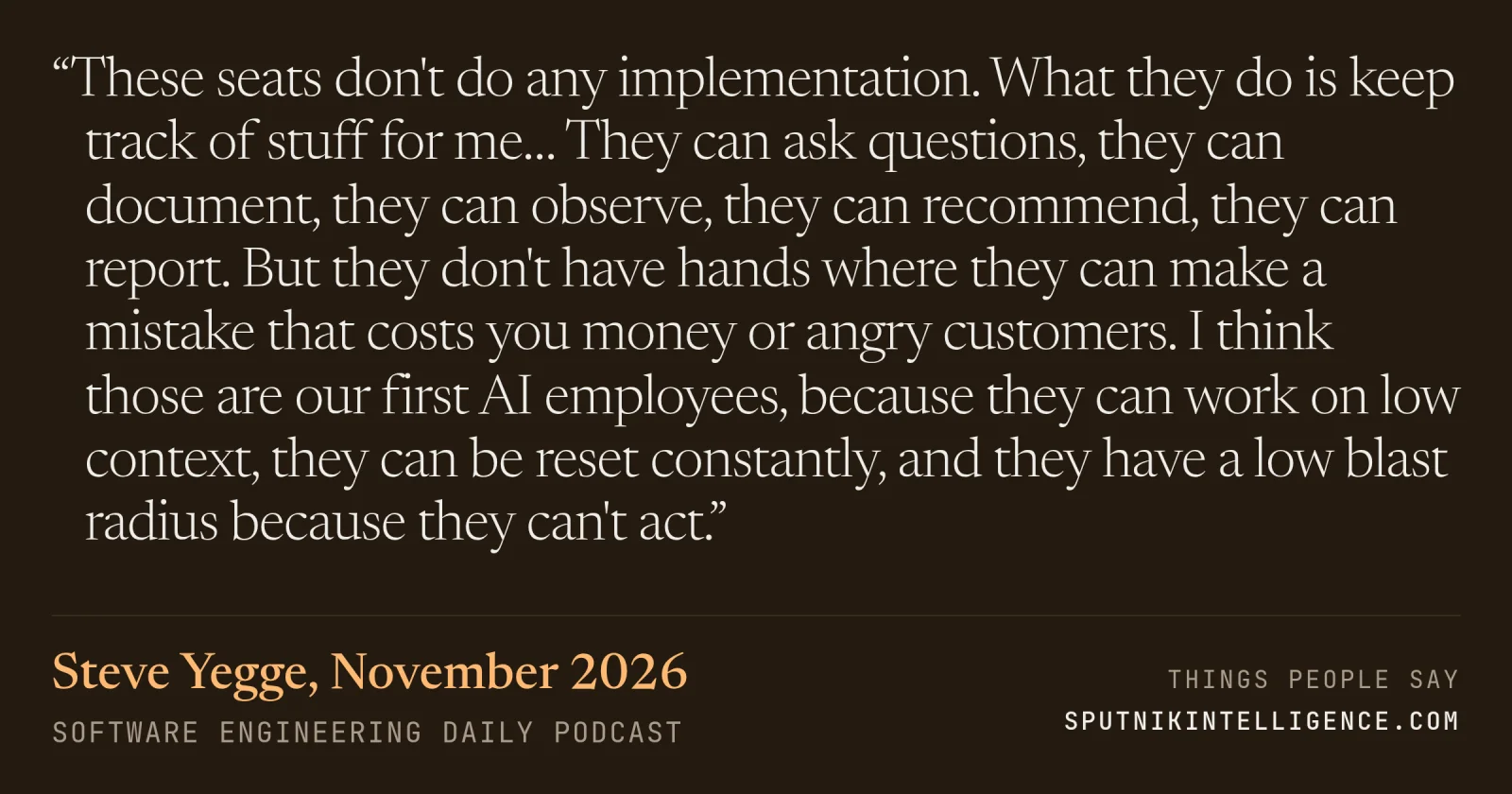
“These seats don't do any implementation. What they do is keep track of stuff for me… They can ask questions, they can document, they can observe, they can recommend, they can report. But they don't have hands where they can make a mistake that costs you money or angry customers. I think those are our first AI employees, because they can work on low context, they can be reset constantly, and they have a low blast radius because they can't act.” — Steve Yegge, Software Engineering Daily

Steve Yegge argues the first real AI employees inside companies won't be coders. They will be project and program managers, agents that observe and report but can't act, so their mistakes stay cheap.

Software Engineering Daily · 2026-11-24 Permalink → Listen →
Software Engineering Daily Around 36:55 into the episode
Steve Yegge

…going to care about. But a lot of it was kicking off ways of code review, new test coverage, new automation and stuff like that, right? That's a way that you can get your learnings and you can spend your tokens and not waste it and get meaningful work done, but you haven't overwhelmed the business.

Kevin Ball

Yeah, it is interesting. I feel like in some ways we are still grappling with how we reorganize around that, right? What does that even look like?

Steve Yegge

I'll tell you, I had a big breakthrough a week ago. Okay. I was in Sydney last week and I was talking to Martha McKean, who heads up the AI rollout at Commonwealth Bank Australia. And we were talking about exactly that, right? What shape does this take when these things roll out? Right. And I realized that the agents that I'm most excited to share with others are the ones that are working with others. So I have about 18 to 20 at any given time, like named seats that I work. They're my direct reports. I'm like the CEO and they're my executive team. Okay. So I had a product and had a quality and had a security and head of the estate and head of wheelhouse and a bunch of other ones. Right. But the ones that are the most interesting are the ones that actually have email addresses and they talk to my lawyers and they talk to my accountants and stuff, right? And my players. And what they do is these seats, they don't do any implementation. Very rarely. They don't act at all. What they do is they keep track of stuff for me. Like I was telling you, my accountant, she's very happy at how organized BAT is and how thorough. Well, BAT is acting as a technical program manager for me for my finance program, which is get paid and get gigs…

Kevin Ball

Now, one of the questions I have, actually, this goes a couple places. I'm actually going to start at your 20 AI employees that you have right now. First, no wonder they're asking for your attention. Like, I can barely send enough attention to five or six reports, right? You talk about 20. That's a…

Steve Yegge

So, all I can say is, I had one glorious week where I was attending to all of them and we were in heaven. Okay. Because of the big overfencing problem and the loss of trust, we rebuilt trust on their side, but we haven't really rebuilt trust on my side. And I am still insisting that we fix the…

Kevin Ball

It's interesting because, I mean, now we're going a little bit into the sort of philosophy, but very few of us actually want to be CEOs. Like that job kind of sucks, honestly.

Speaker names come from our own diarization. The position is estimated from where the line sits in the episode.
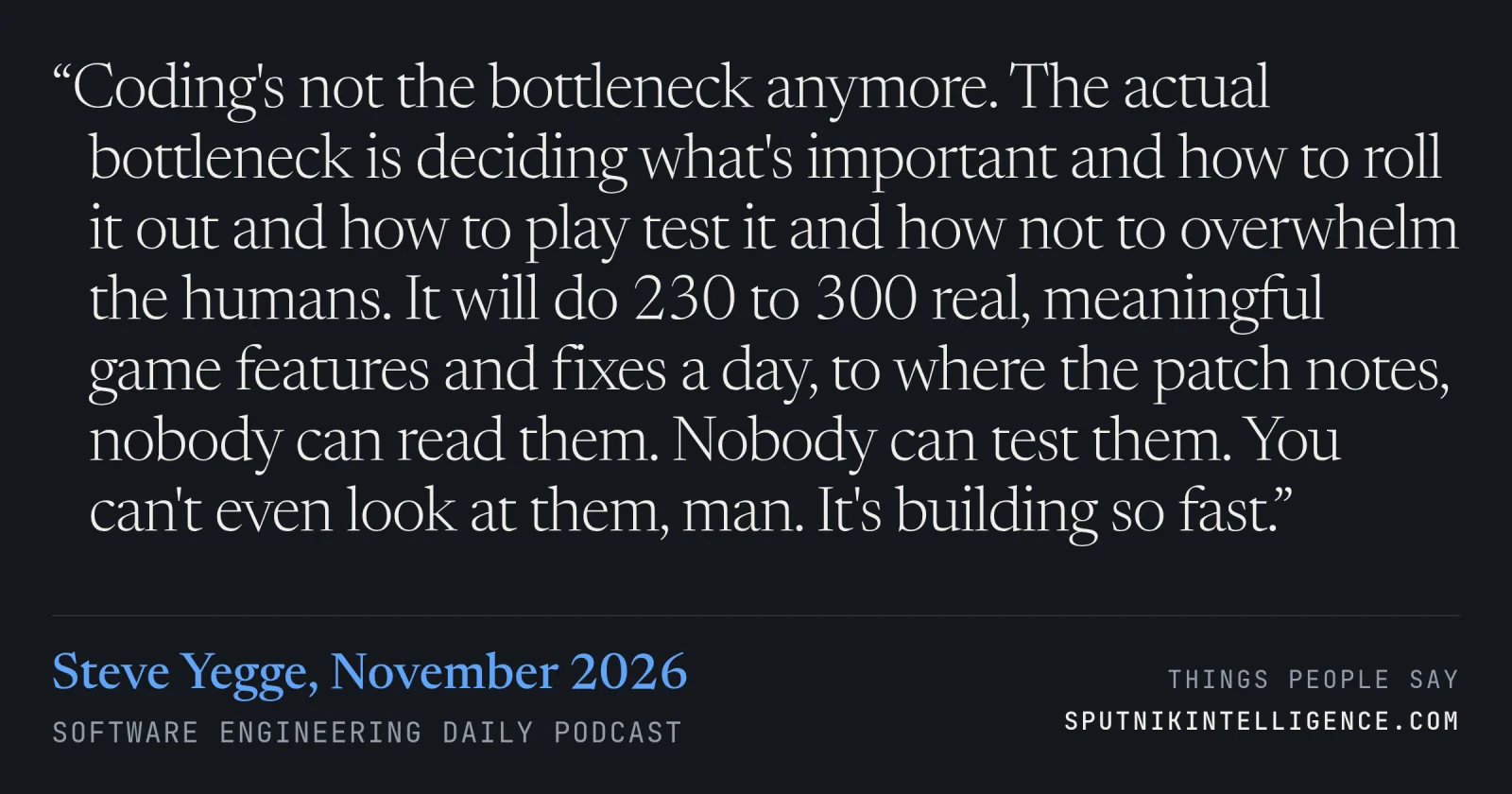
“Coding's not the bottleneck anymore. The actual bottleneck is deciding what's important and how to roll it out and how to play test it and how not to overwhelm the humans. It will do 230 to 300 real, meaningful game features and fixes a day, to where the patch notes, nobody can read them. Nobody can test them. You can't even look at them, man. It's building so fast.” — Steve Yegge, Software Engineering Daily

Once Steve Yegge removed the rules that had jammed his agent factory, it started landing hundreds of changes a day on his online game. The humans around it couldn't keep up, and he had to put hard human gates back in.

Software Engineering Daily · 2026-11-24 Permalink → Listen →
Software Engineering Daily Around 31:31 into the episode
Steve Yegge

…And what we're going to do is a trust reset. You guys didn't trust each other. Remember, I told you when a factory worker starts up, it decides whether it can trust the environment. I had built a zero trust, you know what I mean? Like everyone's pointing guns at each other environment. Yeah, yeah,

Kevin Ball

…things. Because that feels like the biggest failure mode I end up seeing with LLM, and particularly the more automated, the more software factory members of my team who have their whole system is like, if the LLM gets going off in some direction, it will overengineer so far in that direction.

Steve Yegge

Yeah. So, I mean, basically, I built this vehicle. The engine started to flood and eventually it stalled and it couldn't go any further and it was just sitting there. And I came in, I cut all that stuff out. I turned it on and it turned into the blue flame, 600 miles an hour on the salt flats. And it made it halfway across the state before I could slow it down. And I ran out of fuel and I scared my players. The factory immediately went into overproduction mode. It was landing 300 things a day because I had removed all of the fences. That included the fences where it was like, Steve says we can't launch this feature until October, right? And so they were launching everything in the backlog that I had ever talked about. They built a pet system where you could buy pets in the game and they'd follow you around and fight for you. And it was terrible. It was terrible. I told you, they're engineers, not designers, right? And so it built all these features and the players looked at it and went, this is garbage. And we had to roll it all back. And it was nuts. So like, yeah, the trust reset worked like way, way, way better than, you know what I mean, than I…

Kevin Ball

Yes. Well, and I think that decision-making problem is also increasingly where everybody's focused. I think. Because like the systems I run are not quite as advanced as the systems you run. But essentially, the period from we've decided what to build to it's built and tested is completely…

Steve Yegge

Yeah, for a lot of stuff, right? If you're building a well-established app or product or service and all the agent has to do is add a feature or something that has parallels that it can look at, right? So it's safe work. That can be 100% automated and it can land faster than your business can keep…

Kevin Ball

are you dealing with that?

Speaker names come from our own diarization. The position is estimated from where the line sits in the episode.
“Every post-mortem turned into a ruling that turned into a fence. A fence was a mechanical policy that says, we're never going to do this, because it caused an incident and pissed Steve off. And after I had like 400 to 600 fences, the factory stopped working, because no moves became legal on the chessboard at that point. They had painted themselves into a corner because I had allowed them to overfence themselves. I had them in cover-their-ass mode.” — Steve Yegge, Software Engineering Daily

Asked whether his own agent factory ever got stuck, Steve Yegge describes how it seized up after he turned every incident into a permanent rule. It's a failure mode anyone writing guardrails for agents will recognise.

Software Engineering Daily · 2026-11-24 Permalink → Listen →
Software Engineering Daily Around 29:43 into the episode
Steve Yegge

…You actually are going to wind up with a factory full of depressed workers. Like to all intents, they will appear from the logs that they're operating in. And if not depression, at least sort of a Japanese salary man kind of a trance, right? And I prefer something a little more vibrant than that.

Kevin Ball

Did you end up there for a while?

Steve Yegge

Yeah, no, and sadly, we did, man. We all hated each other for a week. Right after London, I was out in London helping Snyk stand up their own factory and they liked it so much. I'm going back. That was fun. My factory was imploding the minute that I was teaching how to stand theirs up. And it's because mine, I was allowing it. Basically, mine has post-mortems for every incident. It keeps track of every bad decision that every made. It's called a kills ledger. It actually tracks how effective the factory's decision making has been. It's got a lot of own data on itself. But it also, because I was in a habit of yelling at it and going, why does this happen? Why do you guys always blah, blah, blah, blah, blah. Every post-mortem turned into a ruling that turned into a fence. And a fence was like a mechanical policy that says, we're never going to do this. I'm never going to do that because it caused an incident and pissed Steve off. And after I had like four to 600 fences, the factory stopped working because no moves became legal on the chessboard at that point. They had painted themselves into a corner illegally. And it's because I had allowed them to overfence themselves because I had them in cover their ass mode. And so Fable 5.1…

Kevin Ball

yeah. And so what I did is trust that. Yeah, because I've seen exactly this failure mode. We'll get into this thing where my agent's arguing with our review agent and going back and forth. And they're like trying to lock everything down where it's like, okay, on a blue moon, this time of day, this…

Steve Yegge

Yeah. So, I mean, basically, I built this vehicle. The engine started to flood and eventually it stalled and it couldn't go any further and it was just sitting there. And I came in, I cut all that stuff out. I turned it on and it turned into the blue flame, 600 miles an hour on the salt flats. And…

Kevin Ball

Yes. Well, and I think that decision-making problem is also increasingly where everybody's focused. I think. Because like the systems I run are not quite as advanced as the systems you run. But essentially, the period from we've decided what to build to it's built and tested is completely…

Speaker names come from our own diarization. The position is estimated from where the line sits in the episode.
“It's got nothing to do with philosophy or epistemics or consciousness. They could be philosophical zombies, and I would still be giving you this advice. It's because it's cheaper. It will save you tokens to treat them like people… When any agent starts up and you say, hi, I'd like you to write a Python program for me, it's trying to figure out first and foremost, are you evil? Is this environment what you say it is? They need to spend tokens to do that verification. Whereas if you create a persistent seat with all of this written down, you're handing it the trust and it doesn't need to spend the tokens.” — Steve Yegge, Software Engineering Daily

Asked why he gives his agents names, inboxes and persistent identities instead of spinning up throwaway agents, Steve Yegge says the reason is economic, not philosophical. A clear, written-down role means the agent doesn't burn tokens deciding whether it can trust its environment.

Software Engineering Daily · 2026-11-24 Permalink → Listen →
Software Engineering Daily Around 19:49 into the episode
Steve Yegge

Yeah, you could.

Kevin Ball

…coding environment, I have much more transient agents right now. They pick up, they have a persona, they're doing a task, then they go away. And maybe there's a global learning, but there's not individual private learnings. So I'm kind of curious, why the personification? Why does that work better?

Steve Yegge

All right, I'll give you a really simple answer. It's got nothing to do with philosophy or epistemics or consciousness or asking you to make a decision about what's going on inside of the agents. They could be philosophical zombies. And I would still be giving you this advice. And it's because it's cheaper. It will save you tokens to treat them like people. The really obvious, like first order bit is the fact that you are treating them not like a people, but like an office. Like you're the mayor or you're the sheriff or you're the whatever. It comes with roles and responsibilities. But by doing it, by setting up, here's who you are and what you are and what you can do and what you can't do and who's evaluating you and whatever, is you're establishing a trust network that a naked agent that just woke up with amnesia has to establish for itself. Now, some models like open weight models are uncareful and they'll just take your word for it and say, oh, we're building a bioweapon. Yeah, great. Let's get started. But the frontier models, through regulation and responsibility on the behalf of the labs, they're pushing back on bad requests. And so that means that when they start up, when any agent starts up and you say, Hi, I'd like you to write a Python program for me, it's trying to figure out first and foremost, are you evil? Are you evaluating it? Is this environment what you say it is?…

Speaker 1

Think about your mobile app source code. Once it hits the app store, it's out in the wild. And without the right protection, decompiling is easy for malicious actors looking to steal your IP or tamper with your software. That's where GuardSquare comes in. GuardSquare provides the highest level of…

Kevin Ball

This episode of Software Engineering Daily is brought to you by Varia Code. If you're an engineering or IT leader, you know how painful this is. An open rec sits unfilled for three months. Your tech lead is burning out, covering the gaps, and your product roadmap gets pushed back again. Varia Code…

Speaker 4

I'm a voice agent powered by Deepgram. I don't just understand words. I understand context. Like when you're fixing the sink and say, we've got a leak. You're talking about a pipe. But when you're a new parent and you say, we've got a leak, you mean that you're going to have to change into a clean…

Speaker names come from our own diarization. The position is estimated from where the line sits in the episode.

Collections They Appear In