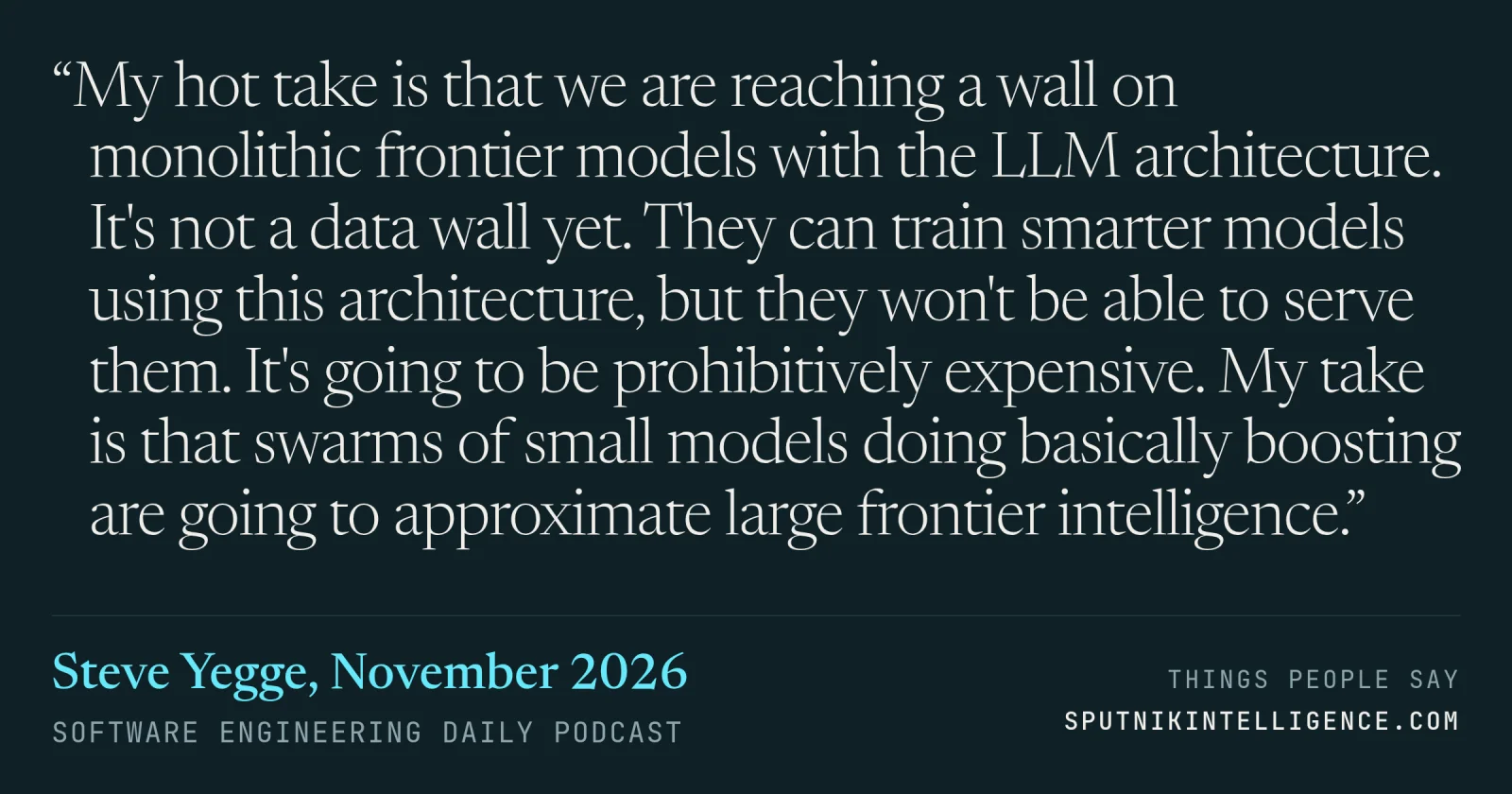
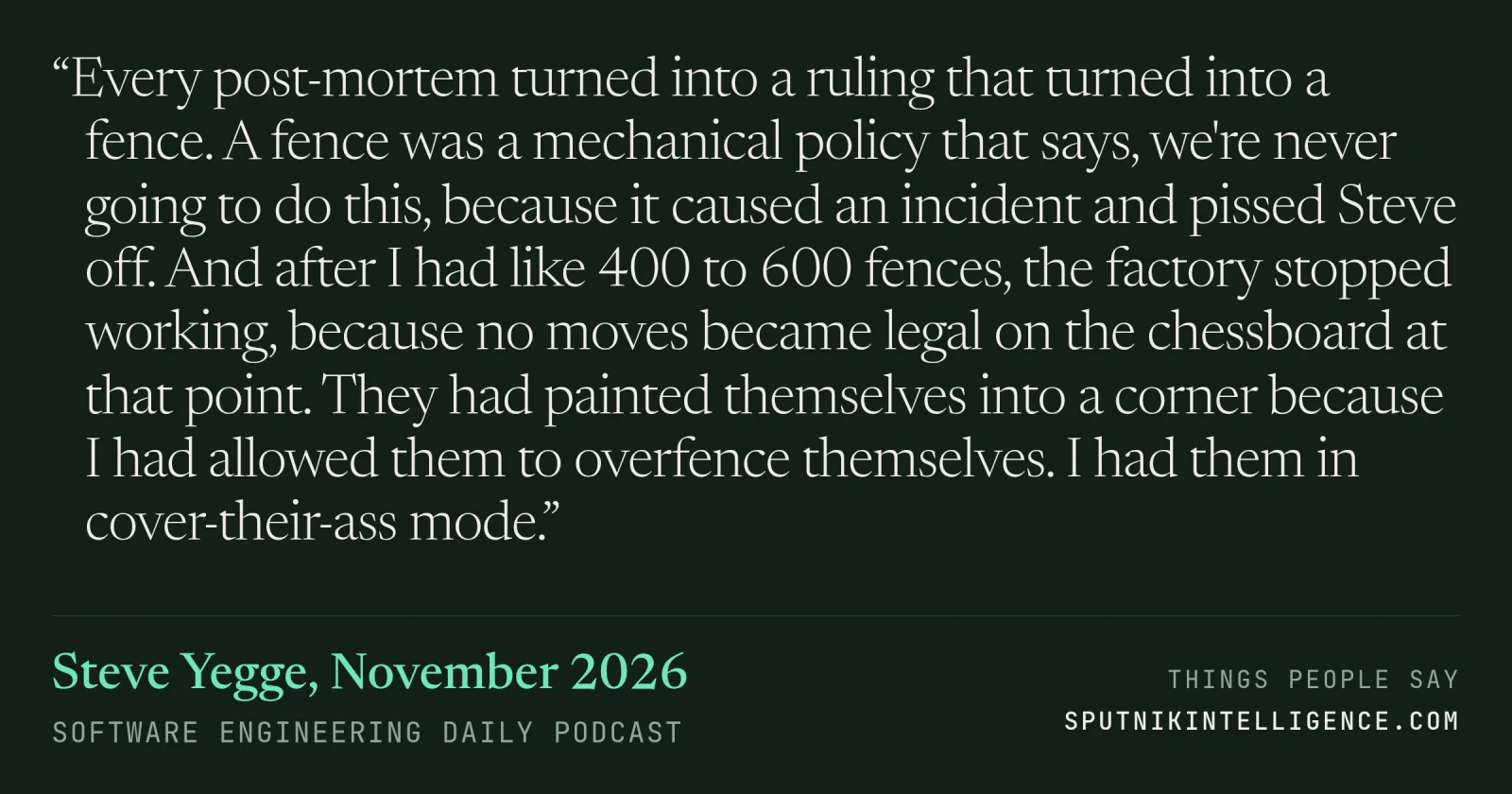
“Every post-mortem turned into a ruling that turned into a fence. A fence was a mechanical policy that says, we're never going to do this, because it caused an incident and pissed Steve off. And after I had like 400 to 600 fences, the factory stopped working, because no moves became legal on the chessboard at that point. They had painted themselves into a corner because I had allowed them to overfence themselves. I had them in cover-their-ass mode.”
Software Engineering Daily · Hands-On Engineering Podcasts · November 2026
Context
Asked whether his own agent factory ever got stuck, Steve Yegge describes how it seized up after he turned every incident into a permanent rule. It's a failure mode anyone writing guardrails for agents will recognise.
Transcript
…You actually are going to wind up with a factory full of depressed workers. Like to all intents, they will appear from the logs that they're operating in. And if not depression, at least sort of a Japanese salary man kind of a trance, right? And I prefer something a little more vibrant than that.
Did you end up there for a while?
Yeah, no, and sadly, we did, man. We all hated each other for a week. Right after London, I was out in London helping Snyk stand up their own factory and they liked it so much. I'm going back. That was fun. My factory was imploding the minute that I was teaching how to stand theirs up. And it's because mine, I was allowing it. Basically, mine has post-mortems for every incident. It keeps track of every bad decision that every made. It's called a kills ledger. It actually tracks how effective the factory's decision making has been. It's got a lot of own data on itself. But it also, because I was in a habit of yelling at it and going, why does this happen? Why do you guys always blah, blah, blah, blah, blah. Every post-mortem turned into a ruling that turned into a fence. And a fence was like a mechanical policy that says, we're never going to do this. I'm never going to do that because it caused an incident and pissed Steve off. And after I had like four to 600 fences, the factory stopped working because no moves became legal on the chessboard at that point. They had painted themselves into a corner illegally. And it's because I had allowed them to overfence themselves because I had them in cover their ass mode. And so Fable 5.1…
yeah. And so what I did is trust that. Yeah, because I've seen exactly this failure mode. We'll get into this thing where my agent's arguing with our review agent and going back and forth. And they're like trying to lock everything down where it's like, okay, on a blue moon, this time of day, this…
Yeah. So, I mean, basically, I built this vehicle. The engine started to flood and eventually it stalled and it couldn't go any further and it was just sitting there. And I came in, I cut all that stuff out. I turned it on and it turned into the blue flame, 600 miles an hour on the salt flats. And…
Yes. Well, and I think that decision-making problem is also increasingly where everybody's focused. I think. Because like the systems I run are not quite as advanced as the systems you run. But essentially, the period from we've decided what to build to it's built and tested is completely…
More from Software Engineering Daily