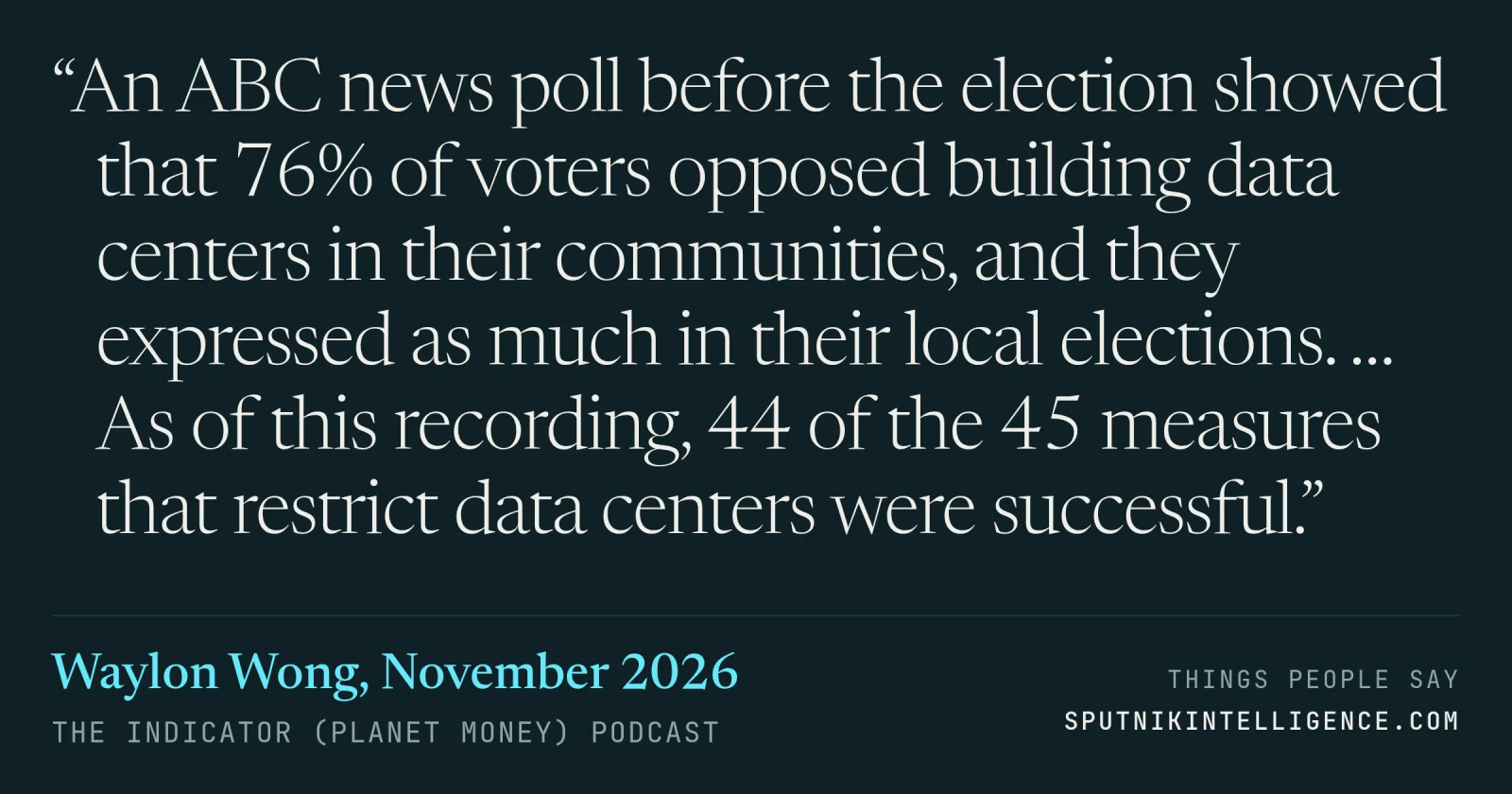
“An ABC news poll before the election showed that 76% of voters opposed building data centers in their communities, and they expressed as much in their local elections. … As of this recording, 44 of the 45 measures that restrict data centers were successful.”
The Indicator (Planet Money) · Money & Markets · November 2026
Context
Wong explains why the midterms became a referendum on the AI boom's physical footprint, citing a pre-election poll and a tally of local ballot measures restricting data centers.
Transcript
All right, it is our economic post-mortem on the midterms, and I'm going to talk about data centers. The midterms ended up being kind of a referendum on how communities across the country feel about these hulking physical manifestations of the AI boom.
Yeah, we've been covering this local backlash to data centers on our show, and it seems like a lot of this sentiment came to a head last week.
Yeah, an ABC news poll before the election showed that 76% of voters opposed building data centers in their communities, and they expressed as much in their local elections. There's a polling firm called Redbud Consulting that's been tracking ballot measures related to data centers. And as of this recording, 44 of the 45 measures that restrict data centers were successful. This polling firm also found that anti-data center measures passed with a majority of the vote, over 75%.
And these were bans on data center development?
The ballot measures were worded differently depending on where you were. Some did propose moratoriums on data centers of any size. Others didn't ban data centers outright, but did propose caps on like how many megawatts of power a center could tap into. Overall, though, people voted to restrict…
And that's interesting because some incumbents were already responding to the backlash before the elections. Like Governor Greg
More from The Indicator (Planet Money)