 Sherry Turkle
Professor at MIT and a licensed clinical psychologist who has studied people's relationships with technology for decades.
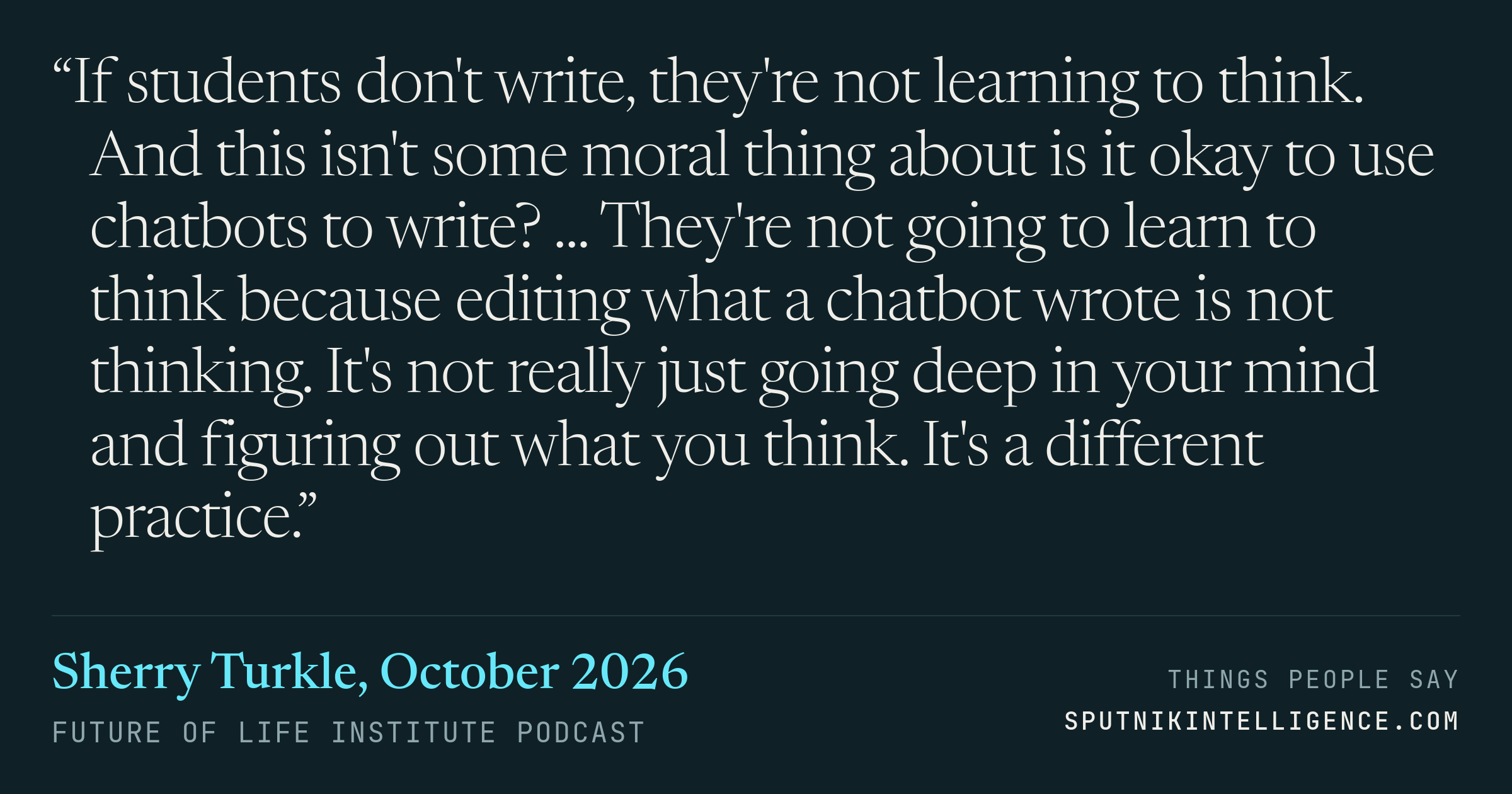
“If students don't write, they're not learning to think. And this isn't some moral thing about is it okay to use chatbots to write? ... They're not going to learn to think because editing what a chatbot wrote is not thinking. It's not really just going deep in your mind and figuring out what you think. It's a different practice.”
Future of Life Institute Podcast · AI Research & Frontier Labs · October 2026
Asked whether heavy AI use could cause a point of no return for people's social and cognitive skills, Turkle pointed to studies showing steep drops when students move from take-home work to in-person tests. She called for no chatbots for young children and none in schools.
Transcript
…let the child walk a little bit ahead, hold their hand, be quiet. The child starts to understand that being quiet and alone and reflective and just gathering oneself is a very important part and a crucial part of being a person. It's not to be sort of run from as though it were a terrible thing.
Is there a point of no return where if we begin interacting with AIs constantly, our social skills or our sort of psychological setup degrades such that we can't get it back? Is that something to worry about?
…the perfect answer. You know, I'm not vulnerable, they're not vulnerable. I mean, vulnerability is like the worst thing. Now, I guess I'm in the middle of a debate about whether there's a point of no return where you don't become a person anymore. But we're certainly in a moment of tremendous danger. And I think one of the dangers, I mean, you see in the conversation about reading and writing, if students don't write, they're not learning to think. And this isn't some moral thing about is it okay to use chatbots to write? Is it terrible? Is it plagiarism? Is it they're not going to learn to think. I don't want to put anybody in jail. I mean, they're not going to learn to think because editing what a chatbot wrote is not thinking. It's not sitting in, it's not really just going deep in your mind and figuring out what you think. It's a different practice. And offloading that kind of cognitive ability to say, well…
Now, in the past, we've had moral panics around television and cartoons, even around novels. I think we've, if you go far back enough, we've had a moral panic around writing itself, where people worried that this was going to degrade our ability to remember epic poems in our minds. How do we know…
Well, I say think of the end game. Instead of thinking of moral panic, think of the end game. The AIs are so good at talking to us and making us feel good, that we prefer their company to people because we feel less vulnerable. And we know that people want to avoid vulnerability. We invest less in…
I think one thing that's different with AI compared to other sort of writing or novels or television that's where we've had moral panics in the past is that AI is interactive. It can respond to us in ways that a novel or a television show could never do. And so, as we discussed earlier, the way…
More from Future of Life Institute Podcast