 Michael Liebreich
Host of Cleaning Up.
Michael Liebreich
Host of Cleaning Up.
“Measuring energy demand in primary energy is about as useful as measuring nutrition in acres because it's the input to the system. And if we're enormously inefficient and we waste most primary energy, which we do, then it's similar to saying, well, Africa may have vast amounts of acres under cultivation, but it's no good if it doesn't get to people and provide the nutritional needs.”
Everything Electric Podcast · Climate & Energy · October 2026
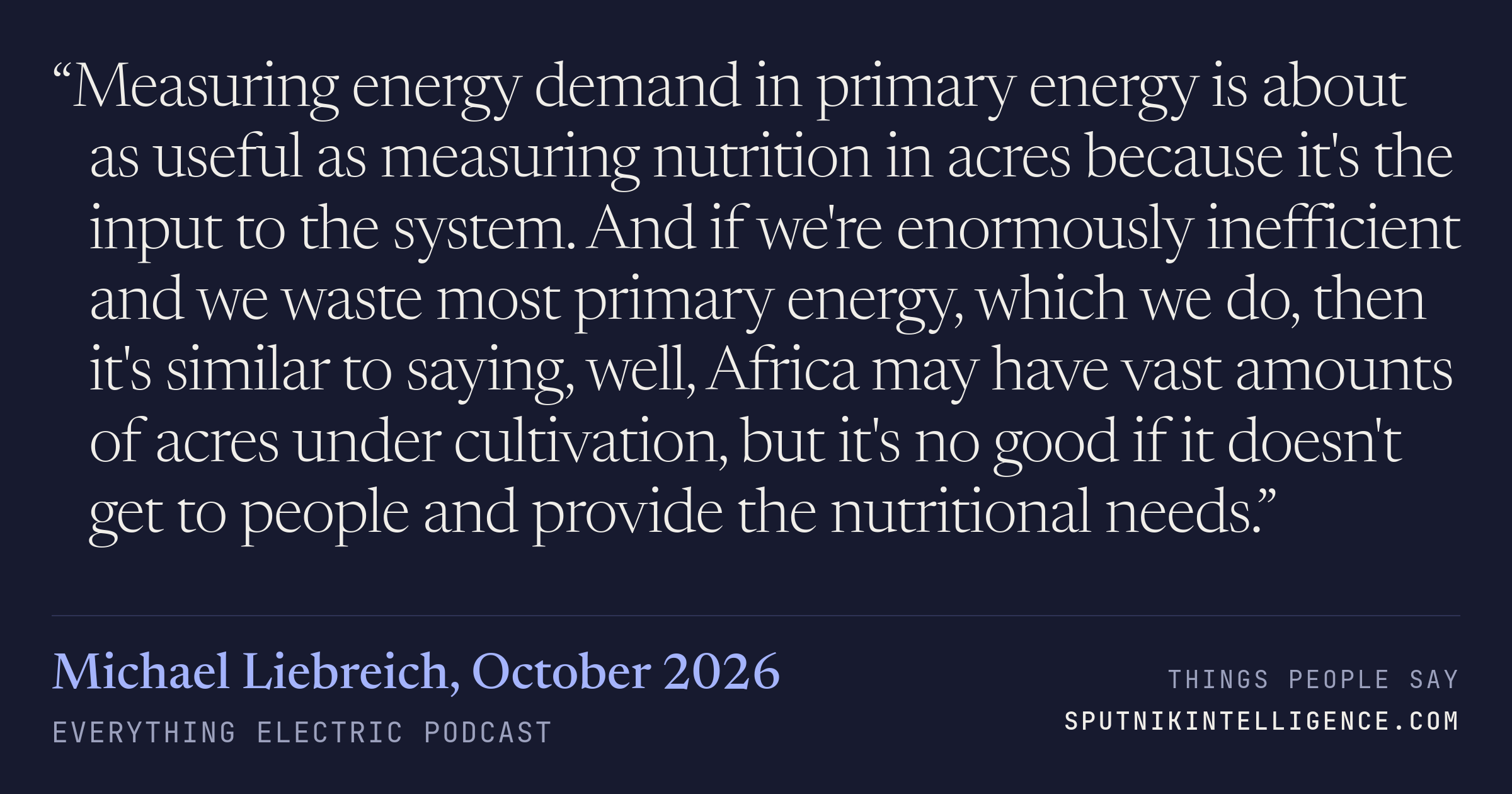
Liebreich was describing what he calls the primary energy fallacy: adding up all the fuel going into an economy and treating the total as the amount that needs replacing. His argument is that what counts is the useful energy that reaches the end use.
Transcript
social media, people saying, I don't understand. And those aren't, that's not, you know, and there are no fusion reactors working on Earth. And I'm like, yes, I know. Look at the footnote. And of course, all of the nuclear bros were most angry at the idea. And in fact, last year, very interestingly, both wind and solar, each individually, overtook nuclear power output. And together, they overtook gas, which I bet not many people know. If you put wind and solar together, there's more electricity produced from them than there is now from natural gas.
Well, it may, I mean, so this is something I'm thinking a lot about at the moment because of my next book, actually, which is not about the ocean, but the planet. But, you know, this sort of planetary cascade of energy, the thing that powers Earth is solar power that comes from the fusion reactor in the sky. But it trickles through the system and where you tap into it is what determines how much of it there is, basically, because of thermodynamics. But so I think these questions of, I think we're going to have to get a lot better at understanding where energy actually is and isn't and where useful energy is, which is obviously what really matters. It's not about how much energy there is. It's about how much useful energy is accessible. And those are different things.
Absolutely. And I'm doing a lot of thinking about this. And I very much look forward to your book because I'm sure it'll enlighten enormously. Because I do a lot of work on trying to educate people about things like what I call the primary energy fallacy, right? If you just add up all the energy that goes into our economy and you get a number in joules or in, you know, it doesn't, you can do it in any unit. You can do it in millions of barrels of oil equivalent or petajoules or whatever. But it's so many different resources added together that it's actually utterly, utterly meaningless because you've got, you've, well, as you know, it is, it's not useful energy. What you really need to be counting is how much do we need in the economy and then work back to how we fulfill that. And the thing I've come up with now is saying that measuring energy demand in primary energy is about as useful as measuring nutrition in acres because it's the input to the system. And if we're enormously inefficient and we waste most primary energy, which we do, then it's similar to saying, well, you know, Africa may have vast amounts of acres under cultivation, but it's no good if it doesn't get to people and provide the nutritional needs. So if you really want to measure whether people are healthy, whether our economy can function, you've got to look at what's actually reaching the end use.
And the clarification here for people who don't think about the physics all the time is that whenever if you get, if you get your energy by combustion, you effectively waste a lot of it as heat. That's why it's inefficient.
Two-thirds of all primary energy is, I mean, it's called waste. Waste is actually not the right word for it. It's also called rejected, because if you want to have, if you want to ride up and down your building in an elevator and you've got a lump of coal, you actually, most of the energy in the coal goes to turning a small amount of it into electricity, which actually powers the elevator. And the rest of it is, you can call it waste or they just, you can call it rejected or used up in the process of turning a bit of the energy into something useful. And it's badly misunderstood by people who really need to know better.
Well, we can have our crusade on understanding Earth as an energy cascade that we can tap into. Helen,
More from Everything Electric Podcast